About Leptoptilos crumenifer (R.P.Lesson, 1831)
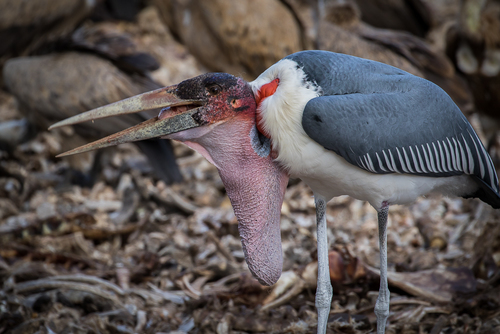
The marabou stork, Leptoptilos crumenifer, is a very large bird. Large individuals are thought to grow up to 152 centimetres (5 feet) in height and weigh 9 kg (20 lb). Fisher and Peterson accepted a wingspan measurement of 3.7 m (12 ft) for this species, and ranked it as having the largest wingspan of any living bird. Even larger wingspan measurements, up to 4.06 m (13.3 ft), have been reported, but no measurement over 3.20 m (10.5 ft) has been verified. The species is often said to have the largest wingspan of any landbird, matching the Andean condor, but marabou storks more typically have a wingspan of 225–287 cm (7–9 ft). This typical wingspan is about one foot shorter than the average wingspan of the Andean condor, and nearly two feet shorter than the average wingspan of the largest albatrosses and pelicans. The typical weight range of the marabou stork is 4.5–8 kg (10–17.5 lb), and exceptionally individuals can weigh as low as 4 kg (9 lb). Their total length from bill to tail is 120 to 130 cm (47 to 51 in). Females are smaller than males. Their bill length ranges from 26.4 to 35 cm (10.5 to 14 in). Unlike most stork species, the three species in the genus Leptoptilos fly with their neck retracted, similar to a heron. The marabou stork is easily identifiable by its large size, bare head and neck, black back, and white underparts. It has a very large bill, a pink gular sac at its throat (the species epithet crumenifer means "carrier of a pouch for money"), a neck ruff, white legs, and black wings. Male and female marabou storks have similar appearance, while juvenile birds are browner and have a smaller bill. The species does not reach full maturity until up to four years after hatching. Like most storks, the marabou stork is gregarious and breeds in colonies. Breeding occurs during the African dry season, when shrinking pools make food more available. During this time, the stork builds a nest in a tree, and lays two or three eggs. Marabou storks are known to be quite ill-tempered. Similar to other storks, they are not very vocal, but perform bill-rattling courtship displays. They also use their throat sac to produce a variety of noises during courtship. Marabou down is commonly used to trim many types of clothing and hats, and is also used in fishing lures. Turkey down and other similar feathers are often used as a substitute for marabou trimming.