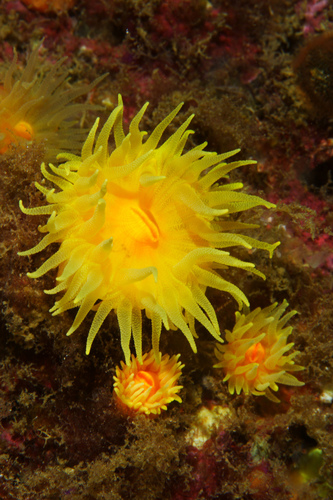
About Leptopsammia pruvoti Lacaze-Duthiers, 1897
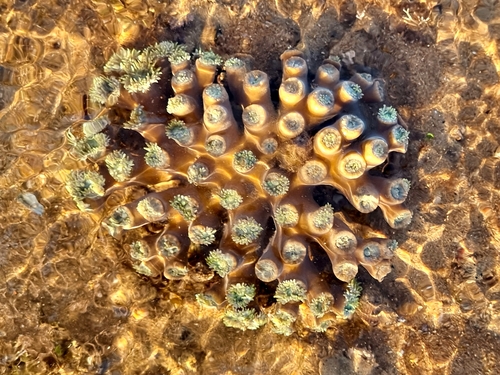
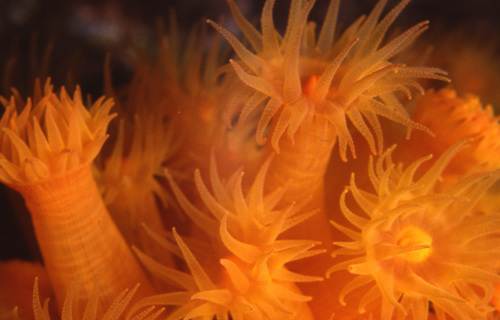
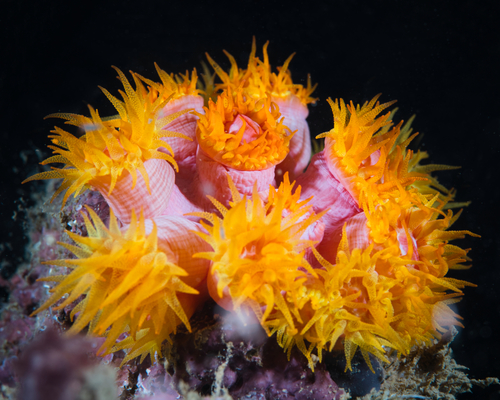
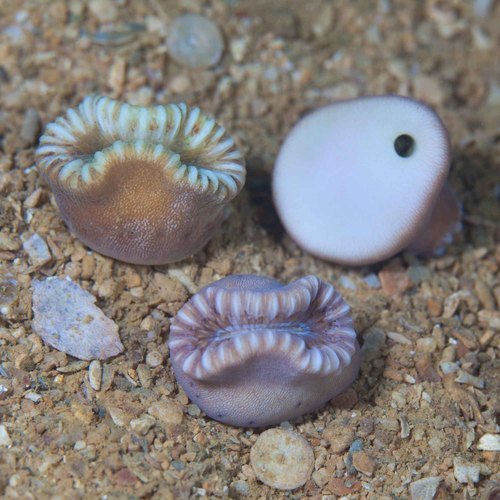
Leptopsammia pruvoti is a solitary stony coral that bears a superficial resemblance to a sea anemone. Its polyp rests inside a calcareous cup, which is wider at the base than at the top. The cup can range in shape from short and cylindrical to long and conical. This coral grows to around 60 mm (2.4 in) in height and 20 mm (0.8 in) in diameter. The polyp is yellow or orange, and has approximately ninety-six long, translucent yellow tentacles. The polyp can retract fully back into its skeletal cup, leaving the tentacles barely visible. This species is often confused with another yellow or orange cup coral, Balanophyllia regia; however, Balanophyllia regia never grows as large as Leptopsammia pruvoti, and has fewer tentacles. Leptopsammia pruvoti is native to the western Mediterranean Sea, the Adriatic Sea, and the Atlantic coasts of Portugal, Brittany, the Channel Islands, and southwestern England. It does not require sunlight to survive, and is found in habitats including under boulders, on bedrock, in crevices, under overhangs, and inside caves, at depths between 10 and 40 metres (33 and 131 ft). Observations from an Italian sea cave found that the colonial coral Astroides calycularis was abundant in well-lit areas of the cave, and became less common in darker sections, while Leptopsammia pruvoti became more abundant in darker positions. This pattern was reversed in locations where sulphur-laden spring water mixed with seawater, and Astroides calycularis became the more common species. The relative abundance of the two species may be influenced by mats of sulphur-digesting bacteria that grow around the spring. A barnacle species, Megatrema anglicum, is often found living parasitically inside Leptopsammia pruvoti. The breeding strategy of this coral features high fecundity, a short incubation period for embryos, small planula larvae, and rapid maturation. The average generation time for Leptopsammia pruvoti is around 2.3 years, and its maximum recorded longevity is 13 years.