About Leptopoecile sophiae Severtzov, 1873
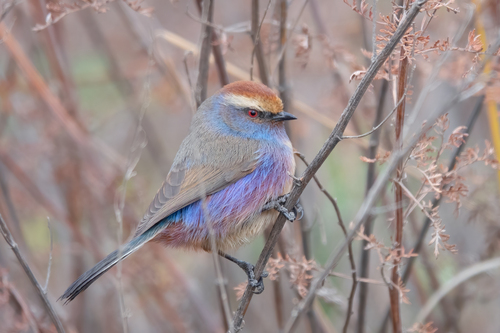
This bird species, Leptopoecile sophiae Severtzov, 1873, is commonly known as the white-browed tit-warbler. It is a small bird, with a body weight of 6–8 g (0.21–0.28 oz) and a total length of 8.5–10 cm (3.3–3.9 in). Males have vibrant plumage, with distinctive blue-mauve underparts. Both males and females have a light brown crown and a white supercilium, or eyebrow. Their rump and upper tail-coverts are violet blue. Females are generally duller in color than males, and can be identified by their pale underparts. By contrast, males have violet-blue underparts and chest. The white-browed tit-warbler has a relatively long tail. The species prefers dry mountainous shrubland located between 2,000–5,000 m (6,600–16,400 ft) in elevation. Its range covers the Himalayas, the Tibetan Plateau, and most of Northwest China. During the winter, individuals typically disperse to lower elevations. A 2016 paper classified this species as part of the "Middle-mountainous forest steppe community" within the Tian Shan mountain range. A study conducted in Karakoram National Park found that the white-browed tit-warbler is an uncommon resident there, and that the park sees a winter influx of the species. In terms of behavior and ecology, white-browed tit-warblers generally live in pairs during the breeding season. At the end of the breeding season, they join flocks of 25 or more individuals. During winter, these flocks may include individuals of multiple other bird species.