About Leptogorgia virgulata (Lamarck, 1815)
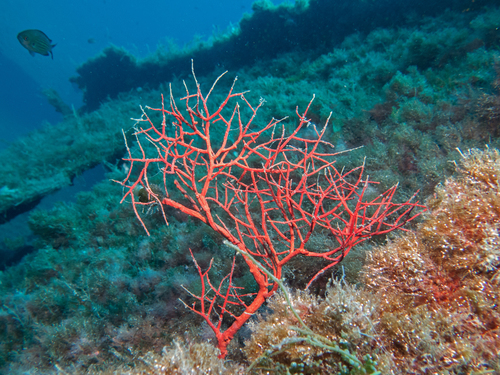
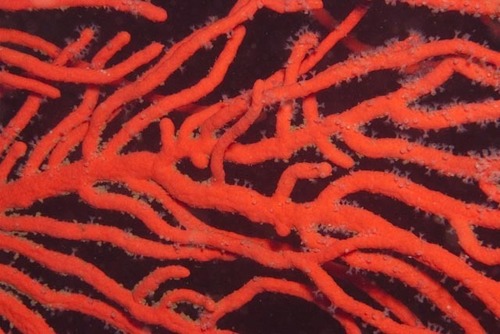
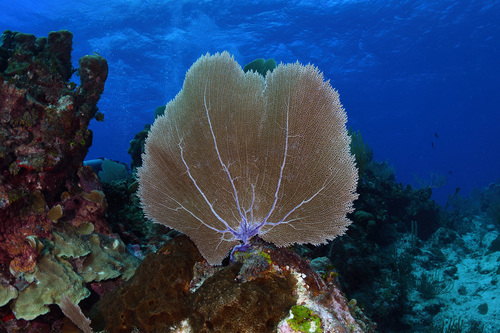
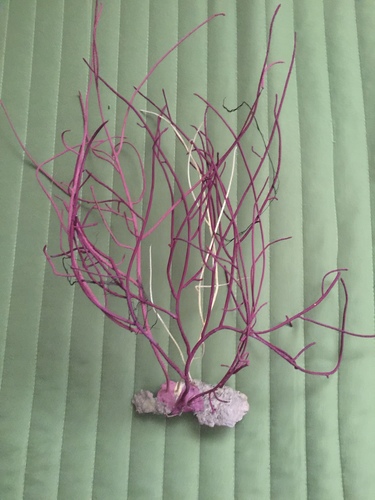
Leptogorgia virgulata is a colonial coral. Adult colonies average 20 cm (8 in) in height, usually ranging between 15 and 60 cm, and may occasionally reach 1 metre (3.3 ft). Unlike true corals, it does not have a rigid calcium carbonate skeleton. Instead, its stalks have an internal axial skeleton stiffened by sclerites, covered by an outer layer called coenenchyme. It grows in an upright form, with vertical, whip-like stems that branch sparsely near the base. All stems are a uniform colour, which can range from white, yellow, and orange, to various shades of red and mauve. Its polyps are arranged in several rows along both sides of each branch. On older main branches, distinct grooves form between these rows. When polyps are retracted, their calyces do not protrude outward. The polyps are translucent white, each bearing eight tentacles and eight mesenteries, which places this species in the group Octocorallia. As octocorals are cnidarians, this species has stinging organelles called cnidea, or nematocysts, that it uses for feeding and defense. The entire colony has a single siphonoglyph. This coral is found growing on rocks at depths of up to 20 metres (66 ft) along the western edge of the Atlantic Ocean. It is common on the continental shelves of southern US states, on rocks and limestone ledges. Its range extends from Chesapeake Bay south to the Gulf of Mexico, and the species also occurs in Brazil. It inhabits shallow water reefs, as well as estuaries and bays because it can tolerate low salinity levels, though it typically prefers environments with high salinity. Leptogorgia virgulata uses chemical defenses to stop algae, barnacles, and bryozoans from growing on its stalks. It produces protective substances that prevent invertebrate larvae from settling on its surface. These chemical products have been researched, and are being considered for use as anti-fouling agents to stop marine organisms from growing on human-made structures. The snail Simnialena marferula feeds on debris around this coral, and takes on the colour of the coral's stems by assimilating the pigments they contain. Larvae of the barnacle Conopea galeata tend to settle preferentially on the remains of this snail's egg mass. As the egg mass decays, the juvenile barnacle becomes attached to the coral's skeleton. This barnacle is an obligate commensal of Leptogorgia virgulata: the coral's coenenchyme grows to enclose the barnacle, leaving only an aperture open for the barnacle to feed and reproduce. Leptogorgia virgulata sometimes grows in meadows of the seagrass Thalassia testudinum, where it is often associated with the amphipod Caprella penantis. In winter, after seagrass dies back, decapod crustaceans move into these areas. The oyster Pteria colymbus is often found attached to this coral. A number of other animals use camouflage that matches the coral's shape or colour. These include the shrimp Neopontonides beaufortensis and the nudibranch Tritonia wellsi, also called the sea whip slug. This nudibranch is colourless, and its branching gills closely resemble the polyps that it feeds on. The sclerites and specific secondary metabolites produced by Leptogorgia virgulata deter predation by fish. One of these metabolites has emetic properties, and has been shown to trigger a learned avoidance response in fish. Because of its unique ability to live on hard bottom substrate in the coastal regions and estuaries of South Carolina, and its abundance in these habitats, it can act as an indicator species. It is a representative example of sessile fauna found in coastal reefs within the range of this colourful sea whip.