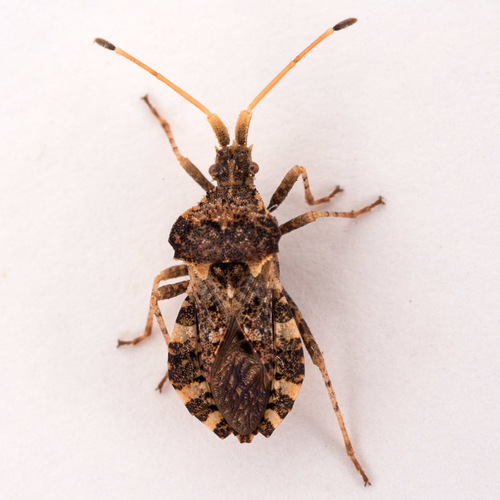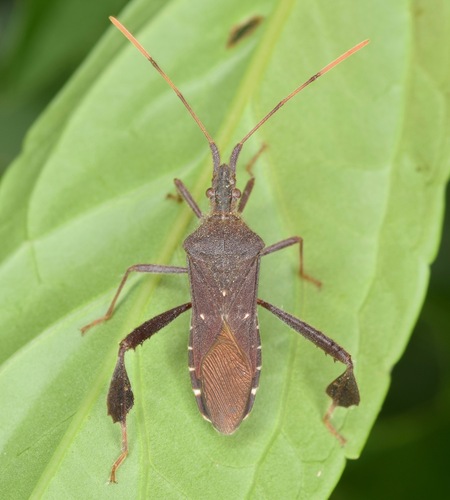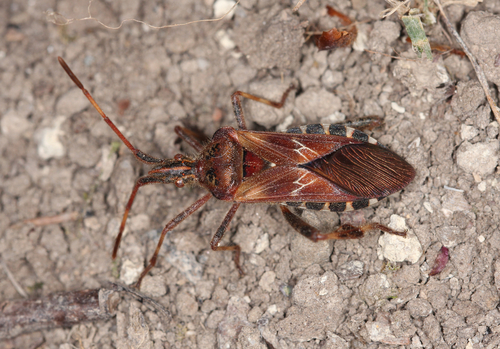
About Leptoglossus occidentalis Heidemann, 1910
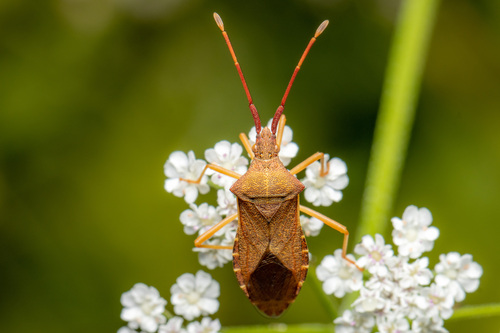
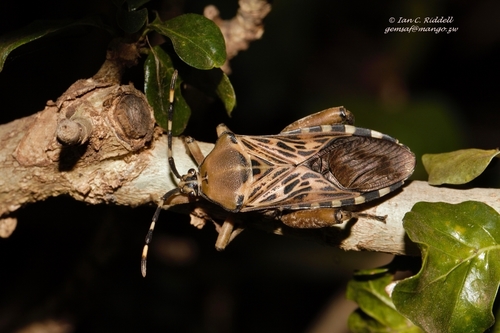
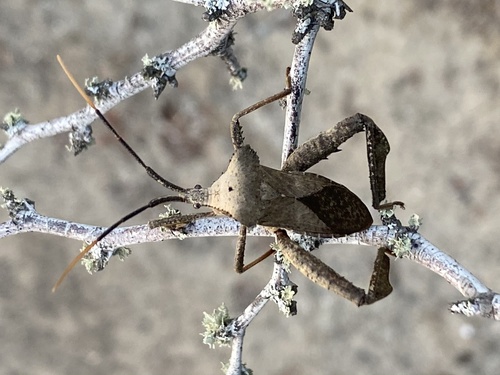
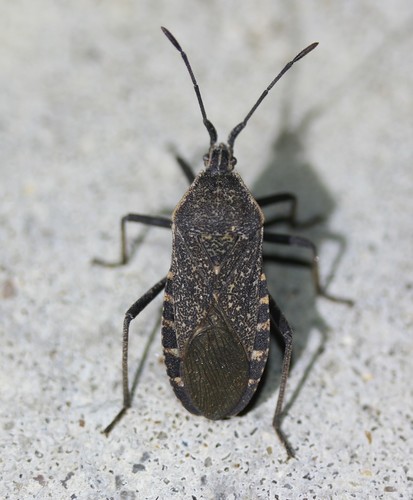
Leptoglossus occidentalis, commonly called the western conifer seed bug, averages 16 to 20 millimetres (0.63 to 0.79 inches) in length, with males smaller than females. It is capable of flight, and produces a buzzing noise while airborne. This species looks somewhat similar to the wheel bug Arilus cristatus and other assassin bugs (Reduviidae). As members of the infraorder Cimicomorpha, assassin bugs are not closely related to leaf-footed bugs like L. occidentalis within the order Heteroptera. While both groups have a proboscis, only assassin bugs will bite even when unprovoked. L. occidentalis and its close relatives are most easily identified by two key features: expanded hindleg tibiae, and alternating light and dark bands that run along the outer wing edges on the flared sides of the abdomen. The primary defense of L. occidentalis is emitting an unpleasant-smelling alarm pheromone. If handled roughly, it will stab with its proboscis, but it almost never causes injury to humans. Its proboscis is adapted only to suck plant sap, unlike the venom-injecting proboscis of assassin bugs. This insect is native to the temperate and warmer regions of the Pacific coast of North America, and has steadily expanded its range eastward across the continent. On its native North American continent, it has been found as far northeast as Nova Scotia. In Europe, it was first reported in 1999 from northern Italy, most likely accidentally introduced via imported timber, with likely multiple separate introductions, since it was found at the same time in distant locations across Italy. By 2007, it had established populations in the northern Balkans (Slovenia, Bosnia and Herzegovina, and Croatia), the Alps (Austria, Switzerland), and parts of the Czech Republic, France, Germany and Hungary. It was first found in Spain in 2003, and this population likely comes from a separate introduction. The 2007 records from Weymouth College (England) and Ostend (Belgium) may also represent one or two additional independent introductions. In late 2007, it was found in Wrocław and Miechów, Poland, and these individuals are likely the result of range expansion out of the Czech Republic. During autumn 2008, a large influx of this species reached the south coast of England, showing natural immigration from continental Europe. In late 2009, a large group of western conifer seed bugs invaded Koç University in Istanbul, Turkey. A similar large invasion occurred in October 2012 across most cities of the French Alps, including Moûtiers. In 2017, it was recorded for the first time in the Southern Hemisphere, with multiple records from Chile. It was first recorded in Tokyo, Japan in 2008, with additional records from Tokyo and Kanagawa Prefecture added by 2009. The first detection in Ukraine occurred in 2010 in Dniprorudne, and the following year it was found in Rostov-on-Don, Russia. It was first reported in Finland in 2020. On October 21, 2020, the first sighting in Andorra was submitted to iNaturalist, and in September 2020 the species was found in Kozhukhovka, Ukraine. It is also present in North Macedonia. On October 8, 2024, it was observed in the mountains surrounding Sofia, Bulgaria, and again on October 20, 2024, in Velingrad, a town surrounded by coniferous forest. In March 2025, it was observed in western Romania. On September 29, 2025, it was observed in Klaipėda, Lithuania, near the port. Within its native range, the western conifer seed bug feeds on sap from developing conifer cones throughout its life. Its sap-sucking feeding causes developing seeds to wither and develop abnormally, so it is considered a minor tree pest in North America, though it can sometimes cause more damage in conifer plantations. It is not monophagous, and is adaptable enough to feed on angiosperms when necessary. It prefers resiniferous plants that are high in terpenes; because plants produce these compounds to deter herbivores, L. occidentalis may have evolved to become somewhat dependent on these compounds after developing the ability to overcome these chemical defenses. In its native range, its known host plants include conifers like Douglas-fir (Pseudotsuga menziesii), ponderosa pine (Pinus ponderosa), lodgepole pine (Pinus contorta), and white spruce (Picea glauca). Outside its native range, it has been recorded feeding on eastern white pine (P. strobus) and red pine (P. resinosa) in eastern North America and Europe, and mountain pine (P. mugo), black pine (P. nigra), Scots pine (P. sylvestris) and pistachio (Pistacia vera) in Europe. L. occidentalis lays its eggs in small groups on the needles or leaf stems of its host plants, and eggs hatch in spring. Nymphs go through five instar stages before molting into adults. The species is univoltine (has one generation per year) in the United States, but completes two generations a year in southern Europe, and up to three generations a year in tropical Mexico. In the northern parts of its range, these bugs begin moving widely by around September to find crevices to overwinter. They can become a nuisance in areas with extensive conifer woods, as they sometimes enter houses in large numbers. They have the potential to become structural pests, as they will occasionally pierce PEX tubing with their mouthparts, which leads to leakage.