About Leptoglossus gonagra (Fabricius, 1775)
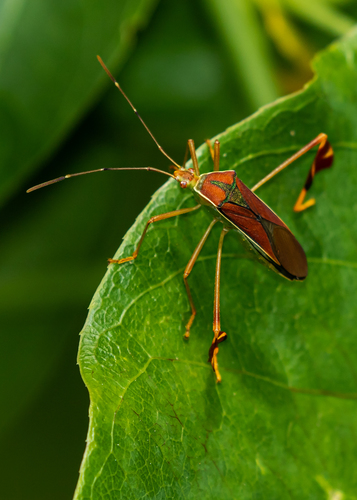
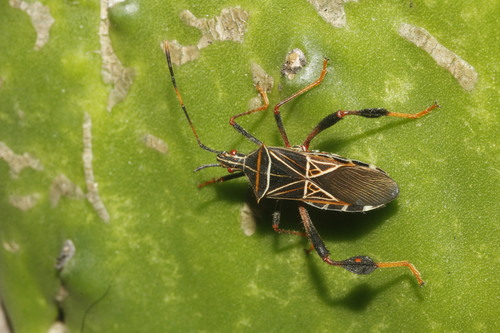
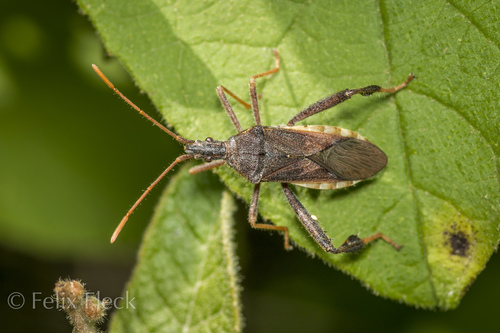
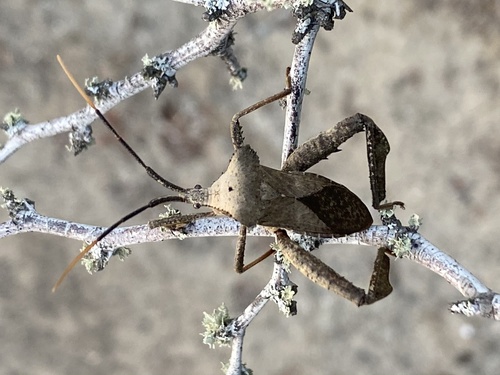
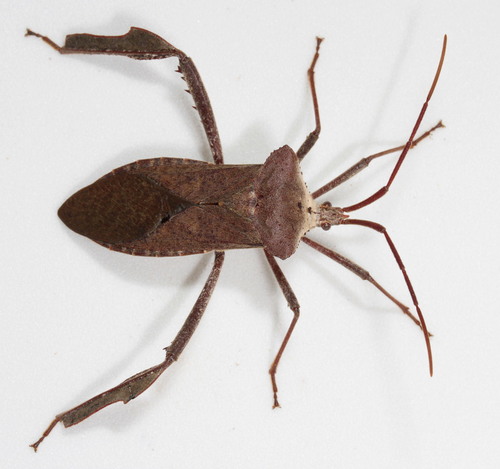
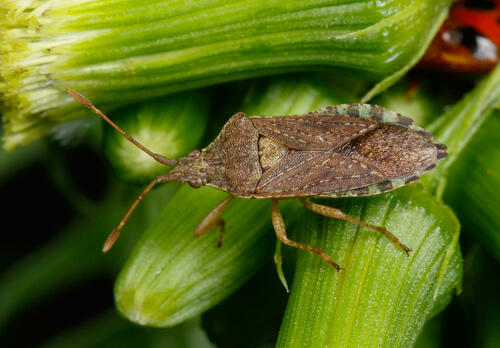
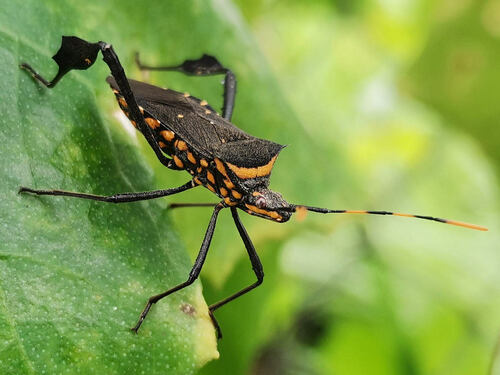
Leptoglossus gonagra, commonly known as the leaf-footed plant bug, has an elongated body, measuring approximately 18 mm (0.7 in) in length and 6 mm (0.2 in) in width. Its long antennae are patterned with alternating black and orange bands. A pale orangish transverse band runs across the front of the wide plate that covers its prothorax. The rest of the insect's body surface is dark brown or dull purplish-black. Small orange spots appear on the underside of the thorax and abdomen, and there is a pair of orange spots on the two enlarged, flattened rear tibiae. Leptoglossus gonagra is distributed across most of sub-Saharan Africa, southern Asia, the Pacific region, northern Australia, North America, Central America, South America, and the Caribbean. Its known host plants include mung beans, navy beans, cowpeas, other legumes, passion fruit, cacao, coffee, avocado, macadamia, mango, cashew, citrus, pomegranate, and cucurbits. For its life cycle, female Leptoglossus gonagra lay chains of roughly 16 eggs in lines on the twigs or stems of their host plant. The eggs hatch after about one week. As nymphs grow, they moult five times. Nymphs resemble adult bugs, but are reddish when young and have dark spines on their heads and thoraxes. Nymphs cluster together when young, before dispersing more broadly across the host plant as they develop. Both adult and nymph Leptoglossus gonagra feed by sucking sap from host plant cells, and they inject toxic saliva during feeding that can cause plant shoots to shrivel. Nymphal development takes approximately seven weeks, and the insect's full life cycle lasts nine to ten weeks. A female can lay a total of around sixty eggs over her lifetime, and lives for several weeks.