About Leptogium cyanescens (Ach.) Körb.
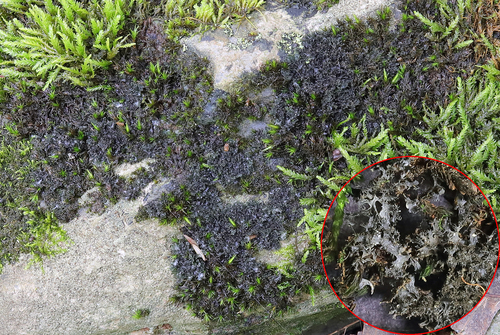
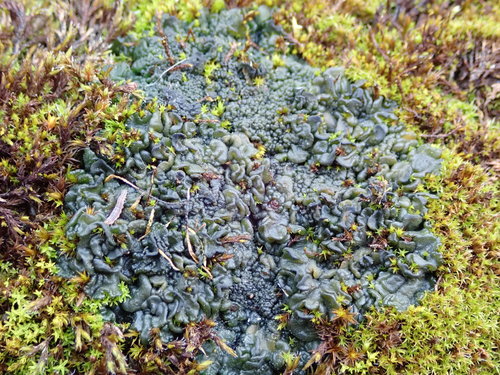
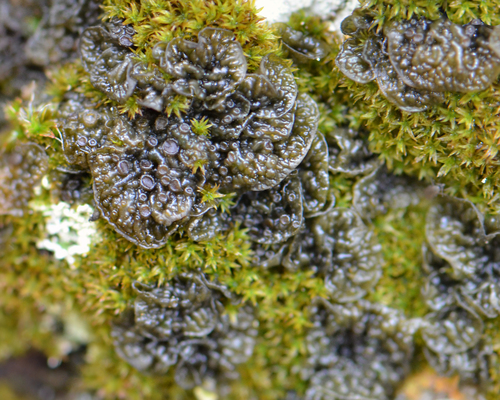
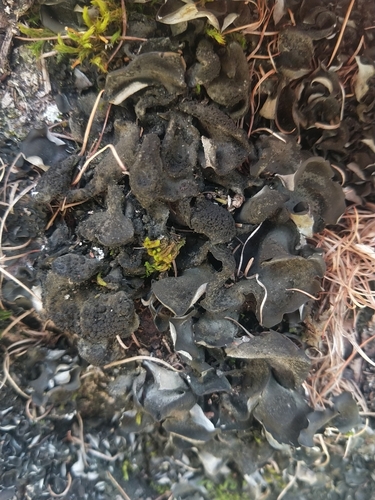
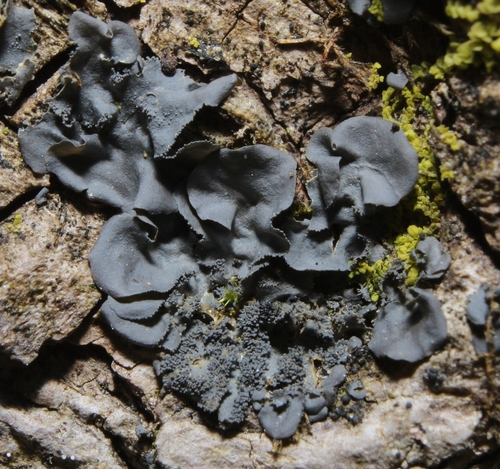
Leptogium cyanescens is a lichen that forms soft, sheet-like thalli. These thalli become jelly-like when wet and crisp when dry. Individual rosettes are usually 1–5 cm (0.4–2 in) across, and occasionally reach up to 10 cm (4 in) across. They are made up of flat, irregular lobes 4–5 mm wide. The upper surface ranges from smooth to slightly wrinkled, and has a characteristic blue-grey colour. The lower surface is a similar colour, but may have scattered tufts of white attachment hairs called haptera. Minute, finger-shaped outgrowths called isidia cover the lobes. Isidia start as simple cylinders, and often branch or flatten as they age. These structures break off easily, and are the main method of reproduction for the lichen. Sexual fruit bodies are rare. When apothecia are present, they are disc-shaped, 0.5–2 mm in diameter, with a brown centre and an isidiate thalline margin. Ascospores are translucent (hyaline), usually three-septate (occasionally with an extra longitudinal septum), and measure 18–23 μm by 7–10 μm. Like all species in the genus Leptogium, L. cyanescens contains chains of the cyanobacterium Nostoc throughout its interior. No secondary lichen substances have been detected in spot tests. NatureServe rates this species G5, meaning it is secure, due to its virtually worldwide range and common occurrence. In North America, it is frequent on the bark of deciduous trees from southern Canada through the eastern United States, extending west into the humid forests of British Columbia, where its populations are considered vulnerable to intensive logging. In Europe, records of the species extend from the British Isles and Fennoscandia to the Mediterranean. The species has also been documented in Chile, the Galápagos, Madeira, and South-East Asia. Across its range, L. cyanescens prefers shaded, persistently humid microsites. Typical substrates include stream-side hardwoods, old orchards, coastal fog belts, and rainforest mangroves. Most collections of the species are corticolous (growing on bark), but the thallus can occasionally colonize shaded siliceous rock or mossy soil in spray zones next to waterfalls. Field observations from Brazil show colonies growing on mangrove trunks and restinga shrubs only a few metres above sea level, which demonstrates the species' tolerance for salt-laden air.