About Leptoctenus byrrhus Simon, 1888
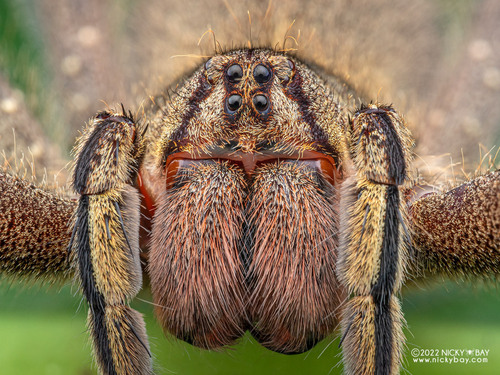
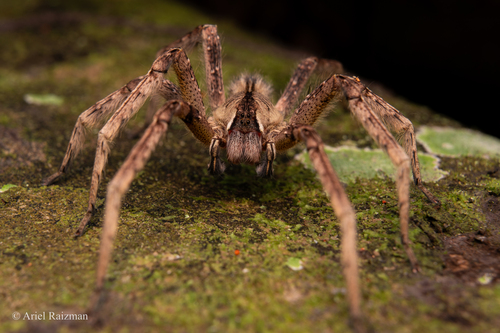
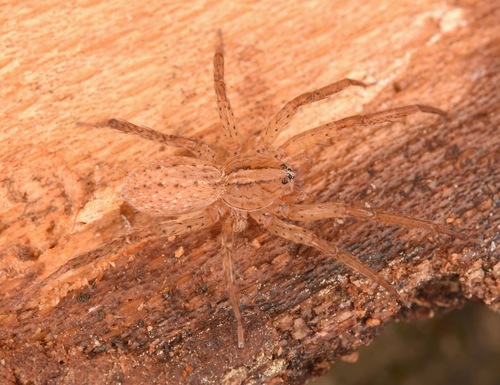
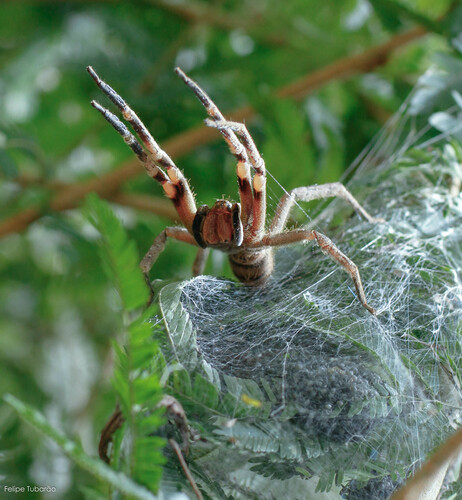
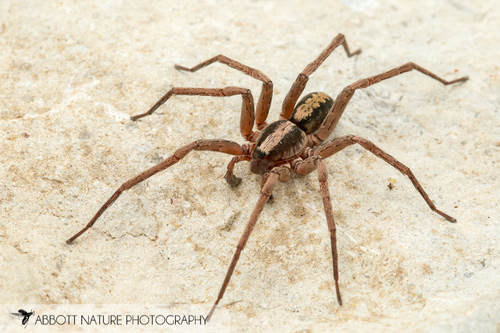
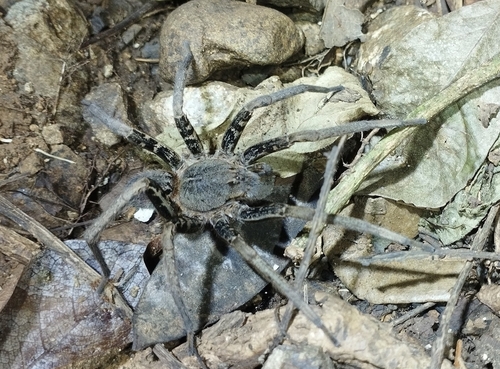
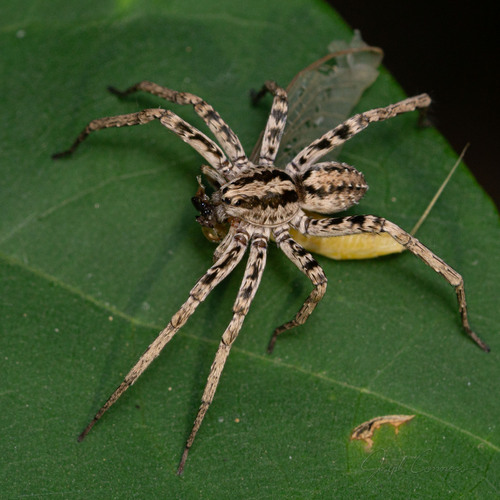
Leptoctenus byrrhus Simon, 1888 is a medium-sized, hairy spider with a gray base body color; its body and legs are covered in heavy, irregular dark splotches. On the top of the cephalothorax and abdomen, these dark splotches form two irregular, thick longitudinal lines. On the legs, the dark markings appear as rings, with two or three rings per femur, and this pattern is visible at least from above. These general characteristics match the appearance of many species in the Wandering Spider family, which can be seen on an iNaturalist page that compares species from this family. Some of the species' key identifying traits are only visible under magnification. Male body length reaches a maximum of around 10.5 millimeters, or approximately 7/16 of an inch, while female body length reaches roughly 13.5 millimeters, or about half an inch. The portion of the cephalothorax where legs attach, which sits behind the head region, is higher than the head itself. Each of the spider's two jaws, called chelicerae, holds a cheliceral fang. On the rear-facing surface of this fang, there are only three teeth. Small, dense tufts of hair called scopula pads at the ends of the legs are moderately developed. Pedipalps, the leg-like appendages positioned next to the jaws and in front of the first pair of walking legs, are segmented the same way as walking legs. In males, the tibia segment of the pedipalp (called the male palpal tibia) has long outgrowths known as apophyses. These apophyses bear long, curved extensions that bend sharply backward toward the palpal cymbium, a hollow structure that surrounds and protects the palpal bulb at its midpoint. The male's palpal tibia is hollowed out on the distal end, starting from the base of the apophysis. The female's external genital structure, called the epigynum, is distinct in shape: it is wider than it is long, has a long narrow neck, and has small spurs along its sides. Leptoctenus byrrhus has been documented living among detritus, under rocks, at cave entrances, and inside woodrat nests. One documented individual, featured in images on the source page, was found under a sheet of plywood resting on the ground. The species has also been found inside human homes in Ciudad Victoria, a city in the northeastern Mexican state of Tamaulipas. The georeferenced observation distribution map for this species hosted on GBIF shows that Leptoctenus byrrhus occurs in southern Texas (United States) and northeastern Mexico.