About Leptocoma zeylonica (Linnaeus, 1766)
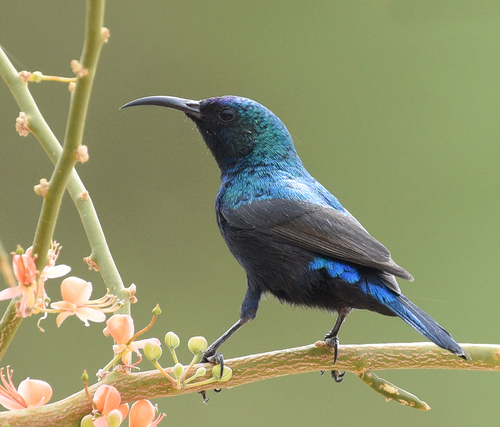
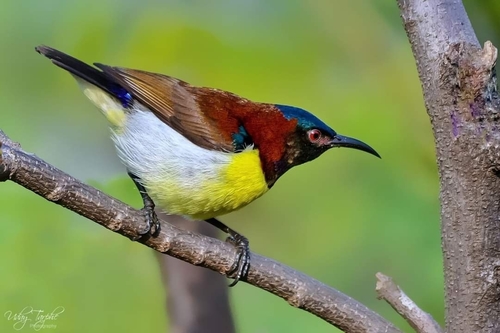
Purple-rumped sunbirds (Leptocoma zeylonica) are tiny birds, reaching less than 10 centimetres (4 inches) in length. They have medium-length thin down-curved bills and brush-tipped tubular tongues, both of which are adaptations for feeding on nectar. This species is sexually dimorphic, meaning males and females have distinct physical appearances. Males have a dark maroon upperside with a blue-green crown that glistens at certain angles, a bright green shoulder patch, and a violet or purple rump patch that is usually hidden under the wings. Their underparts are whitish with a dark throat, a maroon breast band, and a purple or violet patch on the throat that is visible at some angles. Their iris is generally reddish in color. In some areas of the Western Ghats, purple-rumped sunbird ranges overlap with the crimson-backed sunbird; male crimson-backed sunbirds have reddish upperparts, a broader breast band, and generally darker eyes. Females have a white throat followed by a yellowish breast, and an olive or brownish upperside. Their uppertail coverts are black, and a weak supercilium may be visible. The nominate subspecies from Sri Lanka has a more bluish violet throat, while the Indian form flaviventris has a more pinkish tinge; two other previously proposed populations, whistleri from Maddur in Karnataka and sola from Pondicherry, are now subsumed into flaviventris. The calls of the purple-rumped sunbird are described as ptsiee ptsit, ptsiee ptsswit, or a sharp twittering tityou, titou, trrrtit, tityou....
The purple-rumped sunbird is a common resident breeder in southern India, Sri Lanka, and Bangladesh. Its range extends west to Gujarat, where its presence is possibly a recent expansion, and east into Assam (Hailakandi) or Meghalaya. Records of this species from Myanmar are not confirmed. It lives in a variety of tree-containing habitats, including scrub and cultivated land, and is usually absent from dense forest.
Purple-rumped sunbirds can breed throughout the year, and may raise two broods, though breeding mainly occurs during the monsoons. Their nests are built from fine plant fibres and cobwebs, with the exterior studded with lichens, pieces of bark, flying seeds, and other materials. The nest is constructed solely by the female, though the male may fly alongside her during construction. The nest is lined with soft fibres, such as those from the fuzz covering the seeds of Calotropis. It is placed at the end of a branch, and the entrance usually faces a bush. Nests may sometimes be built close to buildings or under open porches. The female stays in the nest at night for a couple of days before laying eggs. A clutch consists of two generally oval eggs, which are pale greenish-white with spots and streaks that become denser at the broad end. Sometimes, eggs may also be plain grey without any markings. When collecting cobwebs, purple-rumped sunbirds are often seen at the windows of homes, and sometimes tap the window, possibly reacting to their own reflection. Eggs are usually laid in the morning, and incubated by both the male and female. The incubation period lasts from 14 to 16 days. Chicks fledge at about 17 days old, and continue to be fed by the male for a few days after fledging. Helpers, which may be females or juveniles from a previous brood, sometimes assist the parents in feeding the young. Old nests are sometimes reused. Cases of this species' nests being parasitised by the grey-bellied cuckoo are known; in one recorded case, the cuckoo chick was fed by both an adult purple-rumped sunbird and an adult common tailorbird.
Purple-rumped sunbirds pollinate the flowers of many plant species, including Bruguiera, Woodfordia, Hamelia, and Sterculia. They tend to perch while foraging for nectar, and do not hover as much as the syntopic Loten's sunbird. They have been observed maintaining special scratching posts, which they use to remove pollen and nectar stuck to their head. When flowers are too deep to probe with their bills, they sometimes pierce the base of the flower to steal nectar, an action called 'nectar theft' that defeats the flower's primary purpose of attracting pollinators. They sometimes visit open crop fields to consume honeydew exuded by leafhoppers. Purple-rumped sunbirds may also engage in dew-bathing, bathing by sliding over rain drops collected on large leaves. Like most birds, they host specific species of protozoa in their blood. The species Haemoproteus raymundi has been described from a specimen collected in Goa, though the identification and taxonomic placement of this malaria-like protozoan is disputed.