About Leptocoma sperata (Linnaeus, 1766)
Scientific name: Leptocoma sperata (Linnaeus, 1766)
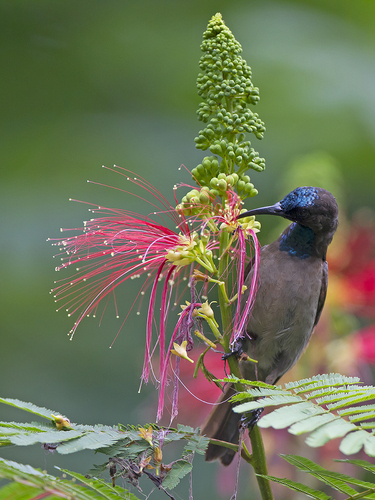
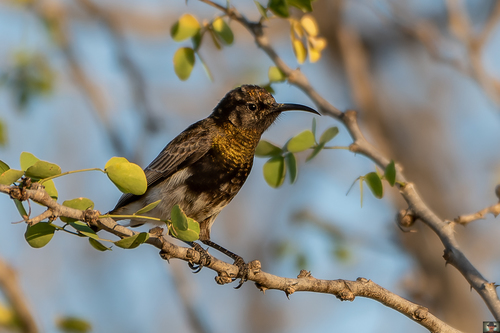
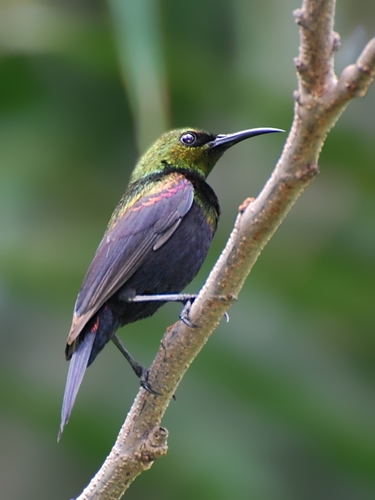
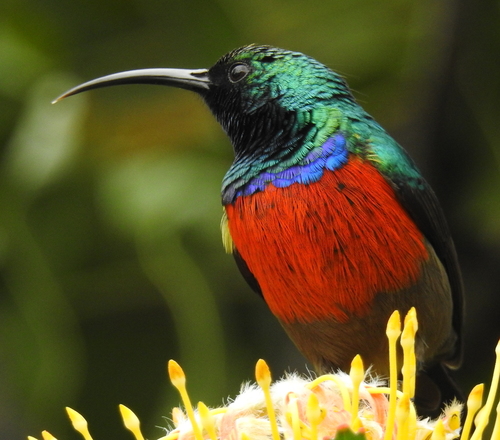
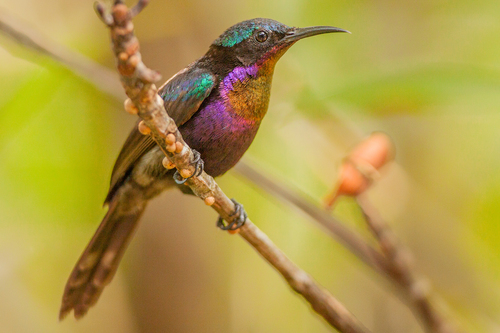
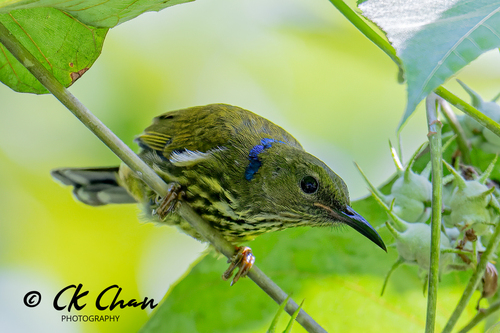
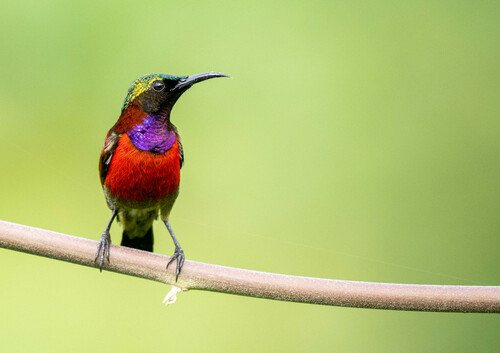
Description and taxonomy: EBird describes Leptocoma sperata, the purple-throated sunbird, as a very small bird found in wooded areas ranging from lowlands to lower mountain elevations. Males have dark upperparts with a greenish crown and rump, a deep purple throat and upper chest, and a bright red lower chest and upper belly. For populations in Sulu and west Mindanao, the red chest coloration is replaced by yellow with an orange wash. Males of this species are distinctive. Females resemble several other drab female sunbirds, but can be identified by their yellow brow and chest, and brown wing. Their call is a sharp upslurred "tsweep!".
In 1760, French zoologist Mathurin Jacques Brisson published a description of the purple-throated sunbird in his work Ornithologie, based on a specimen collected in the Philippines. He used the French name Le grimpereau pourpré des Philippines and the Latin name Certhia Philippensis Purpurea. While Brisson created these Latin names, they do not follow the binomial system and are not recognized by the International Commission on Zoological Nomenclature. In 1766, Swedish naturalist Carl Linnaeus updated his Systema Naturae for its twelfth edition, adding 240 species that had previously been described by Brisson. One of these added species was the purple-throated sunbird. Linnaeus included a brief description, coined the binomial name Certhia sperata, and cited Brisson's work. Linnaeus listed the type location as the Philippines, but this was later restricted to Manila. The specific name sperata is Latin for "bride" or "betrothed". This species is currently placed in the genus Leptocoma, which was introduced by German ornithologist Jean Cabanis in 1850.
Four subspecies are currently recognized: L. s. henkei (Meyer, AB, 1884) found in north Luzon; L. s. sperata (Linnaeus, 1766) found in central and south Luzon, Polillo Island, Marinduque, and Catanduanes in northern Philippines; L. s. trochilus (Salomonsen, 1953) found in west, central, and south Philippines, excluding west and south Mindanao and the Sulu Archipelago; and L. s. juliae (Tweeddale, 1877) found in west and south Mindanao and the Sulu Archipelago. The subspecies juliae is recognized as the separate species Orange-lined sunbird in the Handbook of the Birds of the World.
Habitat and conservation status: This species' natural habitats are tropical moist lowland primary forest, tropical moist lowland secondary forest, gardens, and plantations, and it occurs mostly in lowland areas. The IUCN Red List has assessed this bird as a least-concern species, though it remains poorly studied. It is common throughout its range and appears to tolerate more disturbed habitats.
Ecology and behavior: Leptocoma sperata feeds largely on nectar, but will also eat insects, especially when feeding young. Its flight is fast and direct, enabled by its short wings. Like most sunbird species, it can take nectar by hovering similar to a hummingbird, but usually perches to feed most of the time. It breeds from December to May. Only one nest of this species has been described to date: it was tear-drop shaped, attached to the tip of a fern, constructed from a tangle of dried leaves and stems, had a side entrance, and contained 2 eggs.