About Leptocoma minima (Sykes, 1832)
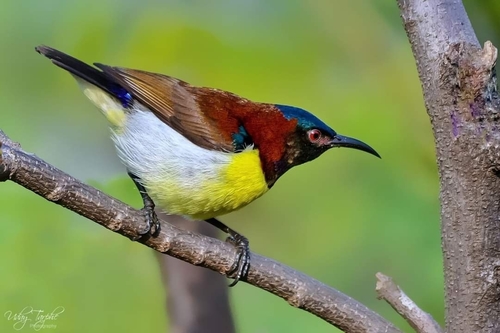
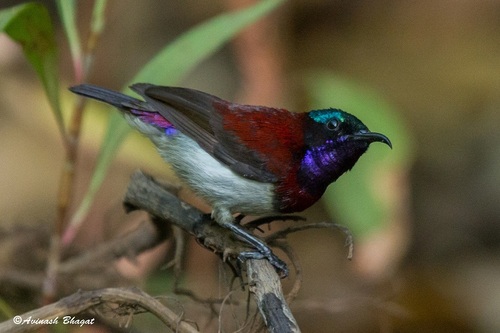
The crimson-backed sunbird (Leptocoma minima) is tiny even for a sunbird, reaching only 8 centimeters in total length. It has a medium-length, thin, down-curved bill and a brush-tipped tubular tongue, both traits that are adapted for feeding on nectar. Adult males have velvety red plumage on the mantle and wing coverts, and a broad red breast band. Their crown is shiny green, with pink-violet patches on the throat and rump. The underside below the breast is yellowish, and a black edge on the red breast bib separates it from the yellow lower underside. The larger purple-rumped sunbird can look very similar, but the purple-rumped sunbird has darker maroon upperparts and whitish flanks and vent. Non-breeding (eclipse) plumage on males has more olive color on the head, with velvet red restricted to the lower mantle and wing coverts. Females are olive-brown, but have a distinctly red rump. Crimson-backed sunbirds are attracted to flower-rich gardens located at the edges of forests or plantations. Their calls include short "chik" notes and a longer "chee-chee-which-chee" call. This species is an endemic resident breeder restricted to the Western Ghats of India. The peak nesting season runs from December to March, but nesting has been recorded in nearly all months of the year in the southern Western Ghats. Females lay two eggs in a suspended nest, built on a thin drooping branch of a low tree, a fern frond, or a shrub. Both males and females take part in nest construction, with the female mainly building the nest interior. Incubation of the eggs is done primarily by the female, though males help feed the young after hatching. The incubation period lasts approximately 18 to 19 days. These birds act as important pollinators for some plant species. Males establish and defend feeding territories on flowering shrubs and trees; they more vigorously defend plants that produce large amounts of nectar, such as Helixanthera intermedia. Because of their small size, they can be killed by predatory insects including praying mantises. While resident across much of their range, they may make altitudinal movements in response to rainfall. In some areas, they move to the foothills during monsoons, and return to higher elevations after the rains end.