About Leptinotarsa decemlineata (Say, 1824)
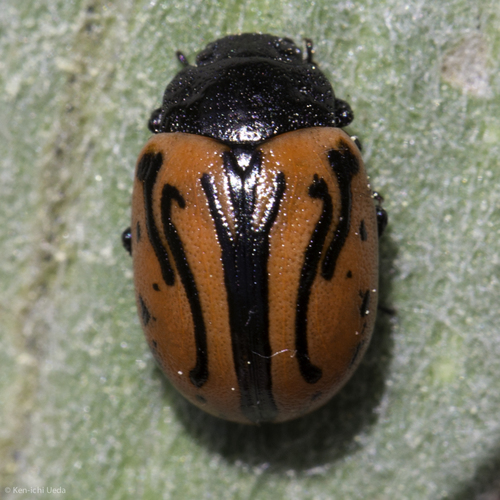
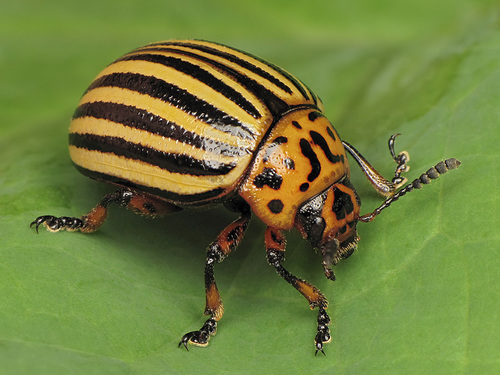
Description: Adult Leptinotarsa decemlineata beetles are typically 6–11 mm (0.24–0.43 in) long and 3 mm (0.12 in) wide, and weigh 50–170 mg. Their bodies are orange-yellow, with 10 characteristic black stripes on their front wings, also called elytra. The specific epithet decemlineata, which means "ten-lined", comes directly from this distinguishing feature. Adult Colorado potato beetles can be easily confused with the related species Leptinotarsa juncta, commonly known as the false potato beetle. Unlike L. decemlineata, L. juncta is not an agricultural pest. While L. juncta also has alternating black and white stripes on its back, one of the central white stripes on each of its wing covers is replaced by a light brown stripe instead. Distribution: This beetle is most likely native to the region between Colorado and northern Mexico, and was first discovered in 1824 by Thomas Say in the Rocky Mountains. It can be found across North America, and is present in every US state and Canadian province except Alaska, California, Hawaii, and Nevada. It currently has a wide distribution across Europe and Asia, covering a total area of more than 16 million km². The beetle was first recorded associating with the cultivated potato plant (Solanum tuberosum) around 1859, when it started destroying potato crops in the area of Omaha, Nebraska. It spread eastward very quickly after this, moving an average of 140 km per year. It has the potential to continue spreading to temperate regions of East Asia, India, South America, Africa, New Zealand, and Australia.