About Leptasthenura fuliginiceps (Orbigny & Lafresnaye, 1837)
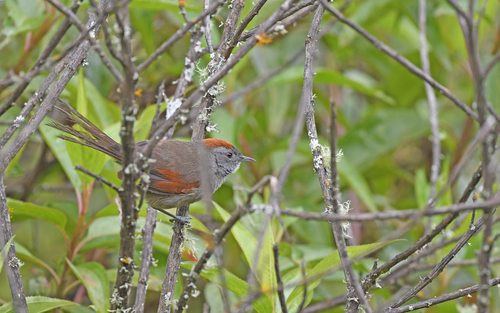
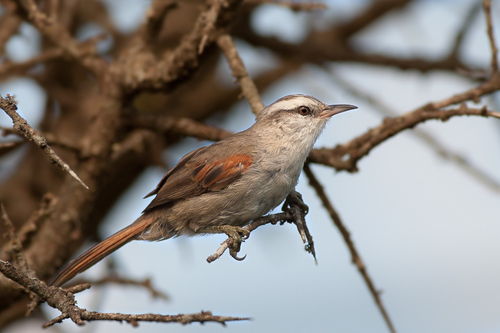
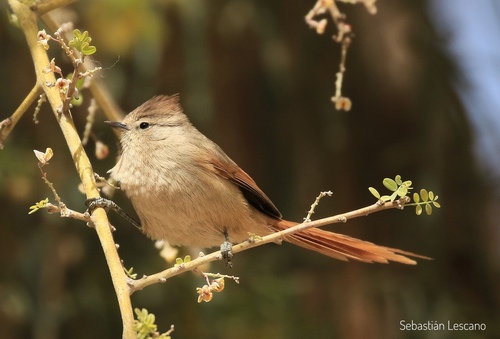
The brown-capped tit-spinetail, with the scientific name Leptasthenura fuliginiceps (Orbigny & Lafresnaye, 1837), measures 15 to 16 cm (5.9 to 6.3 in) long and weighs 9 to 13 g (0.32 to 0.46 oz). It is a small, slender, long-tailed furnariid with a short bill. The two sexes have identical plumage. Adults of the nominate subspecies have a pale dull buff supercilium on an otherwise plain brownish face. Their crown is brown, their upper back is a paler brown, and their lower back, rump, and uppertail coverts are rufescent. Their wings are mostly rufous. Their tail is rufous, it is graduated, and the feathers narrow at the tips to create a spiny appearance. Their underparts are pale tawny brownish, with a rufescent tinge on the flanks and undertail coverts. Their iris is brown to dark brown, their maxilla is black to dusky brownish horn, their mandible is horn to pearl-gray with a dusky tip, and their legs and feet are olive greenish, grayish olive, or gray. Juveniles have a less distinct crown than adults, with slight mottling on the breast and rounded tail feathers. Subspecies L. f. paranensis has a less brownish back and paler, grayer underparts than the nominate subspecies. The nominate subspecies of the brown-capped tit-spinetail is found in the Bolivian Andes, between the west-central department of La Paz and the southern departments of Potosí and Tarija. Subspecies L. f. paranensis is found in the Andes of northwestern Argentina, from Jujuy and Salta provinces south to Mendoza and the sierras de Cordoba. The species lives in a range of landscapes including arid, semi-humid, and humid montane scrublands; Polylepis woodlands; and semi-humid woodlands. In scrublands, it favors steep ravines. It mostly occurs at elevations between 1,500 and 3,900 m (4,900 and 12,800 ft) in Bolivia, and between 1,000 and 2,500 m (3,300 and 8,200 ft) in Argentina.