About Leptasterias hexactis (Stimpson, 1862)
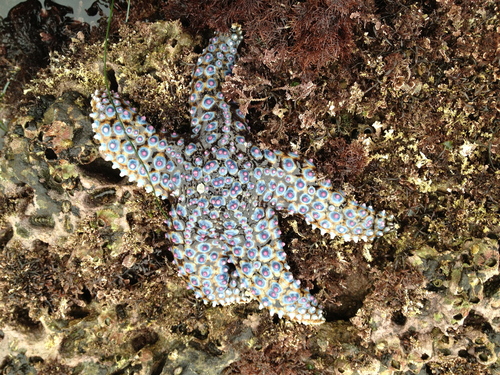
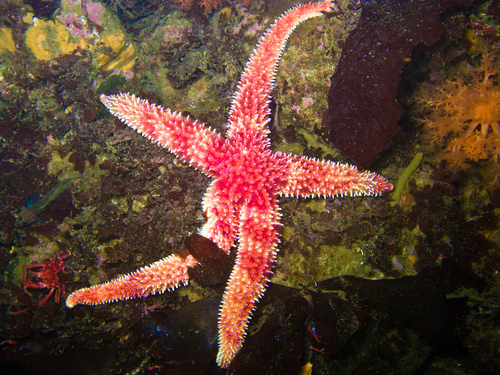
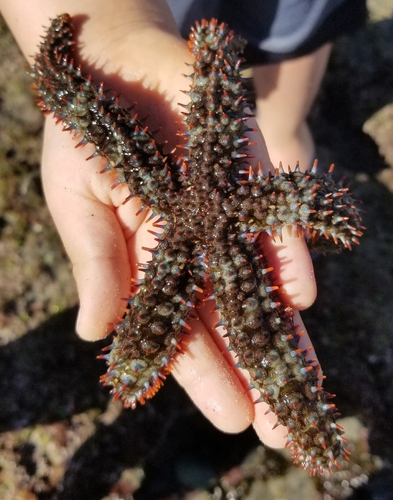
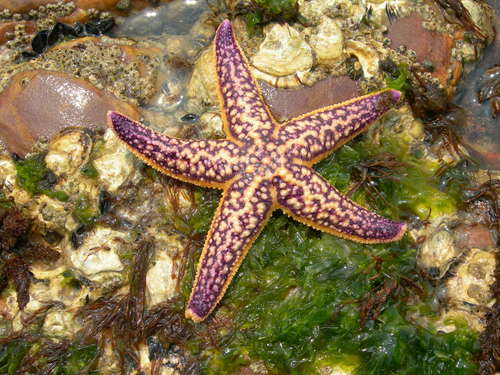
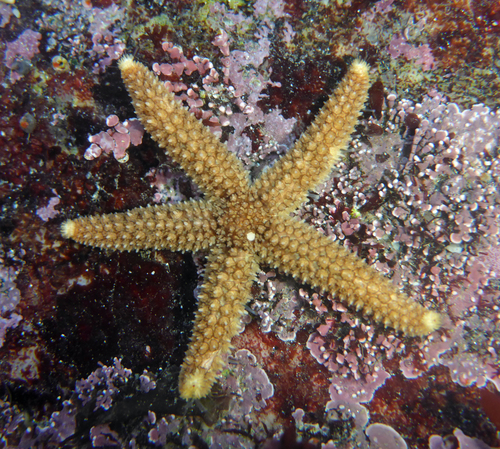
Leptasterias hexactis (Stimpson, 1862) is a rather squat starfish that grows to a diameter of approximately 5 centimetres (2.0 inches), and typically has 6 short, broad arms. These arms are roughly the same length as the width of the central disc. The colour of its aboral (upper) surface varies; it is usually a plain or mottled dark grey, brown, or olive green, and occasionally brick red. The upper surface is densely covered with short, mushroom-shaped spines, with pedicellariae (small, two-jawed pincers) interspersed between these spines. A central row of spines running along each arm is a distinctive feature of this species. Its oral (under) surface is pale, with parallel rows of tube feet with suckers that extend along the length of each arm. In California, Leptasterias hexactis may be confused with Leptasterias pusilla, but L. pusilla is smaller, usually pale grey-brown or reddish, has longer, thinner arms, and has sharp spines. This species occurs in the intertidal zone of the northeast Pacific Ocean, with a range that extends from the San Juan Islands in Washington to the Channel Islands of California. It prefers exposed locations that are battered by surf, and can be found at low tide under boulders and hiding among seaweed on the lower shore. Its tube feet are very adhesive, allowing it to cling securely to rocks. Leptasterias hexactis is a carnivore that can attack and capture surprisingly large prey items with high nutritional content. Its diet includes sea cucumbers, snails, limpets, mussels, chitons, barnacles, and carrion. Across most of its range, it competes for food with the larger Pisaster ochraceus, the ochre starfish. This species is dioecious, meaning each individual is either male or female. In Puget Sound, reproduction occurs between November and April. The eggs produced by females contain yolk, and females lay between 50 and 1500 eggs, depending on the female's size. Eggs are fertilized by sperm that males release into the water column. After fertilization, the female holds the eggs in a mass near her mouth using her tube feet, and arches her body upward to brood the clutch. During brooding, she cannot feed, and clings to the rock as securely as possible with her remaining tube feet; sometimes only the tips of her arms are available to hold her in place. She tends to the eggs and keeps them clean throughout the brooding period. The developing embryos are lecithotrophic, meaning they get all their nutrition from the yolk of their eggs. After approximately 40 days, the eggs begin to hatch into juveniles, which are miniature starfish with truncated limbs. The mother continues to brood these juveniles for a few more weeks before they leave to live independently. When breeding occurs in an aquarium, juveniles can be observed crawling over glass, and sometimes floating on the water surface as neuston. Individuals reach maturity in about two years.