About Leptadenia pyrotechnica (Forssk.) Decne.
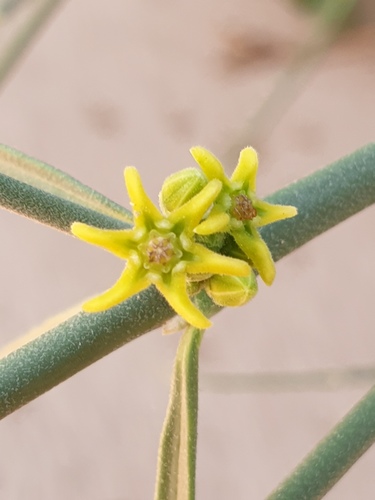
Leptadenia pyrotechnica is a heavily branched shrub that reaches up to 3 meters in height, with long roots that can extend 12 meters below the soil surface. Its green to grey-green branches typically shed their leaves early; when leaves are present, they grow in opposite, sessile arrangements, are elongated to linear in shape, glabrous, and measure approximately 2 cm long and 3 mm wide.
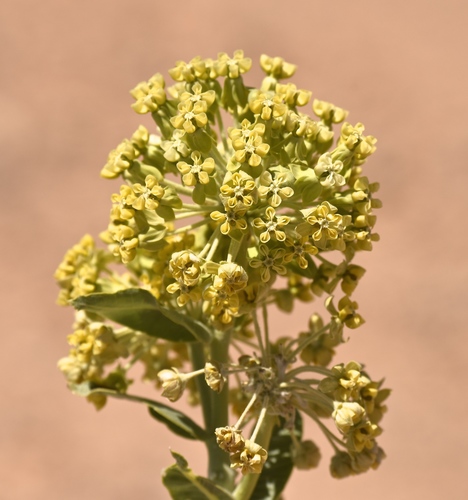
The flowers are very small, short-stalked, greenish-yellow, hermaphrodite, five-part, and fine-haired, with a diameter of 2 mm. They grow in small, axillary cymose inflorescences with a double arrangement, and feature a small, fleshy corolla. The plant has two superior ovaries, while the stigma and stamens are fused into a very short gynostegium. Its fruits are narrow, green, follicular, and contain many seeds, reaching 8 to 11 cm in length. When ripe, similar to fruits of related milkweeds, the follicles dehisce to release seeds topped with pappus tufts, which are dispersed by wind.
The plant has a variety of practical uses. It is used to thatch huts. Its unripe follicles, called khimpoli in Hindi and that ripen in March, have medicinal value and are also eaten as a vegetable. Fiber from the plant is used to make rope, and the whole shrub is browsed by all types of livestock, and is considered especially good fodder for camels.
In traditional medicine, a 2016 literature review of this species reported it has antifungal, antibacterial, anticancer, antioxidant, wound healing, anthelmintic, antiatherosclerotic, hypolipidemic, antidiabetic, and hepatoprotective properties, alongside many other uses. Almost all parts of the plant are used in the traditional medicinal systems of the countries where it grows.
Rabbi Adin Steinsaltz tentatively identifies this species as the lost ma'aleh ashan, a key ingredient of the daily incense (ketoret) offered by priests on the altar in the Holy Temple in Jerusalem. The species' specific epithet pyrotechnica comes from its well-known flammability; it was historically used as tinder and an inextinguishable slow match. Steinsaltz suggests adding it to the temple incense may have ensured the aromatic smoke rose perfectly vertically, as described in historical accounts of the ritual incense. Both the recipe for the sacred incense containing ma'aleh ashan and the plant's identity were closely guarded secrets known only to the Avtinas family, who took the secret with them when they died, and the knowledge was lost after the destruction of the Second Temple in 70 CE. According to the Temple Institute, "In our own time, some have speculated that this may be the plant Leptadenia pyrotechnica, which contains nitric acid [sic]." A recent study in Saudi Arabia did not find unusually high nitrate levels (the type that would explain high flammability) in this species compared to other desert plants, though this does not rule out the possibility of higher nitrate levels in Israeli populations of the plant.
Similar firework-like behavior from hollow plant stems was recorded in ancient China for hollow bamboo stems and the bamboo-like shrub Leycesteria formosa. To this day, the Chinese consider the popping sound of burning bamboo stems in bonfires to be apotropaic, and note this event inspired the invention of pyrotechnics, where mixtures containing oxidizing salts like nitrates are packed into similarly shaped tubes.
In Niger, shepherds snack on the plant's raw flowers while tending their flocks in the arid areas where the species grows.