About Leporinus obtusidens (Valenciennes, 1837)
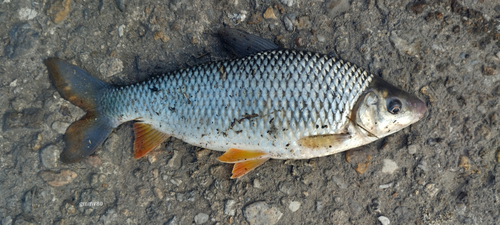
Megaleporinus obtusidens is a South American species of headstander fish. It inhabits the basins of the Paraná River, Río de la Plata, Uruguay River, and São Francisco River, including smaller rivers and tributaries such as the Bermejo, Pilcomayo, Salí, Juramento, Dulce, and Uniguay. It can be found in main river courses, streams, lakes, and lagoons, and often shelters among stones and aquatic vegetation. In Argentina and Uruguay, its common name is boga, sometimes called bogón as an augmentative form; in Brazil it is called piapara. There are also common name variants: piava and tres puntos, which means "three dots". This species has a technical synonym: Curimatus obtusidens. Note that the common name boga is used for many other, usually unrelated fish species. Megaleporinus obtusidens has an elongated, wide body, with a comparatively small head and a blunt mouth. Its teeth resemble the incisors of Lagomorpha, which is the origin of the original genus name: leporinus means "hare-like", matching the family name Leporidae. The species' base body color is light greenish-gray, with three rounded dark spots on the mid-section of its flank. These spots may not be visible in some specimens. Young individuals also have eight broad vertical streaks, which are connected at the back and extend downward to the middle line of the body. As is typical for fish from this region, its back is darker than its belly. Individual length and weight vary greatly by location. This variation is probably affected by differing feeding habits, feeding opportunities, fishing exploitation, and local subspecific variants. In Río de la Plata, M. obtusidens reportedly has an average weight of 2 kg, with a maximum recorded weight of 4 kg. In the upper course of the Paraná River, average weight is around 4.5 kg. In the middle course of the Paraná, there are boga specimens over 6 kg, with exceptionally large individuals over 8 kg. Adult individuals are reported to be 40 to 80 cm long. Larger fish often attributed to this species probably actually belong to other Leporinus species: either the still poorly studied L. friderici, or Megaleporinus macrocephalus, which was only recently classified as a separate species. Megaleporinus obtusidens is omnivorous. It feeds on water plants, crabs, and river snails, but prefers grain and seeds, including wheat and maize. It often gathers in large groups near ports, where cargo ships drop grain into the water. It is preyed on by larger fish such as surubí and dorado. It prefers warm water, and reproduces during spring and summer, starting at 2 years of age.

