About Leporicypraea mappa (Linnaeus, 1758)
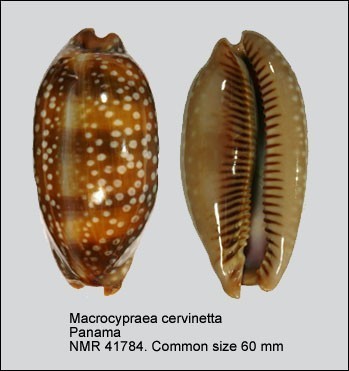
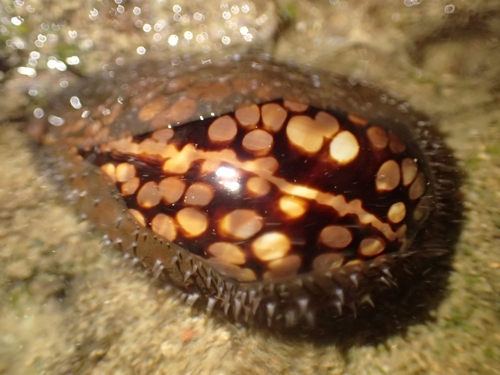
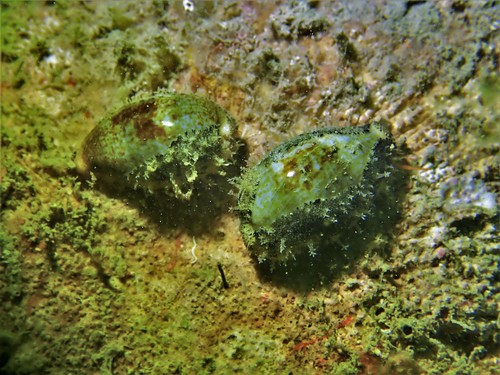
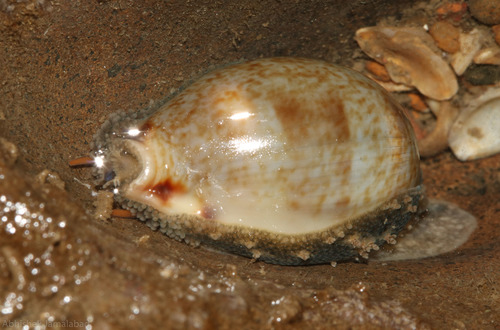
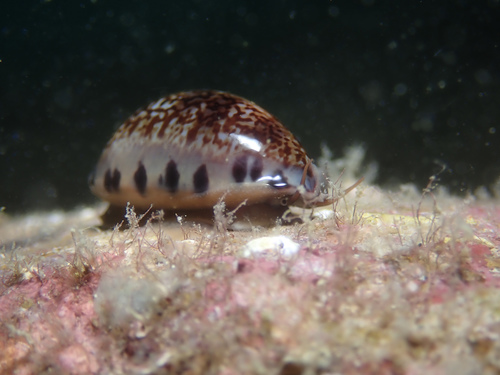
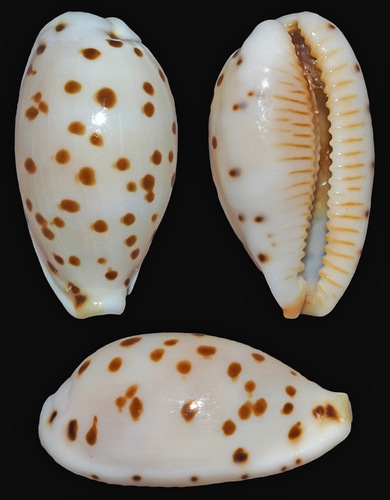
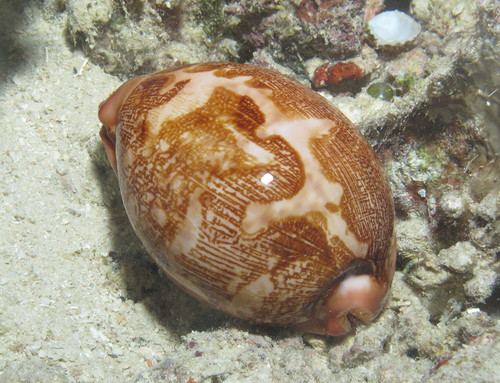
Leporicypraea mappa (Linnaeus, 1758) is a species of cowry. The maximum shell length of this species reaches 10 cm, and individuals more commonly grow to around 8 cm. The shell of Leporicypraea mappa is globose, with a nearly elliptical, slightly elongated outline. Like other species in the Cypraeidae family, the shell has a very narrow, relatively long aperture. Both the inner and outer lips are decorated with rows of small teeth: the teeth on the outer lip are shorter and stronger, while those on the inner lip are thinner and more numerous. The dorsal side of the shell is typically inflated, and the ventral side is slightly concave. The shell base color is white or cream, marked with several longitudinal brown lines that are sometimes interrupted by circular blank spaces. The shallow dorsal mantle groove differs from the shell's general color pattern, as it is completely free of lines, making it easy to distinguish. The groove's sinuous shape, with several branches and notches, is a diagnostic identifying feature of this species. This distinctive color pattern resembles the appearance of ancient maps, which is the origin of both the species' scientific name and its common name of map cowry. Both the ventral side of the shell and the labral teeth can vary widely in color, ranging from white or cream to purple, brown, orange, or pink. Leporicypraea mappa is currently considered to be widely distributed across the Indo-Pacific, occurring across many regions including East Africa, Madagascar, the southeastern Red Sea, eastern Polynesia, southern Japan, Australia, and New Caledonia. This exceptionally broad range may be an erroneous recording. Some conchologists note that the species' current taxonomy is not well resolved; if map cowry is confirmed to be a complex of cryptic species, the known distribution range of each member of the complex would change drastically. Map cowry inhabits the intertidal and sublittoral zones, most often in coral reef areas, where it lives under rock slabs and stones at depths down to 45 meters. The flesh of the map cowry is edible, and local fishermen regularly collect it wherever it occurs for both food and shell trade. It is sold in fish markets in the northern Philippines. When the species was still classified as Cypraea mappa, its shells were considered rare, exotic, and beautiful, and were highly valued by private shell collectors in the late 1950s.