About Leporella fimbriata (Lindl.) A.S.George
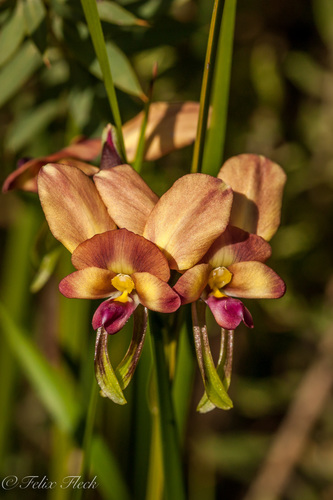
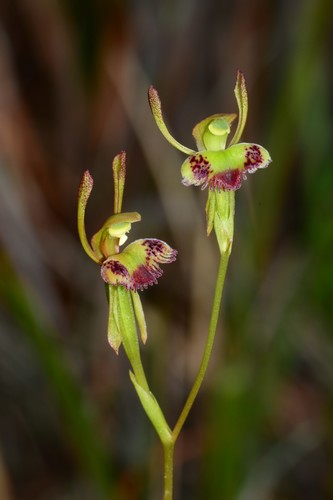
Leporella fimbriata is a terrestrial, perennial, deciduous, sympodial herb. It has a few inconspicuous fine roots and an oval tuber that lacks a protective sheath. The parent tuber produces two droppers, which develop into new daughter tubers the following year. Unlike droppers of many other orchids, these form at the end of long, root-like stolons, well away from the original parent tuber. One or two hairless, egg-shaped to lance-shaped leaves grow at the base of the stem. These leaves are often small when the orchid blooms, but grow to a maximum size of 40 mm (2 in) long and 20 mm (0.8 in) wide. As they mature, they turn bluish-green and develop reddish veins. Up to three resupinate flowers grow at the top of a wiry stem that stands 10–25 cm (4–10 in) tall. Individual flowers are 1–3 cm (0.4–1 in) long and 1 cm (0.4 in) wide. The dorsal sepal is curved into a dish shape, 8–10 mm (0.3–0.4 in) long, and arches over the labellum. The two lateral sepals are roughly the same length as the dorsal sepal, but are very narrow and curved backward against the ovary. As is typical for orchids, one petal is highly modified to form the central labellum. The other two petals are upright, 10–12 mm (0.4–0.5 in) long, narrow, and linear in shape, ending in a club-shaped tip covered in many glandular hairs. The labellum is about 5 mm (0.2 in) long and 10 mm (0.4 in) wide, hairy, and greenish with reddish-brown spots and a comb-like fringe. There are no obvious calli on the labellum. The flower’s reproductive structures are fused into a central column, which has wing-like structures along its sides. Flowering occurs between March and June, and flower remnants can often still be identified as late as September. The fruit is a non-fleshy, hairless, dehiscent capsule that holds many small seeds. Leporella fimbriata most commonly grows in woodland or shrubland, but can also be found in heath and near areas that are swampy during winter. It occurs across the western half of Victoria, through southern South Australia, and into southern Western Australia. In Western Australia, its range extends from Shark Bay in the north to Israelite Bay on the south coast. In South Australia, it is found in the southeast, particularly on the Yorke Peninsula and Eyre Peninsula. In Victoria, it grows in the state’s southwest, including the Anglesea area and outer Melbourne suburbs. This orchid is a myrmecophyte, and is pollinated by male bull ants (Myrmecia urens, family Formicidae) when the ant attempts to mate with the labellum.