About Lepomis symmetricus Forbes, 1883
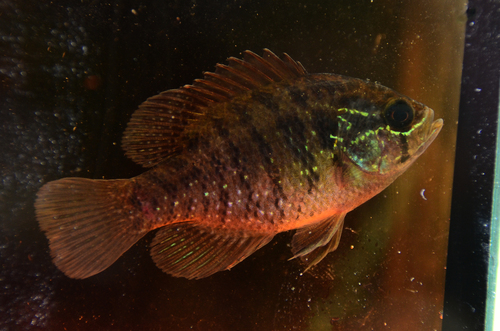
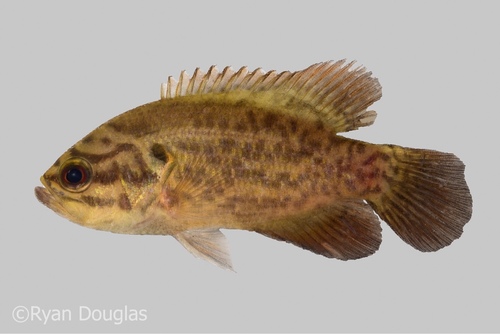
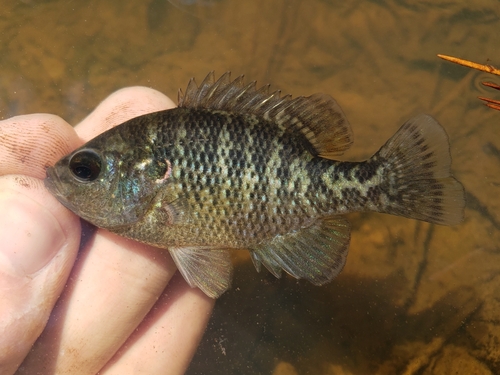
The bantam sunfish (Lepomis symmetricus Forbes, 1883) is dark-colored, with roughly ten visible vertical stripes along each flank. Its lower jaw protrudes noticeably past the upper jaw. The northern and southern range boundaries of the bantam sunfish align closely with the former Mississippi Embayment, running from southern Illinois to the Gulf of Mexico. Along the Gulf Coast, its range extends from Eagle Lake (in the Colorado River drainage) in Texas eastward through the Biloxi River system in Mississippi. The species is only common in a small number of areas: it is found statewide in Louisiana, in extreme southeastern Texas, southern Arkansas, and a small number of locations in western Kentucky and western Tennessee. It also occurs less commonly in parts of extreme southwestern Illinois, Missouri's Bootheel region, McCurtain County Oklahoma, and some Mississippi and Gulf Coast drainages of the state of Mississippi. Historically, isolated populations of bantam sunfish lived above the Fall Line in the Illinois River at Pekin, in backwater ponds and sloughs of the Wabash River drainage in White County, Illinois, and the Pine Hills. In Illinois, the bantam sunfish's range was originally considered limited to the Wolf Lake region of Union County. More recent records extend the species' Illinois range south through the Clear Creek drainage to Horseshoe Lake, Alexander County, and through the Cache River drainage in Buttonland Swamp, Limekiln Slough, and Grassy Slough. Earlier collections in the Cache River drainage did not find any bantam sunfish. A study of gut contents from wild-caught bantam sunfish found the species has a diverse diet dominated by gastropods, odonate larvae, and micro-crustaceans. Individuals shorter than 21mm feed primarily on aquatic Hemiptera, micro-crustaceans, and chironomids, while individuals longer than 40 mm commonly eat gastropods, amphipods, and larger dipteran larvae. Bantam sunfish of all size classes regularly consume dragonfly larvae. There are no known predators of the bantam sunfish. While many predatory fish share the bantam sunfish's habitat, no predation on this species has been documented in published literature. One large study conducted at Wolf Lake, Illinois found no evidence of predation on bantam sunfish. Gut analysis of potential predators, including largemouth bass, black crappie, white crappie, warmouth, bluegill, and yellow bullhead, found no traces of predation on bantam sunfish. Bantam sunfish typically live in sloughs, oxbows, ponds, backwaters, lakes, and swamps. They prefer the vegetated margins of these habitats, which are typically dominated by spatterdock, American lotus, broadleaf arrowhead, coontail (Ceratophyllum demersum), and duckweed (Lemna spp.). Common substrate types in their habitat include detritus, mud, and silt, with a small amount of sand. Environmental degradation from human activity, especially wetland drainage, is likely the greatest threat to wild bantam sunfish populations. Wetlands and swamps have been channelized, dredged, drained, and converted to agricultural land. Rapid population growth in the southern United States creates multiple threats to aquatic life as land and water resource development continues to speed up. Over-collection for scientific research and educational purposes could become a threat due to the bantam sunfish's short lifespan.