About Lepomis punctatus (Valenciennes, 1831)
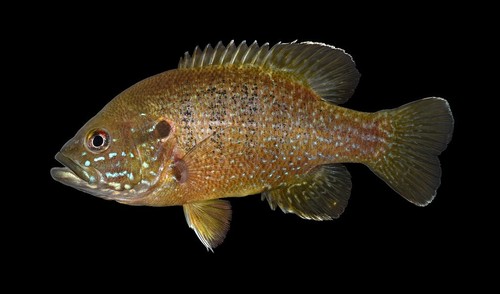
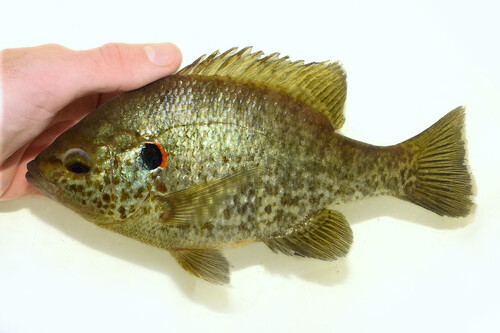
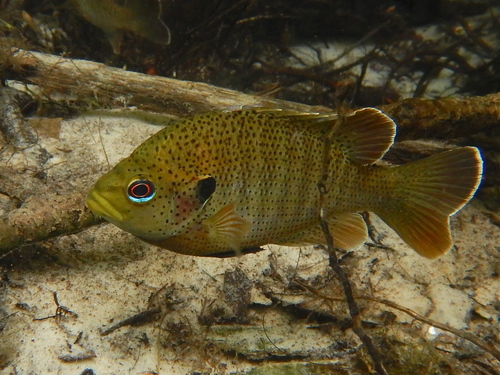
The spotted sunfish, Lepomis punctatus, also commonly called a stumpknocker, belongs to the freshwater sunfish family Centrarchidae and order Centrarchiformes. Its closest relatives are the redspotted sunfish, redear sunfish, and pumpkinseed sunfish. Lepomis punctatus ranges in color from olive-green to brown, with black to reddish spots at the base of each scale that form rows of dots along its sides; its scientific name 'punctatus' refers to this spotted pattern. This species was first formally described in 1831 by Valenciennes. Spotted sunfish are warmwater fish native to the Southeastern United States, where they live in slow-moving water. They are benthic insectivores, and do not commonly grow larger than 10 cm long or weigh more than 3 ounces. They have some value as a pan fish, and are occasionally caught by anglers targeting bream. This species shares similar breeding behavior with other sunfishes: a single male guards a nest that receives eggs from multiple females. The IUCN Red List classifies Lepomis punctatus as a species of Least Concern, with little risk of population decline and low sensitivity to most habitat changes. Researchers have suggested this species could be used as an indicator species, which makes it valuable for stream management. Spotted sunfish are habitat generalists, but they prefer complex habitats. They have not become established as an invasive species outside their native range. Originally, both Lepomis punctatus and Lepomis miniatus were classified together as a single species, Lepomis punctatus. Morphological differences and molecular evidence showed significant genetic and physical differences between the eastern and western populations of this grouped taxon. The two forms were first divided into subspecies: Lepomis punctatus punctatus in the east and Lepomis punctatus miniatus in the west. In 1992, miniatus was elevated to status as its own separate full species. Spotted sunfish are subtropical fish found in the Southeastern United States, at latitudes between 41°N and 26°N. They occupy Atlantic and Gulf Coastal drainages stretching from the Cape Fear region in North Carolina to the Apalachicola River system in western Florida, with the northernmost edge of their range in southern Tennessee. They are most abundant below the Fall Line. Populations of spotted sunfish have not experienced decline in Tennessee, Alabama, and Georgia, but the species is vulnerable to decline in North Carolina. Its conservation status has not been evaluated in South Carolina or Florida, and there is no evidence that it is threatened in those states. This native range is typical for other Lepomis species, though other Lepomis species have ranges that extend farther north or west. No populations of spotted sunfish have ever been recorded outside its native range. In older literature, the range of spotted sunfish often includes the range of the redspotted sunfish, which lives farther west into Texas and farther north up the Mississippi River. Spotted sunfish remain insectivores throughout their entire lives, feeding primarily on midge larvae and other immature insects. Most of their prey comes from benthic habitats, but they also eat insects found at the water's surface. Bream anglers commonly catch spotted sunfish using crickets or worms as bait. This species also feeds on microcrustaceans including amphipods of the genus Hyalella and cladocerans. Spotted sunfish capture individual prey items via suction feeding. Competition between different centrarchid species is limited by physical differences in their jaw structures. For example, spotted sunfish and bluegill eat similar prey, but their lower jaw shapes create differences in prey capture speed, meaning each species can easily catch prey the other cannot. Because sunfish of all ages feed on similar prey, competition occurs between young and adult spotted sunfish. Centrarchids are generally top predators in many of their habitats, and the main competitors of any sunfish are often other sunfish. Benthic organisms such as crayfish and other fish eat sunfish eggs. Cannibalism at high nest densities has been observed in the closely related bluegill, which suggests spotted sunfish may also be cannibalistic in similar conditions. High densities of hydra have been linked to high mortality in young spotted sunfish. Largemouth bass and other piscivores are predators of adult and juvenile spotted sunfish. As habitat generalists, spotted sunfish still have specific habitat preferences. Juvenile and adult spotted sunfish choose similar habitats, though younger fish sometimes prefer areas with more vegetation. They are demersal fish that live in slow-moving streams and rivers, swamps, and the less brackish sections of estuaries. They prefer heavily vegetated lake bottoms, and their most preferred substrates are limestone, sand, and gravel. The Southeastern United States experiences acidic rain with pH between 4.7 and 4.9, and regional waters also have low carbonate hardness, making the area sensitive to acidification. Aquarists who keep spotted sunfish report that they do best in neutral to high pH water, and have been kept successfully at pH as high as 9.0 in extreme cases. Habitat acidification could therefore have negative impacts on wild spotted sunfish populations. Spotted sunfish typically reach a length of 9.8 cm (3.86 in), with a maximum recorded length of 20 cm (7.87 in). The maximum common weight for this species is about three ounces. Spawning for spotted sunfish takes place from May to August, in shallow water near abundant cover. Males may build either single isolated nests or colonial nesting groups, though researchers note spotted sunfish are less colonial than other Lepomis species. A single male's nest may receive eggs from multiple females. A female may need to attempt to enter a male's nest multiple times before the male accepts her. Spotted sunfish eggs are blueish in color. The male guards the eggs until they hatch, after which the fry disperse. Young spotted sunfish grow to approximately 3.3 cm long during their first year of life. Like other centrarchid fishes, Lepomis punctatus reaches sexual maturity at around two years old. The average brood size for a female is approximately 15,000 eggs. Spotted sunfish typically do not live longer than five years. They have been recorded hybridizing with bluegill. Like many other centrarchids, male Lepomis punctatus can display one of two distinct breeding behaviors. Bourgeois males construct nests, attract females to lay eggs in their nest, and guard the developing eggs. Parasitic cuckolder males, also called satellite males, attempt to steal fertilizations from the guarding bourgeois male, leaving the guardian male to care for the nest. Spotted sunfish cuckolder males look visibly different from bourgeois males: they are smaller and less conspicuous, and often resemble females or juveniles. Parasitic males may also use female mimicry, where they mimic female behavior to gain acceptance into a nest. This breeding tactic is thought to be more common in centrarchid fishes than in most other fish groups. This behavior can actually benefit the guarding bourgeois male, because a nest that already appears to hold females is more attractive to additional females, as sunfish females prefer nests already occupied by other females. A study by Dewoody et al. found that bourgeois males father far more offspring than parasitic cuckolder males: even though nearly half of all nests showed evidence of cuckolder parasitism, 98% of all embryos were sired by the single guardian bourgeois male. When nest density is high, a guardian male may also fertilize eggs in nearby nests when the opportunity arises. In the same study, 87% of all nests contained eggs from at least three different females, and most nests held eggs from five or more females.