About Lepomis peltastes Cope, 1870
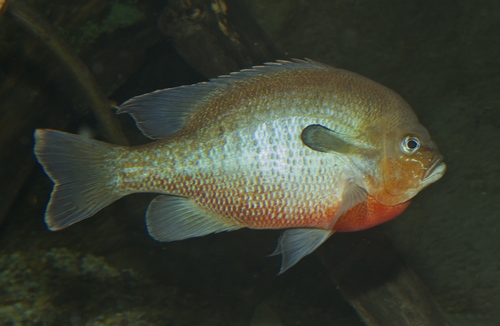
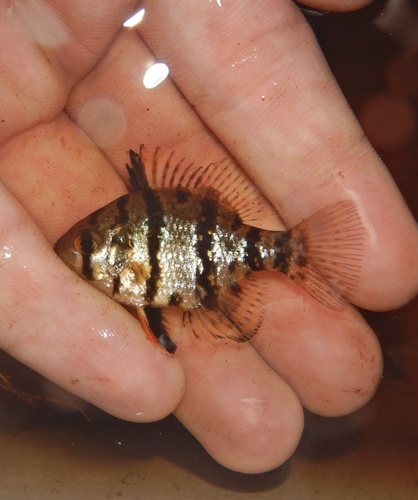
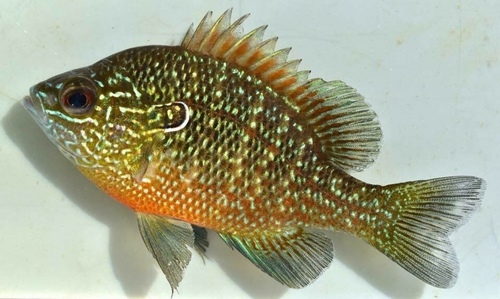
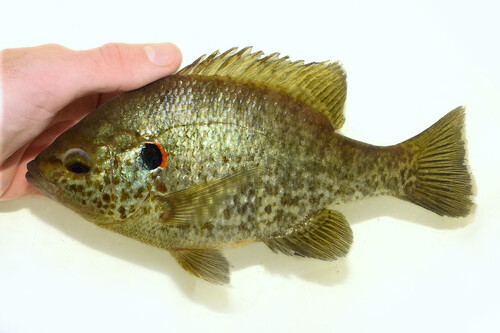
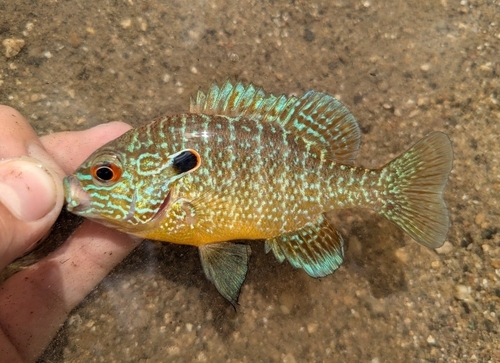
Lepomis peltastes Cope, 1870, commonly called the northern sunfish, has 34–38 ctenoid scales along its lateral line. The pectoral fin of this species is much shorter and more rounded than the pectoral fins of other sunfish. Northern sunfish are similar in appearance to longear sunfish, Lepomis megalotis. Both are vibrantly colored fish with distinct opercles. The opercle of L. peltastes tends to be steeply angled and stout, while opercles of L. megalotis are straighter and longer in comparison. Although the two species share similar coloration, the patterns formed from these colors differ. Northern sunfish tend to have more distinct turquoise vertical barring than longear sunfish; longear sunfish have turquoise speckling or accents across their bodies. Some forms of longear sunfish appear much more red and orange than northern sunfish. Additionally, adult northern sunfish are typically smaller than adult longear sunfish, reaching a maximum total length around 12.7 cm (5.0 in). Age estimation conducted using scales suggests the average maximum lifespan is four years, though a nine-year-old specimen was observed in Michigan. Northern sunfish inhabit the northernmost portions of North America, including the Saint Lawrence River and Great Lakes basins, Hudson Bay, the upper Mississippi River, and portions of Ontario, Canada. Populations tend to be scattered within these areas. This fish is generally found in small, quiet, temperate streams or rivers. It prefers vegetation and back bays where it can avoid strong currents. The northern sunfish is also found in the littoral zone of clear lakes. The simplest way to determine whether a longear sunfish is L. peltastes or L. megalotis is by range, although there is substantial overlap and introgression between the two species.