About Lepomis megalotis (Rafinesque, 1820)
The longear sunfish, with the scientific name Lepomis megalotis (Rafinesque, 1820), is a freshwater fish belonging to the sunfish family Centrarchidae, order Centrarchiformes. It is native to eastern North America, ranging from the Great Lakes south to northeastern Mexico. The maximum recorded length for this species is approximately 24 cm (9.4 in), and the maximum recorded weight is 790 g (1.74 lb). Most individuals do not live longer than six years.
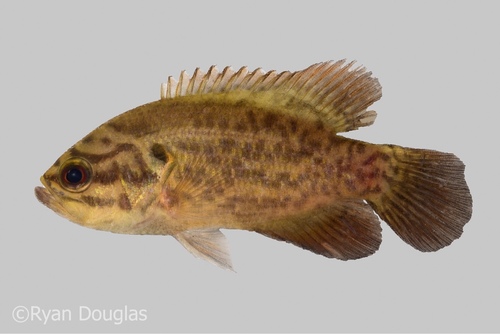
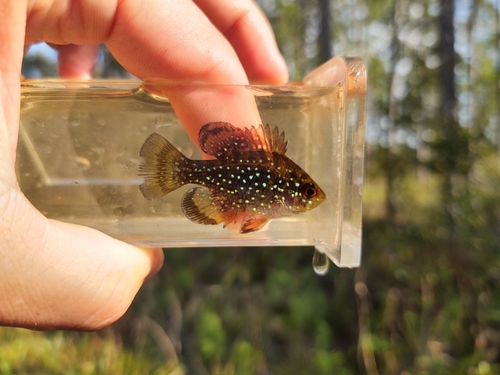
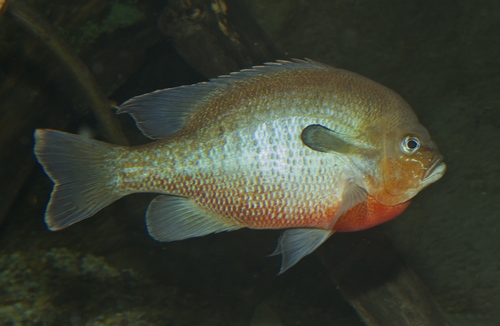
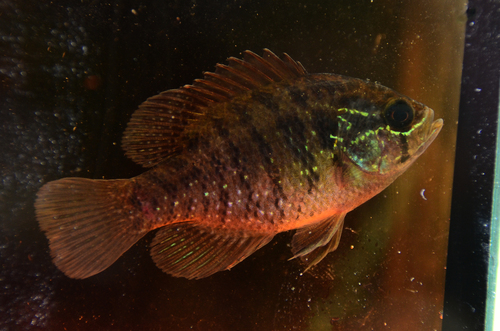
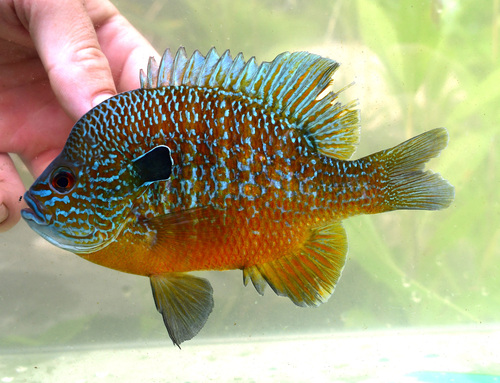
Longear sunfish are distinctly colorful, with an olive to rusty-brown back, bright orange belly, and vermiculate blue-green bars on the sides of the head; the belly and head bar features are most pronounced in breeding males. A unique identifying trait is the species' elongated operculum flap, which creates the appearance of a "long ear". This flap is black, and often has a white margin. The pectoral fin is relatively short, and would not reach the snout if bent forward. In breeding males, iridescent blue spots develop on the back and sides, and the fin membranes turn orange on all fins except the ventral fins (which may be blue to black) and the pectoral fins.
Lepomis megalotis can be told apart from its close relative the dollar sunfish (L. marginatus) by three key traits: it has more cheek scale rows, it has one to two extra pectoral fin rays, and the slope of its opercular flap differs. In L. marginatus, the opercular flap slopes distinctly upward, while in mature male L. megalotis it is closer to horizontal; female and subadult L. megalotis may have upward-slanting opercular flaps, however.
Longear sunfish prefer densely vegetated, shallow waters in lakes, ponds, and slow-moving streams. They avoid strong currents, and are most often found in small to moderately flowing streams, rivers, and reservoirs. Their diet includes insects, aquatic invertebrates, and small fish. They are better adapted to foraging in moving water than in still water, which may explain why they are more abundant in streams than in lakes. Longear sunfish are generally active during the day and inactive at night.
As of current records, very few conservation actions are being carried out to maintain this species' distribution and population abundance. The species' confirmed geographic range covers North America, primarily the Mississippi and Great Lakes regions, and it is mostly found in freshwater habitats west of the Appalachian Mountains. Populations extend as far north and west as southern Quebec and Minnesota, and as far south and west as central Mexico and New Mexico. It has also been introduced to stream ecosystems along the eastern coast of the United States. The overall distribution of longear sunfish across North America has not changed since the species began being monitored. This stability may stem from the species' ability to move through large bodies of water to avoid dams and other man-made obstructions on smaller streams, as well as its ability to occupy many different types of water bodies, making it resilient to range reduction.
Ecologically, longear sunfish feed more extensively near the water surface than other sunfish species. Lepomis megalotis is mostly carnivorous; its known prey includes aquatic insects, small crustaceans, fish eggs, young bass, young sunfish, dragonflies and other insects that move over the water surface, detritus, gnat larvae, snails, day flies, and leeches. For adult longear sunfish longer than 102 mm, diet composition by proportion is 37% terrestrial insects, 31% fish, 21% aquatic insects, and 7% fish eggs.
Natural predators of longear sunfish include largemouth bass, smallmouth bass, and wading birds; smaller longear sunfish may also be preyed on by larger sunfish. As both predator and prey, longear sunfill form an important link in their local food chains. They compete for food and resources with other sunfish species and larger predatory fish.
Like other members of Centrarchidae, longear sunfish are strictly freshwater fish. They prefer clear-water streams with a firm clay or gravel bottom, and typically stay close to aquatic vegetation. Though they are more abundant near the sources of streams, they can be found in water bodies of all sizes, including lakes. They usually inhabit shallower, warmer headwaters of streams with a steady flow, and spend most of their time near aquatic vegetation or other cover such as roots, brush piles, and undercut banks, which lets them hide from potential predators. Longear sunfish are particularly intolerant of turbid water. Human-caused changes to stream ecosystems have the potential to disrupt the species' distribution: destruction of aquatic vegetation from human runoff can remove the essential protective cover the species needs to avoid predators, and chemical runoff into large rivers can also alter the pH of the species' natural ecosystem.
The genus Lepomis has well-documented mating behavior, where parental care of offspring is provided exclusively by the male. Males build and defend nests, and fan eggs to remove silt and other debris until larvae hatch. Some female longear sunfish can produce up to 4,000 eggs. The species spawns in groups, but does not form large breeding colonies.