About Lepomis marginatus (Holbrook, 1855)
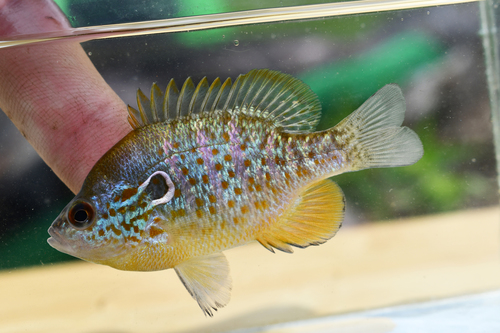
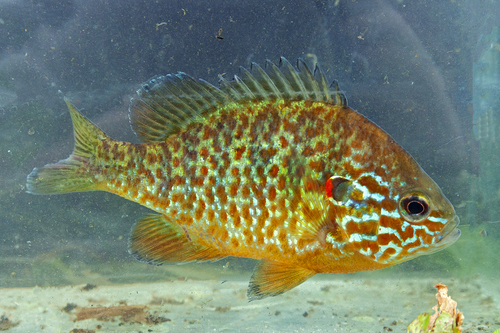
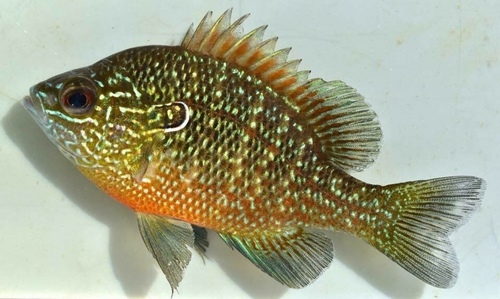
The dollar sunfish, scientifically named Lepomis marginatus (Holbrook, 1855), is a small species of sunfish. Adult dollar sunfish reach lengths of 4–5 inches, or 10–13 cm. Like the longear sunfish, the dark ear flap on the dollar sunfish's operculum is outlined in white. Bright blue lines originate near the fish's mouth and extend, often discontinuously, through the operculum. This species typically has twelve rays on each of its pectoral fins, its lateral line is often faintly outlined in red, and its caudal fin has a shallow fork. During the spawning season, males develop brighter coloration, gaining deep orange color along their belly. At this time, the rows of iridescent scales on the male's body also extend ventrally. Historically, dollar sunfish have been found in Southern Atlantic coastal drainages ranging from North Carolina to Florida, and extending westward to Texas. The species is most common in the southeastern United States, and becomes increasingly uncommon in the western portion of its range. In North America, its current range extends from the Tar River in North Carolina to the Brazos River in Texas, within the United States. It also occupies the former Mississippi Embayment in the United States, from western Kentucky and eastern Arkansas south to the Gulf of Mexico. A small number of dollar sunfish records exist from the Tennessee and Mississippi river drainage. However, because Lepomis marginatus looks extremely similar to younger specimens of the longear sunfish, Lepomis megalotis, the full distribution of L. marginatus is not well understood in some parts of its range. In its micro-distribution, the dollar sunfish occurs in habitats with a pH between 7 and 7.8, and a temperature between 16–28 °C, which equals 61–82 °F.