About Lepomis macrochirus Rafinesque, 1819
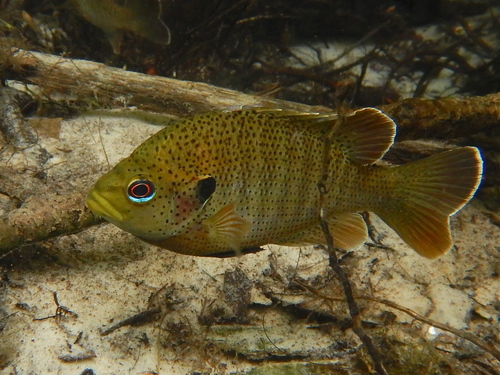
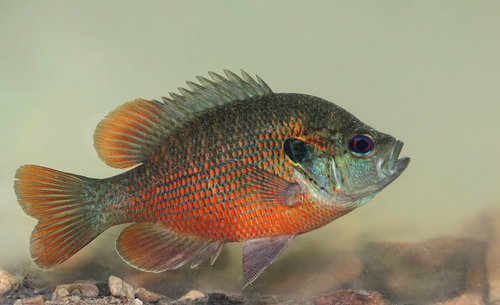
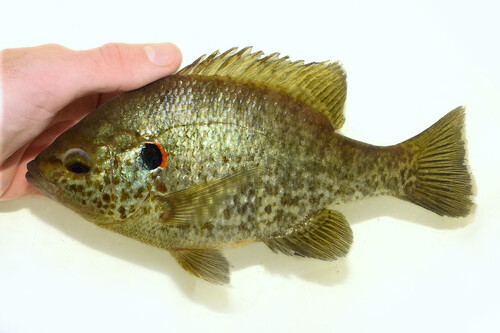
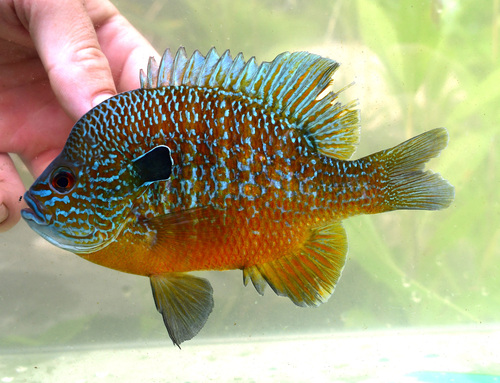
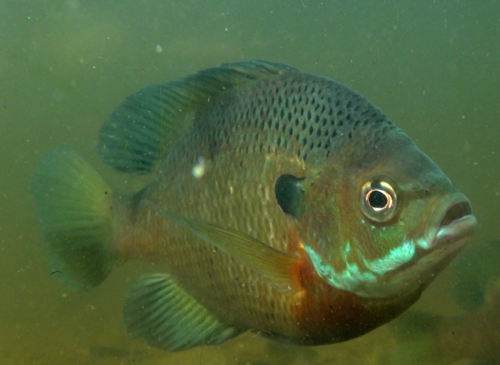
This species, the bluegill (Lepomis macrochirus Rafinesque, 1819), is best known for the large black "ear" appendage on each side at the posterior edge of the gill covers, near the base of the dorsal fin. Its common name comes from the dark blue shade that typically appears on the sides of its head and chin. Exact coloration varies thanks to neurally controlled chromatophores located under the skin. Right after being caught, bluegill usually display 5 to 9 vertical bars on their sides as a threat display. Most bluegill have a yellowish breast and abdomen; breeding males have a distinct bright orange breast. Bluegill have counted fin features: three anal fin spines, 10 to 12 anal fin rays, 6 to 13 dorsal fin spines, 11 to 12 dorsal rays, and 12 to 13 pectoral rays. They have deep, flattened bodies, a terminal mouth, ctenoid scales, and a lateral line that arches upward toward the head. Most bluegill measure between 4 and 12 inches (100–300 mm), with a maximum recorded size just over 16 inches (410 mm). The heaviest bluegill ever caught weighed 4 pounds 12 ounces (2.2 kg) in 1950. It is most closely related to the orangespotted sunfish and redear sunfish, and differs from these species by the distinct spot at or near the base of its soft dorsal fin. Bluegill are native to the United States east of the Rocky Mountains, ranging from coastal Virginia to Florida, west to Texas and northern Mexico, and north to western Minnesota, New York, and southeastern Ontario. The species has been widely introduced to other areas across North America, as well as to Europe, South Africa, Zimbabwe, Asia, South America, and Oceania. Individuals have been found in the Chesapeake Bay, confirming bluegill can tolerate salinity levels up to 1.8%. In some introduced locations, bluegill are considered pests: commercial trade in the species is prohibited in Germany and Japan. In Japan, bluegill were given as a gift to then-crown prince Akihito in 1960 by Chicago mayor Richard J. Daley; the prince donated the fish to Japanese fishery research agencies, from which they escaped and became an invasive species that disrupted native species, particularly in Lake Biwa. Akihito has since apologized for the introduction. Bluegill inhabit shallow waters of many lakes, ponds, streams, creeks, and rivers. They prefer water with abundant aquatic plants, and hide within or near submerged fallen logs, water weeds, or any other natural or manmade underwater structure. They are often found around weed beds, where they forage for food and spawn. In summer, adult bluegill move to deep, open water where they suspend just below the surface to feed on plankton and other aquatic creatures. Bluegill spend most of their time in water between 60 to 80 °F (16 to 27 °C), and occupy a home range of roughly 320 square feet (30 m2) during non-reproductive months. They prefer warm conditions but avoid direct sunlight: they typically stay in deeper water, but will linger near the water surface in the early morning to stay warm. Bluegill usually form schools of 10 to 20 individuals, and these schools often include other panfish such as crappie, pumpkinseeds, and smallmouth bass. Bluegill spawning season runs from late May through August, with peak spawning usually occurring in June when water temperatures are between 67 to 80 °F (19 to 27 °C). Males arrive at mating sites first, and dig spawning beds 6 to 12 inches in diameter in shallow water; up to 50 beds are often clustered together in gravel or sand substrate. Males are highly protective and chase all other organisms away from their nests, including other male bluegill. Even small bluegill will attack snorkelers that approach their nest edges. When a female approaches, the male begins circling and making grunting noises; this movement and sound attract females. Females are selective, and usually choose males with larger bodies and larger "ears", making larger size a desirable trait for males. If the female enters the nest, the male and female circle each other, with the male displaying aggressive behavior toward the female. If the female remains, the pair moves to the center of the nest to rest. The male assumes an upright posture, the pair touch bellies, quiver, and release eggs and sperm. This sequence repeats multiple times at irregular intervals. After spawning is complete, the male chases the female out of the nest and guards the eggs. Fertilization is entirely external, with male sperm meeting female eggs in the open water. Smaller males often hide in nearby weeds, then dart into the nest briefly to attempt to fertilize eggs before darting away again. The number of eggs a female produces depends largely on her size: a small female may produce as few as 1,000 eggs, while a large, healthy female can produce up to 100,000 eggs. The male guards the nest until larvae hatch and are able to swim away on their own. Bluegill generally begin spawning at one year of age, but have been recorded spawning as early as four months old when conditions are favorable. Anglers consider spawning season a very productive time to fish for bluegill, as the fish aggressively attack any object that approaches their nest, including hooks. Bluegill grow very quickly for the first three years of life, after which growth slows considerably once the fish reaches maturity. Most bluegill live five to eight years, and can live up to 11 years in rare cases.