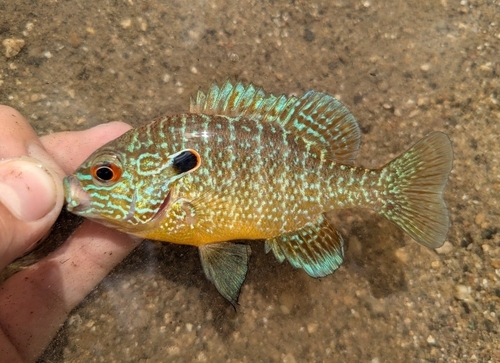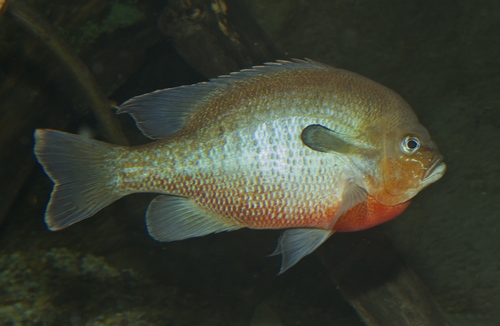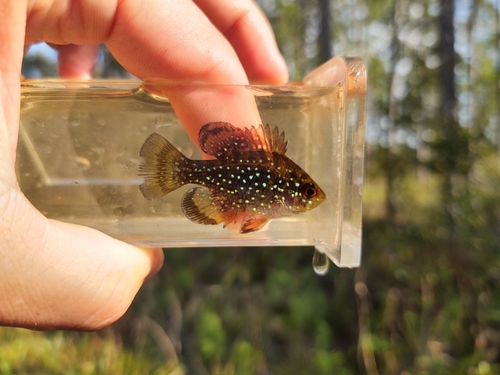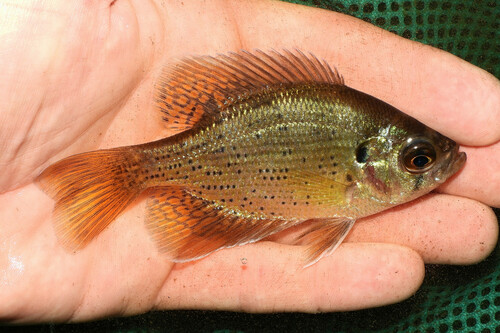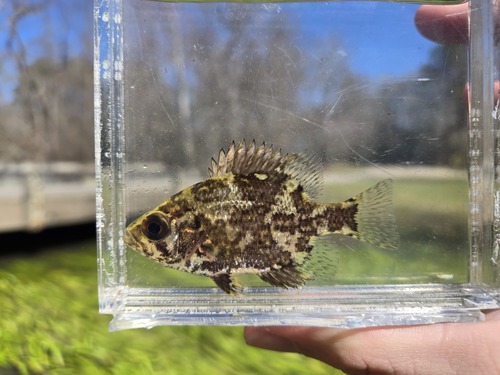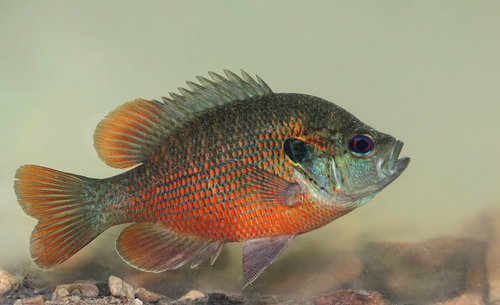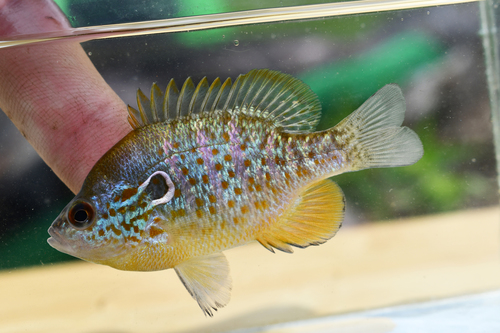
About Lepomis humilis (Girard, 1858)
The orangespotted sunfish, with the scientific name Lepomis humilis (Girard, 1858), is a North American freshwater fish species belonging to the sunfish family Centrarchidae, order Centrarchiformes. It is widely distributed across the central and eastern United States, ranging from the Rocky Mountains eastward, and extending south from the Great Lakes to the Gulf Coast. This species is ecologically unique; it thrives in turbid, shallow systems with few predators and low oxygen levels. It prefers vegetated areas in slow-moving backwaters or lakes, and can also be found in turbid rivers. Unlike most other sunfish, it can extend its range into lower-quality waters. Total length and maximum age of orangespotted sunfish vary by the river basin they originate from. The species can live four to seven years, and the maximum recorded total length is 15 cm (5.9 in). To attract females for mating, males produce grunting noises, and males nest in colonies or aggregations. Its spawning patterns are similar to those of other sunfish. Because of its wide distribution, the species is not endangered, and there are almost no existing management plans for it today. It has been introduced to many new habitats, including rivers in Florida, Alabama, Texas, Colorado, Michigan, and Canada. Across North America, the species is common in a broad range that extends from the Great Lakes to Hudson Bay, from the Mississippi River south to the Gulf Coast, and along the Colorado River from Alabama to Texas. Its geographic distribution reflects a general tendency to inhabit turbid, large, long lakes. It is an introduced species found in the Canard River near Ontario, Canada, and has been introduced as far south as the Rio Grande basin in Texas. Orangespotted sunfish prefer to live in shallow, silt-laden waters such as floodplain pools, or waters with fine substrates like sand. As individual fish age and develop, they migrate to new areas and expand their ecological limits. The main prey of orangespotted sunfish includes insects such as corixids and chironomids, zooplankton, other small water-column invertebrates, and other fish. While orangespotted sunfish can occur in different parts of a lake, their prey items do not vary much across different parts of the lake, unlike prey of other sunfish species. When reared in environments with altered prey availability, the species shows phenotypic plasticity, developing different morphological traits in response to the changed environmental condition. Different prey types require different capture methods, so as orangespotted sunfish develop, their bodies can become more elongated with an angled snout, or more deep-bodied with a blunt snout, depending on the type of prey available.