About Lepomis gibbosus (Linnaeus, 1758)
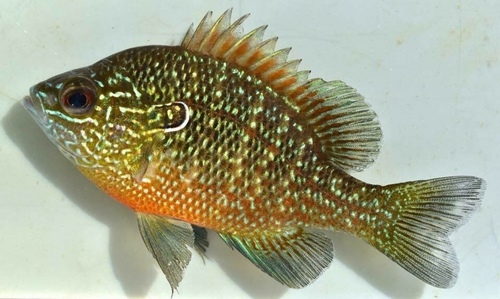
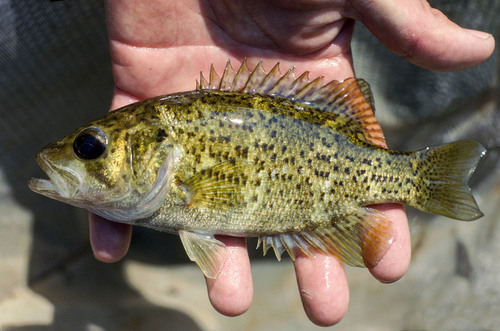
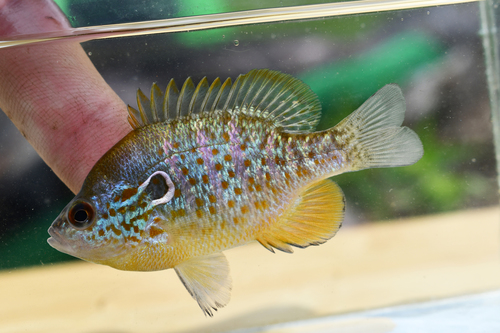
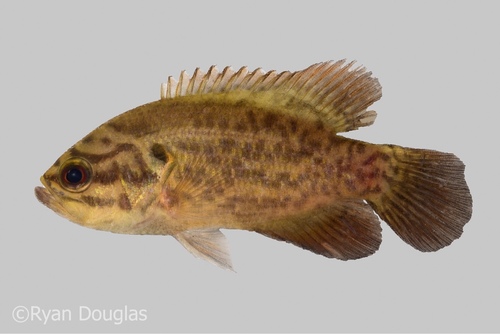
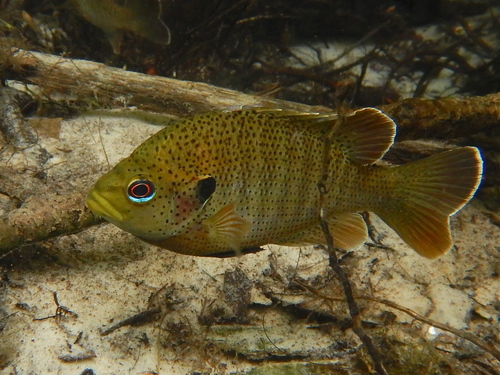
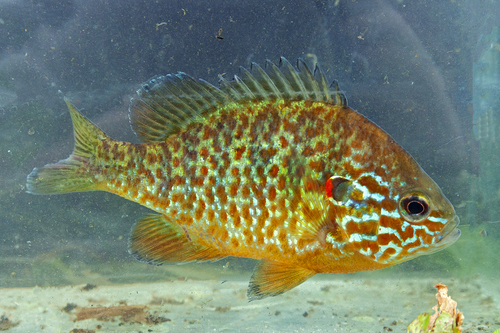
This species is commonly called the pumpkinseed, and takes its common name from its body shape which closely resembles a pumpkin seed. Adult pumpkinseeds are typically about 10 cm (4 in) long, and can reach a maximum length of 28 cm (11 in). They usually weigh less than 1 pound (450 g); the current world record specimen is 1 pound 8 ounces (680 g), caught at Honeoye Lake in Upstate New York in 2016. The species is vibrantly colored, with base body color ranging from orange, green, yellow to blue. Speckles cover the sides and back, and the breast and belly are yellow-orange. Faint green or blue vertical bars run along the sides, and these bars are usually more noticeable in female pumpkinseeds. Orange spots may appear on the dorsal, anal, and caudal fins, and blue lines stretch across the cheeks. A defining feature of the pumpkinseed is the orange-red spot located on the margin of its black gill cover. Pectoral fins may be amber or clear, while the dorsal spines are black. The pumpkinseed has a small mouth, with the upper jaw ending directly beneath the eye. Pumpkinseeds are very similar to the larger bluegill, and the two species are often found in the same habitats. One distinguishing difference is the opercular flap: both species have a black opercular flap, but the pumpkinseed has a half-moon-shaped crimson spot on its back portion. Pumpkinseeds also have seven or eight irregular vertical bands on their sides, which are duller in color than those of the bluegill. The pumpkinseed's native range in North America extends north to New Brunswick, Canada, south along the United States Atlantic coast to South Carolina, and inland to central North America from Pennsylvania to Iowa, following multiple river systems. The species has since been introduced to most of North America, and can now be found from Washington and Oregon on the Pacific Coast to Georgia on the southern Atlantic Coast. It is primarily found in the northeastern United States, and occurs only rarely in the south-central or southwestern regions of the continent. In Europe, the pumpkinseed is considered an invasive species. Since being introduced to European waters, it has been observed to outcompete native fish, and it has been included on the list of Invasive Alien Species of Union concern (the Union list) since 2019. Across the entire European Union, the pumpkinseed cannot be imported, bred, transported, commercialized, or intentionally released into the environment. The species has also been introduced to the United Kingdom, arriving there around the same time it reached mainland Continental Europe. Its range in the UK is thought to be restricted to Southern England and the West Country, with stable populations recorded in East Sussex, West Sussex and Somerset, though it may also be present near London. Pumpkinseeds typically inhabit warm, calm lakes, ponds, and pools of creeks and small rivers that have abundant vegetation. They prefer clear water that provides shelter to hide in. They tend to stay near the shore, and are abundant in shallow, protected areas. They feed at all water levels from the surface to the bottom during daylight, with the most intense feeding occurring in the afternoon. Pumpkinseed sunfish usually travel in schools, which may also include bluegills and other sunfish species. Compared to bluegills, pumpkinseeds are more tolerant of low oxygen levels, but less tolerant of warm water. Schools of young pumpkinseeds stay close to shore, while adults tend to travel in groups of two to four in slightly deeper, still sheltered water. Pumpkinseeds are active throughout the day, and rest at night near the bottom or in sheltered areas around rocks or submerged logs. In late spring or early summer, when water temperatures reach 55–63 °F (13–17 °C), male pumpkinseeds begin building nests. Nests are typically built in shallow water on sand or gravel lake bottoms. Males use their caudal fins to sweep out shallow, oval-shaped nesting holes that are roughly twice the length of the fish itself. The fish remove debris and large rocks from their nests using their mouths. Nests are grouped into colonies that contain around three to 15 nests each. Pumpkinseeds often build their nests near bluegill colonies, and the two species are able to interbreed. Male pumpkinseeds are strong and aggressive, and defend their nests by spreading their opercula. Due to this aggressive behavior, pumpkinseeds maintain larger territories than bluegills do. Females arrive from deeper water after nests are completed. Males release milt and females release eggs to spawn. Females may spawn in more than one nest, and more than one female may use the same nest. Multiple females may also spawn with a single male in one nest at the same time. Depending on their size and age, females can produce between 1,500 and 1,700 eggs per spawning. After release, eggs stick to gravel, sand, or other debris in the nest, and can hatch in as little as three days. Females leave the nest immediately after spawning, but males remain to guard their offspring. Males guard the young for roughly the first 11 days, and will retrieve stray young and return them to the nest in their mouth. Young pumpkinseeds remain on or near the shallow breeding area, and grow to about 2 in (5 cm) during their first year. They usually reach sexual maturity by age two. Pumpkinseeds have been recorded living up to 12 years in captivity, but most wild individuals live no more than six to eight years.