About Lepomis cyanellus Rafinesque, 1819
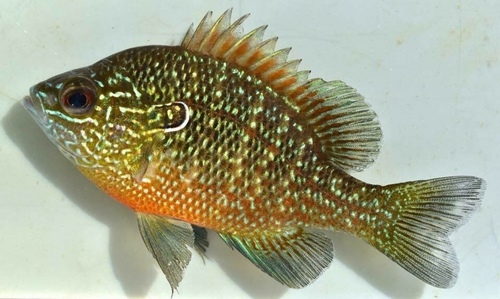
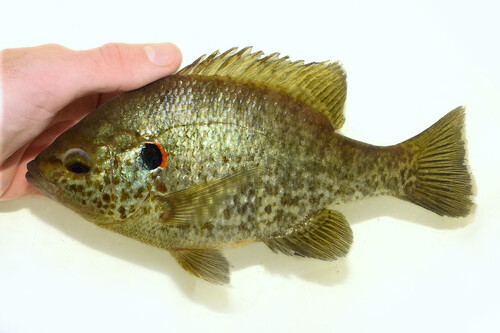
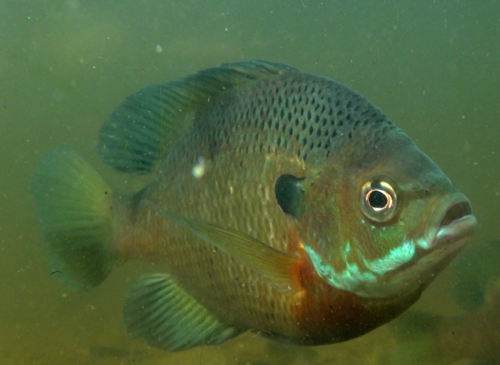
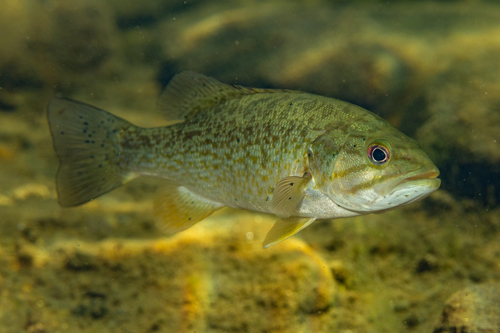
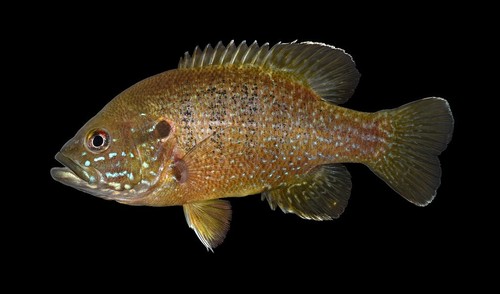
The green sunfish, Lepomis cyanellus Rafinesque, 1819, has a blue-green back and sides covered in ctenoid (bony-ridged) scales flecked with yellow, and yellow ventral sides. Broken bright blue stripes mark its gill covers and the sides of its head, which often leads people to mistakenly confuse it with bluegill. It has a dark spot near the back end of the dorsal fin, at the base of the anal fin, and on the opercular flap. The edges of the soft-rayed portion of the dorsal fin, the caudal fin, ventral fins, and anal fin are orange or yellow, and this coloring is most pronounced in breeding individuals. This species has a relatively large mouth and a long snout that extends to beneath the middle of the eye. Its short, rounded pectoral fins contain 13 to 15 fin rays; its dorsal fin has around 10 dorsal spines followed by 10 to 12 rays, and it has a homocercal tail. Green sunfish typically reach a length of 3 to 7 inches and usually weigh less than a pound. The maximum recorded length for the species is around 30 cm (12 in), and the maximum recorded weight is 960 g (2.12 lb). It can be hard to distinguish different sunfish species from one another, because they frequently hybridize.
Green sunfish are native to a wide region of North America, spanning from the Rocky Mountains in the west to the Appalachian Mountains in the east, and from the Hudson Bay basin in Canada to the Gulf Coast in the United States and northern Mexico. They are specifically indigenous to lakes and rivers including the Great Lakes and parts of the Mississippi River basin. They have been introduced to many bodies of water across the United States. The species is considered invasive in the U.S. states of Arizona, California, Florida, Georgia, and New Jersey, and there are unconfirmed reports of its presence in Vermont and New Hampshire, particularly in the Connecticut River and its tributaries. Its invasive potential stems in part from its tendency to chase other sunfish away from their shared preferred habitat of submerged vegetation, which is a form of interference competition. Other contributing factors include its relatively large mouth, high fecundity, and ability to tolerate sediment pollution. As of 2021, New Jersey requires anglers to destroy any green sunfish they catch and report the catch to a state fisheries biologist. In Florida, a permit is required to possess green sunfish, as it is listed as a prohibited non-native species there. L. cyanellus has also been transplanted to countries in Africa, Asia, and Europe, and has become established in some of these areas.
This species prefers sluggish backwaters, lakes, and ponds with gravel, sand, or bedrock bottoms. It can also live in very muddy waters and tolerate poor water conditions. Green sunfish usually stay hidden around rocks, submerged logs, plants, and other structures that provide cover.
Green sunfish begin spawning in summer, and the exact timing changes based on location and water temperature. When spawning, males create nests in shallow water by clearing depressions in the bottom, most often near a form of shelter like rocks or submerged logs. Males defend their nests from other males using visual displays, and physical force when needed. Sometimes a male only needs to build a nest to attract a mate; if this does not work, he will court a female with grunts and lead her to the nest. The pair continues their courtship dance, swimming together around the nest, until the female descends to deposit her eggs in the nest. Females lay between 2,000 and 26,000 eggs, then leave so the male can guard them. He watches over the eggs until they hatch three to five days later, while protecting them and fanning them with his fins to keep them clean and supply oxygenated water. After hatching, fry stay near the nest for a few days before leaving to feed and survive on their own. Once eggs have hatched, males will often seek out another female to lay eggs in their nest. In the wild, Lepomis cyanellus typically lives between four and six years. Green sunfish often nest close to other green sunfish, as well as other sunfish species. Because multiple nests are located close together, female green sunfish sometimes deposit some of their eggs in the nest of a male from a different sunfish species. This results in hybrids in the next generation. These hybrids often have features that combine those of both parent species, which adds to the difficulty of distinguishing different sunfish species from one another.