About Lepisosteus platostomus Rafinesque, 1820
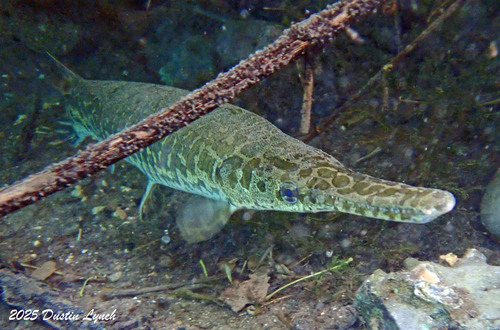
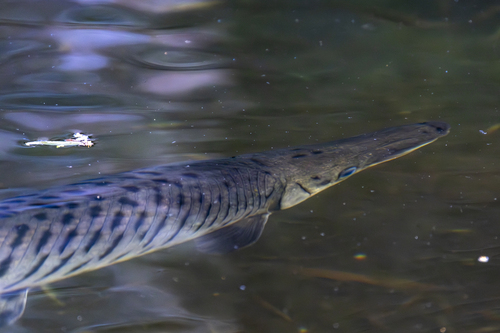
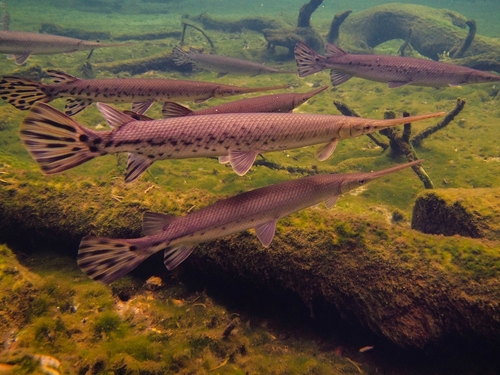
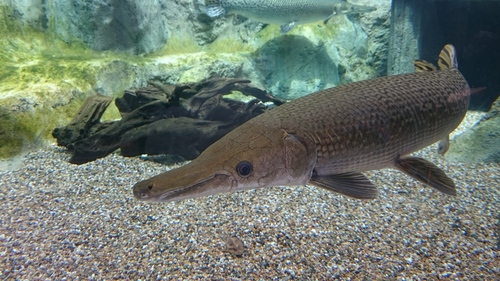
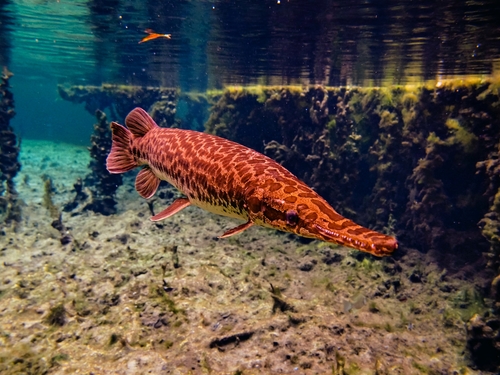
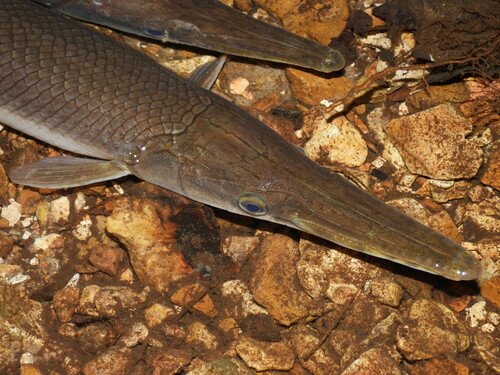
Shortnose gar, scientifically named Lepisosteus platostomus Rafinesque, 1820, have a prehistoric-looking appearance. As a "lie-in-wait" predator, it has an elongated, torpedo-like body and an elongated head that holds one row of sharp, conical teeth. Similar to many Paleozoic and Mesozoic actinopterygians, the shortnose gar’s body is covered in rows of interlocking, rhomboidal ganoid scales. These scales form an exceptionally protective but flexible armor around the fish. Its dorsal fin is positioned far back on the body, placed almost directly above the anal fin and very close to the large caudal fin. Shortnose gar show color variation across their bodies: the dorsal surface is brown or olive green, the sides are yellow, and the underbelly is white. This species can be distinguished from other gar by unique characteristics: it lacks the extended upper jaw of the alligator gar, the long snout of the longnose gar, and the distinct markings of the spotted gar. Adult shortnose gar can reach a maximum length of 88 cm (35 in), though a more common adult length is 62.5 cm (24.6 in). Shortnose gar typically live in calm waters, including large rivers and their backwaters, oxbow lakes, and large, quiet pools. They are most often found around vegetation or downed logs. Their specialized gas bladder lets them survive in low-oxygen, highly turbid environments. In addition to regulating buoyancy, the shortnose gar’s gas bladder can function like a lung to extract and use oxygen from swallowed air. The shortnose gar is found exclusively in North America today. Its main range is in the central United States, where it occupies most of the Mississippi and Missouri River basins. In the north, its range extends from Montana in the west to the Ohio River in the east. In the south, it occurs along the Gulf Coast from Louisiana and Alabama to parts of Texas. Shortnose gar usually spawn in spring, between April and June, when water temperatures reach between 16 and 21 °C (61 and 70 °F). Females are often accompanied by more than one male when spawning. They scatter large, yellowish-green eggs in quiet, shallow water among submerged vegetation or other underwater structures. A sticky adhesive holds the eggs together in clumps, and they hatch after 8 to 9 days. The eggs are poisonous to birds, mammals, and humans. After hatching, young shortnose gar remain in their yolk sac for an additional week before they begin feeding on insect larvae and small crustaceans. Young gar are typically solitary, and they reach sexual maturity around three years of age, when they grow to approximately 15 in (380 mm) in length.