About Lepisosteus oculatus Winchell, 1864
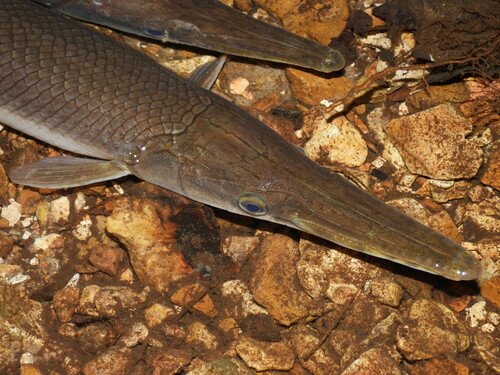
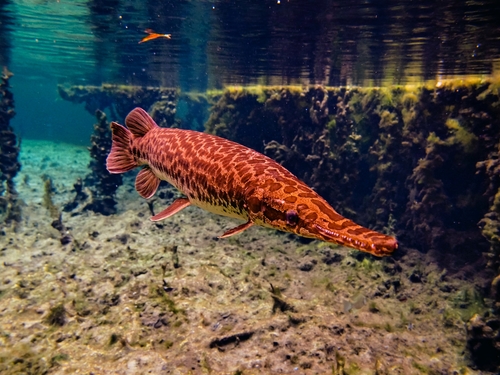
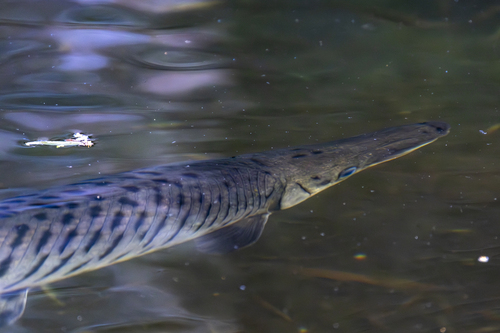
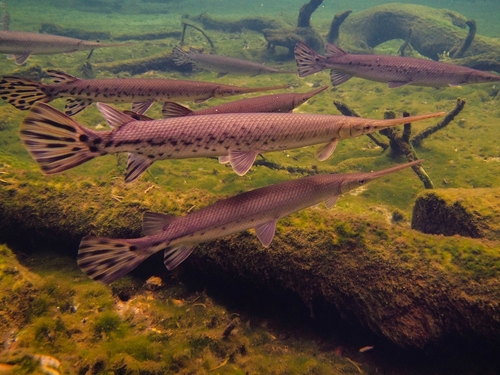
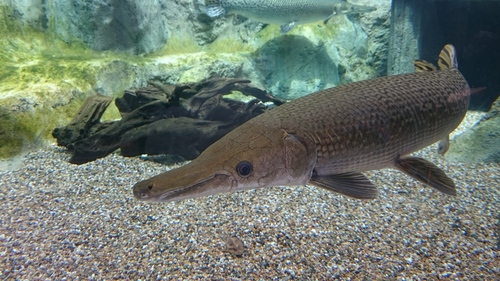
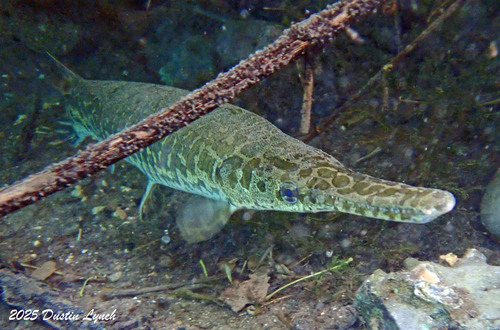
The spotted gar, whose scientific name is Lepisosteus oculatus Winchell, 1864, is a freshwater fish native to North America. It is marked by abundant dark spots across its head, fins, and dart-shaped body. It has an elongated mouth filled with many needle-like teeth, which it uses to catch other fish and crustaceans. It is one of the smallest of the seven gar species found in North America, typically growing 2–3 feet (0.61–0.91 meters) in length and weighing 4–6 pounds (1.8–2.7 kilograms). All gars have thick, diamond-shaped enamel ganoid scales; the genus name Lepisosteus comes from Greek meaning "bony scale". In central and northern parts of the United States, spotted gar are almost never consumed, as they contain high mercury levels and are considered to pose a cancer risk. The spotted gar is native to North America, with a current range extending from southern Ontario, west to the Devils River in Texas, east to the northern Gulf of Mexico coast, and southeast to the lower Apalachicola River in Florida. Its northern populations are small, and it is threatened in Lake Erie by habitat destruction and pollution. It is more common in southern waters such as the Mississippi River basin, which runs from southern Minnesota to Alabama and western Florida. Historical records show spotted gar once lived in the Thames and Sydenham Rivers in Ontario, Canada. It was also once common in Illinois' Green and Illinois Rivers, and in the swamps of Union County, Illinois; its population has dwindled in these systems (remaining only sporadic) due to loss of its required specific habitat: clear pools with aquatic vegetation. Spotted gar inhabit clear, slow-moving, shallow waters of creeks, rivers, and lakes, and occasionally enter brackish or more saline waters. To cope with low oxygen levels common in slow-moving water, spotted gar have evolved the ability to gulp air and transfer it to a primitive lung called a gas bladder. One study found most spotted gar stay close to shorelines, prefer submerged branches for cover, and avoid exposed bank areas. During flood pulses, floodplains provide spawning and nursery habitat for gar eggs. The spotted gar is a voracious predator. Its sharp-toothed elongated mouth is very effective at catching fast-moving prey. A diet study found that 57.5% of the total food volume in spotted gar stomachs was shrimp, four fish species (golden topminnow, warmouth, bluegill, and spotted sunfish) made up 18.1%, and other invertebrates filled the remaining 23.6%. Spotted gar are also known to eat insect larvae and algae. They are major predators in the aquatic food chains of lakes and rivers. Two common food chains they participate in are: herbivorous fish eat algae, then are eaten by gar; and herbivorous invertebrates eat algae, are eaten by carnivorous fish, which are then eaten by gar. Spotted gar have few natural predators; only carnivorous fish prey on them, mostly targeting young individuals in early life stages. They compete with other carnivorous fish, such as the bowfin Amia calva. Spotted gar movement rates are higher in summer than in fall and winter, and higher at night than at dawn in both seasons. Water temperature strongly affects their movement rate and home range size: they travel more often in the warmer spring and summer than they do in cold seasons. Seventy percent of the spotted gar's total food intake occurs at night, compared to dusk and dawn. Human-caused abiotic factors that impact spotted gar include habitat destruction and increased water sedimentation. In 2002, the Louisiana Department of Environmental Quality Office of Water Resources, working with the United States Environmental Protection Agency, collected fish tissue samples from the Lower Mississippi River to test for heavy metals and organic compounds. This testing confirmed spotted gar has high concentrations of these contaminants and poses a cancer risk.