About Lepisorus thunbergianus (Kaulf.) Ching
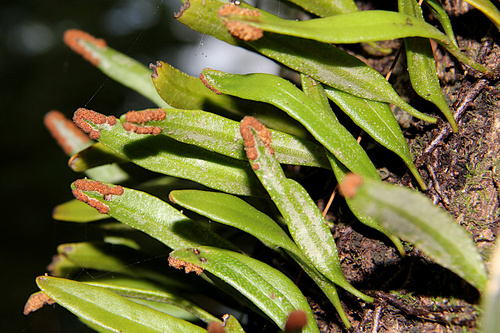
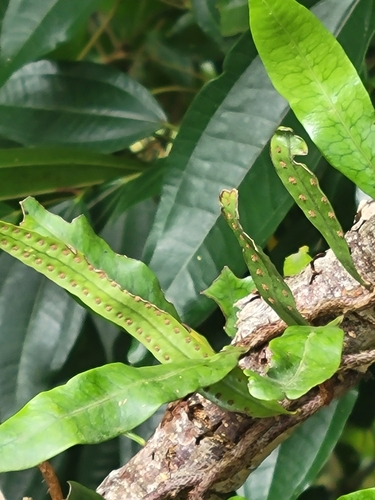
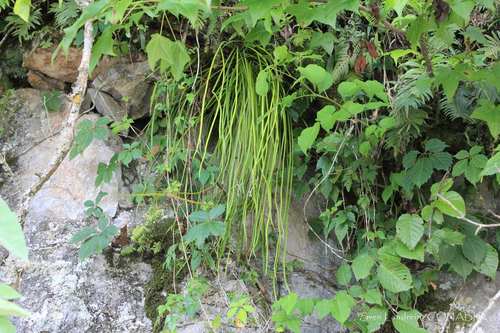
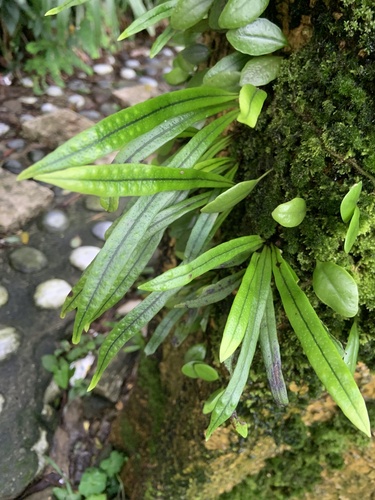
Lepisorus thunbergianus (Kaulf.) Ching is an epiphytic fern that grows in clusters. Its clusters hold 8 to 20 cm tall fronds that point upward, spaced 0.5 to 2 cm apart, and the plant anchors itself to mossy trees, rocks, or similar substrates via creeping rhizomes. The rhizomes measure 1.5 to 2.5 mm in diameter; young rhizomes are covered in dense, brown, lanceolate scales, while mature plants lose these scales. Unlike fiddlehead-forming fern species such as bracken, the fronds of Lepisorus thunbergianus are simple and undivided. Each frond is nearly linear, slightly lanceolate, with its widest point located one-third of the way from the base. Frond color ranges from yellowish-green or brownish-green to solid green, and the stalk (stipe) is straw-colored. A distinct central midrib vein is visible running through the center of the frond, but other veins are not noticeable beneath the leathery leaf surface. Round to oval dark brown sori, 1.5 to 3 mm in diameter, develop on the upper half of the frond. Lepisorus thunbergianus occurs across mainland Eurasia, specifically in Bhutan, China, northeastern India, Korea, Laos, Myanmar, Nepal, Pakistan, and Vietnam. It is also found in several Asian and Pacific island locations: Hawaii, Japan, the Kuril Islands, the Ryukyu Islands, the Philippines, and Taiwan. This species grows as an epiphyte, primarily on trees, and sometimes grows on rocks or human-made structures including rock walls, shrines, and the undersides of thatched roof eaves. It grows mainly in temperate regions within its range, and can be found from sea level up to 2000 m elevation. Lepisorus thunbergianus is a host plant for the leaf-miner fly Chromatomyia masumiae; the fly's larvae live inside the fronds, eating the leaf tissue from within and creating tunnels. Lepisorus thunbergianus has been used in Korean folk medicine. It has also been suggested as a natural long-term monitor for airborne mercury pollution, as past mercury levels are accurately recorded in its leaves.