About Lepiota ignivolvata Bousset & Joss. ex Joss.
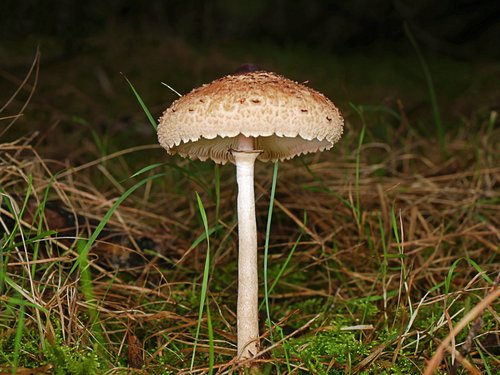
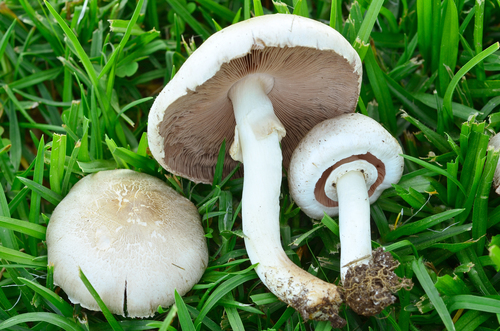
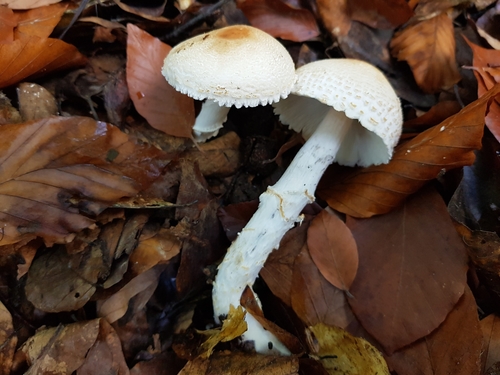
The cap of Lepiota ignivolvata ranges from 4 to 10 centimetres (1.6 to 3.9 inches) in diameter. It starts convex, becomes flat with age, and has a raised central umbo. The cap center is reddish brown or orange-brown, and breaks into small scales that become fewer and lighter closer to the cap margin. The clearest identifying feature is an orange, somewhat indented ring positioned low on the stem. The stem itself is white, slightly bulbous to club-shaped, and often has an orange flush at its base. The gills are white to cream, leave a white spore print, are not attached to the stem, and are fairly crowded. The flesh is uniformly white, with an unpleasant chemical odor similar to that of cut metal, which has also been compared to the smell of rubber. This species has an unpleasant, rancid taste. Its spores are fusiform (spindle-shaped) or amygdaloid (almond-shaped), with dimensions of 9–13 by 5–7 micrometres. Similar species Lepiota ventriosospora and Lepiota cristata do not have orange colouring on their rings. Lepiota ignivolvata belongs to the section Fusisporae within the genus Lepiota; this section's members are defined by long spindle-shaped spores and a fluffy stem below the ring. Lepiota ignivolvata has a widespread distribution across Europe, with its largest populations found in central to southern Europe. It is rare in Britain, where it appears on the British Red Data list. It grows in deciduous and coniferous woods in autumn, and appears to prefer beech woodland.