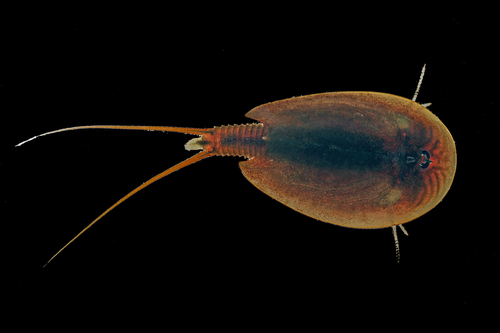
About Lepidurus apus (Linnaeus, 1758)
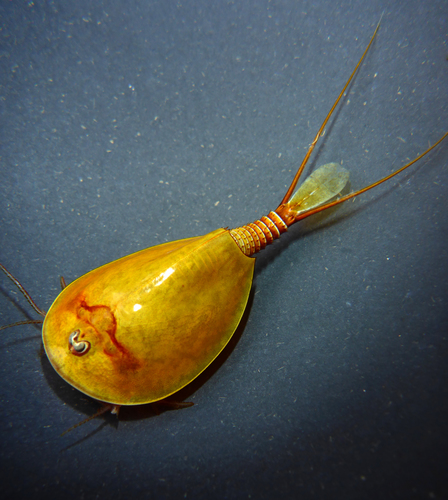
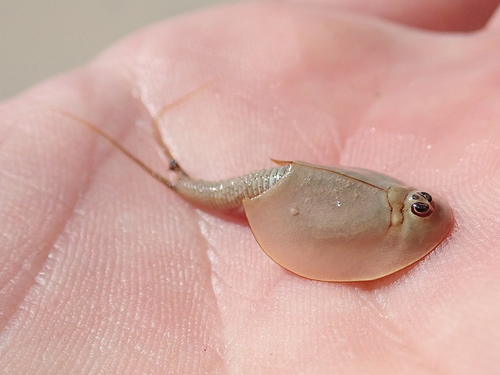
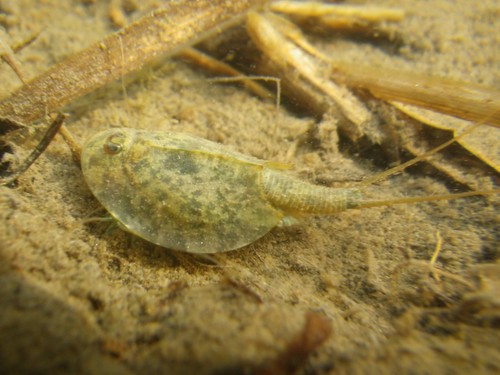
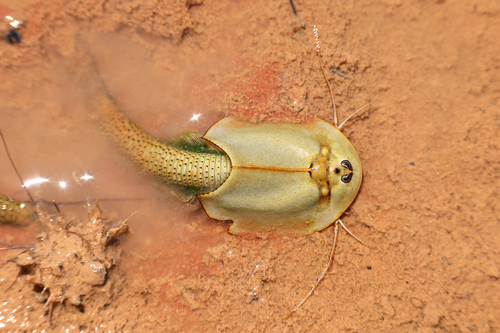
Lepidurus apus (Linnaeus, 1758) reaches an adult length of 4.2–6.0 cm (1.7–2.4 in). Its long abdomen is divided into approximately 30 segment-shaped rings, and two long caudal rami, commonly called "tails", attach behind the final ring. A small projection located between these two tails is the feature that distinguishes the genus Lepidurus from Triops, the other notostracan genus. The species has a flat carapace with an average length of 1.9 cm (0.75 in); it is only attached at its front edge, and covers up to two thirds of the animal's abdomen. The carapace has a mottled dark yellow-brown color that fades to a lighter shade along its edge, and it bears a single pair of compound eyes. One to three pairs of feelers are located at the front of the abdomen. Under the body, there are 41–46 paddle-like swimming limbs, with an average count of 44 pairs. Males can be easily recognized by their lack of ovisacs, and also have slight differences in the shape of the carapace. Females and hermaphrodites appear almost identical, but hermaphrodites have testicular lobes mixed among their ovarian lobes, which lets them reproduce without a partner. L. apus is often called a "living fossil", as it has remained almost unchanged for more than 300 million years. However, a recent study proposes that the similarity between modern L. apus and fossil notostracans is likely caused by highly conserved general morphology across this group, as well as homoplasy. While modern Lepidurus species are nearly morphologically identical to fossil specimens, they may belong to very different evolutionary lineages. Lepidurus apus is likely the most widespread cosmopolitan species among all Notostraca, and occurs across much of the world. Confirmed locations include New Zealand, Australia, Iran, Israel, France, Germany, Italy, Denmark, and Austria, and the species is also found elsewhere beyond these locations. The species is divided into multiple geographically separated subspecies: one example is L. apus viridis, which lives in parts of Australia, Tasmania, and New Zealand. L. apus occurs most often in temporary freshwater ponds that are 10–100 cm deep, fill during autumn and winter, and dry out completely over spring and summer. It is far less common in permanent water bodies including swamps and ditches. For example, L. apus viridis is found across New Zealand in small ponds and ditches. The species' life cycle lets it enter dormancy when its habitat freezes over, becomes covered in snow, or dries out. It can persist as a dormant cyst in the dry sediment at pond margins for many years, until water returns to the habitat. L. apus prefers water with a pH between 6 and 7.8, and can tolerate relatively high chemical concentrations: it survives at total nitrate levels of 1 mg/L and phosphate levels of 0.1 mg/L, concentrations that would harm many other aquatic species. Worldwide, wetlands and temporary ponds are increasingly converted to agricultural grassland, so the total area of suitable habitat for L. apus is slowly shrinking. Some subspecies may already be threatened, or could become threatened in the future, though current data on their conservation status is limited. Across its entire wide range, L. apus appears less sensitive to human disturbance than many species, due to its broad adaptations to different climates and locations, high dispersal ability, and highly resilient dormant eggs. L. apus has an unusual life cycle: it produces microscopic dormant cysts that can remain inactive for years through extreme environmental conditions, allowing the species to survive in habitats with highly variable climates ranging from Morocco to Denmark. These resting cysts, also called resting eggs, are extremely drought resistant; one recorded case saw cysts hatch successfully after 28 years of dry storage. This species includes hermaphroditic individuals. The New Zealand subspecies L. apus viridis has no males at all, while populations in Italy have non-functional males. Different subspecies of L. apus use different fertilization methods: some rely on males, while fertilization is carried out by hermaphroditic individuals in others. Dormant cysts average 0.447 mm in diameter, and have been recorded at concentrations of 250 cysts per 100 cm² of sediment. Cysts are laid on gravel in the center of ponds or ditches; researchers speculate this placement avoids having large animals like sheep carry cysts out of the water onto land. Cysts can survive drought and sub-zero temperatures, and are even able to synthesise haemoglobin when oxygen levels are low. When a pond dries out in summer, cysts remain dormant until they are submerged again in water. Light is a key requirement for hatching: experiments found no cysts hatched in complete darkness, some hatched after 10 minutes of bright light, and all tested cysts hatched when kept under continuous light. Hatching occurs between 10 °C and 24 °C, with the optimal range between 16 °C and 20 °C. Even in optimal conditions, total hatch rates never exceeded 60%. Hatching most often occurs after winter rainfall refills temporary ponds. Larvae feed and grow quickly to sexual maturity, reaching adulthood in as little as 4 weeks when conditions are optimal during the warmer spring and summer months. L. apus has been found in globally remote areas with no connecting waterways to carry individual animals. In dry conditions, the tiny dust-like resting eggs are easily carried and dispersed by wind. L. apus eggs are also believed to be dispersed by moving water, human activity, wild animals, and migratory birds.