About Lepidotrigla papilio (Cuvier, 1829)
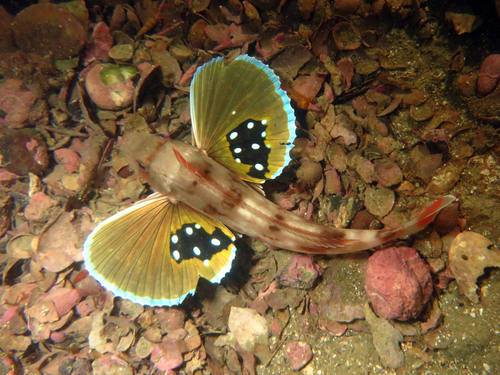
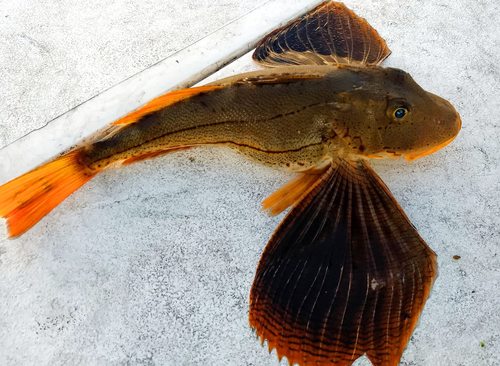
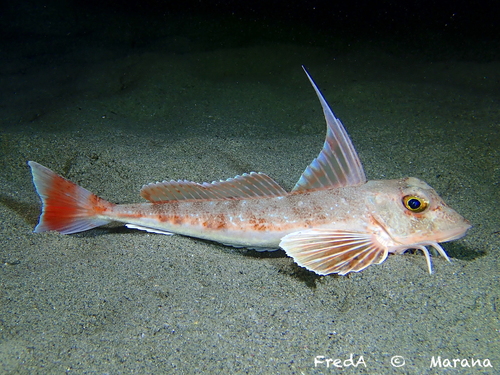
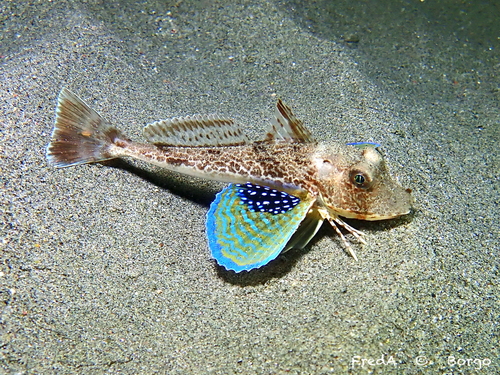
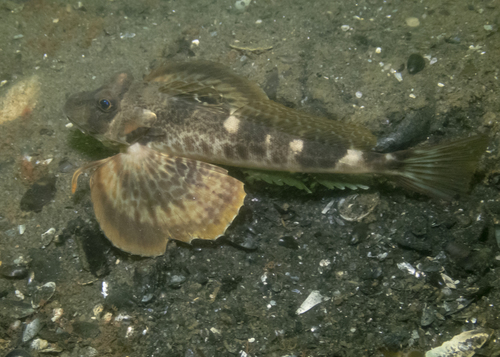
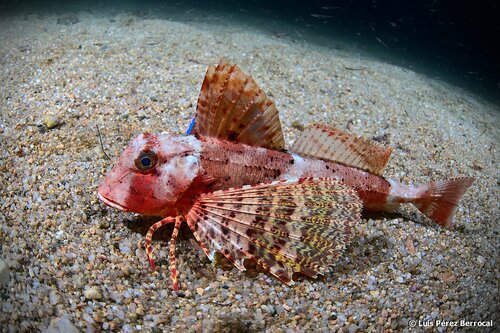
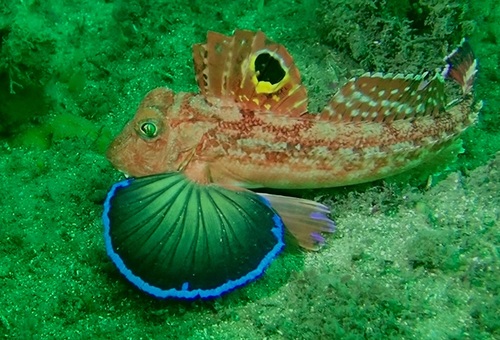
Lepidotrigla papilio has a large bony head. The margin of its snout is nearly smooth, and the snout's lateral profile is very slightly concave. The area between the eyes is very flattened, and a deep groove runs above and behind the eye, joining at the top of the head. The bony snout has a small medial notch, with tiny marginal spines along both edges of the notch. This species has firmly attached ctenoid scales, which are absent from the breast and belly. Its lateral line scales are notably enlarged, and each of these scales bears a number of distinct spines. The rear margin of the caudal fin is truncate, and the tip of the pectoral fin extends past the origin of the anal fin. The first dorsal fin has 8 or 9 spines, while the second dorsal fin and the anal fin each have 15 or 16 soft rays. There are 14 total pectoral fin rays: 11 are enclosed within the fin membrane, and the 3 lower pectoral fin rays are detached from the membrane and enlarged. The body is typically red overall, with reddish brown to dark brown mottling on the dorsal body and dorsal fins, and a whitish ventral side. The roof of the mouth is mostly orange. There is a large black spot with white margins on the first dorsal fin. The caudal fin is brownish, with a whitish band at its base. The inner surface of the pectoral fins is dark green, edged with a thin blue band; in small juveniles, this pattern resembles an eyespot. The maximum published total length for this species is 20 cm (7.9 in).
Lepidotrigla papilio is endemic to Australia, where it occurs in the southeastern Indian Ocean and southwestern Pacific Ocean. It inhabits the temperate seas of southern Australia, ranging from central New South Wales to south-western Western Australia, including Tasmania. It lives on shelly and sandy substrates in bays and coastal waters, at depths between 2 m and 110 m. It is most commonly found at depths of less than 50 m, and juveniles are occasionally found in seagrass beds.