About Lepidonotus squamatus (Linnaeus, 1758)
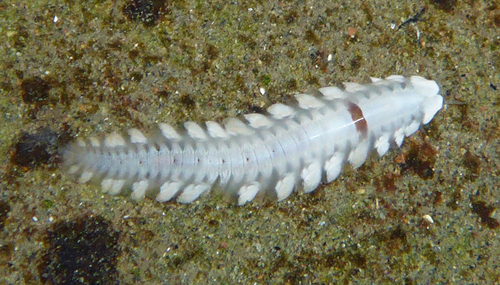
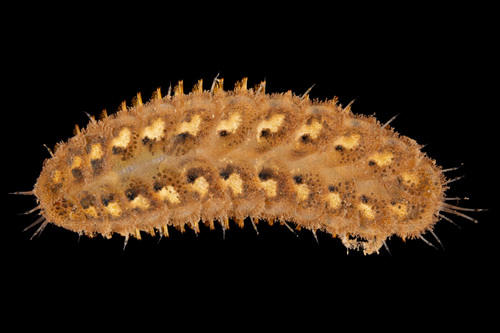
This species of scale worm has the scientific name Lepidonotus squamatus. Its prostomium is divided into two lobes, and it bears several pairs of antennae, one pair of palps, and two pairs of eyes. Its uniformly wide body has a dorsal surface that is completely covered by two rows of overlapping scales, which look similar to fish scales. These scales are modified cirri, supported on short stalks, covered in tubercles of varying sizes, and edged with a fringe of papillae. This worm has 26 body segments, and reaches an adult length of around 5 cm (2 in). Its body color ranges through grey, drab brown, or yellow, and individuals are often covered in mud. Lepidonotus squamatus is distributed across Western Europe, including the North Sea, the Skagerrak, the Kattegat, the Öresund Strait, and the western Baltic Sea. It can also be found along the eastern coast of North America from Labrador south to New Jersey, and along the western coast of North America from Alaska to California. It inhabits the littoral and sublittoral zones, at depths ranging down to approximately 2,700 m (8,900 ft), and is typically found under stones or among tangled marine growth. Like other scale worms, Lepidonotus squamatus fills an ecological role on the seabed comparable to that of terrestrial isopods such as pill bugs and woodlice on land. It is a carnivorous species, feeding on crabs, starfish, gastropod molluscs, and any other small invertebrates it encounters. The scales of L. squamatus produce a faint bioluminescent glow, which acts as a defensive adaptation. If a predator eats the worm, some of its scales are likely to stick to the predator's mouthparts, making the predator more visible and alerting its own predators to its location.