About Lepidocolaptes angustirostris (Vieillot, 1818)
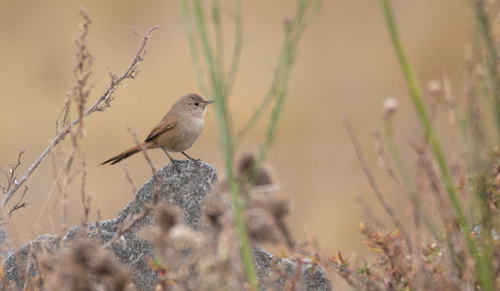
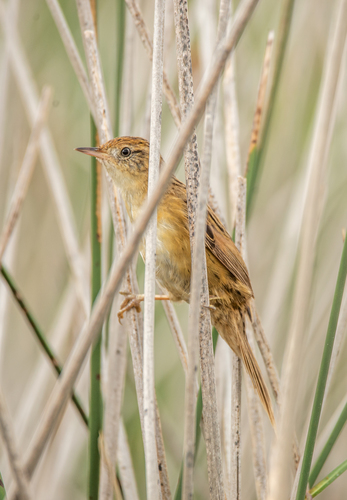
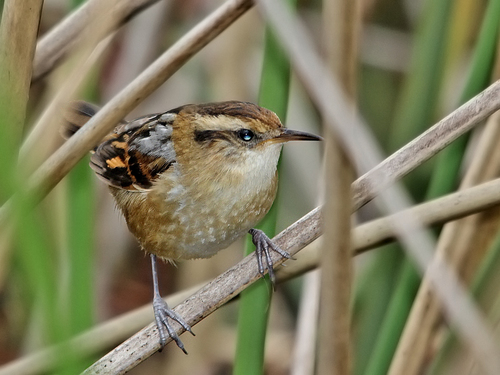
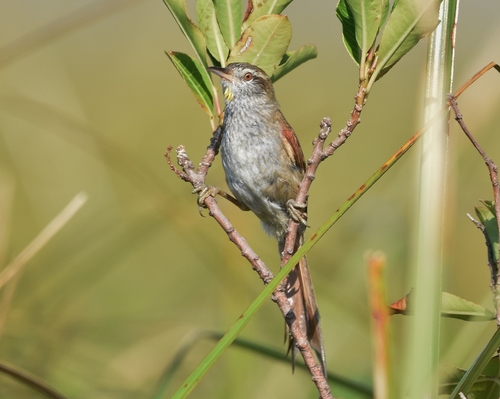
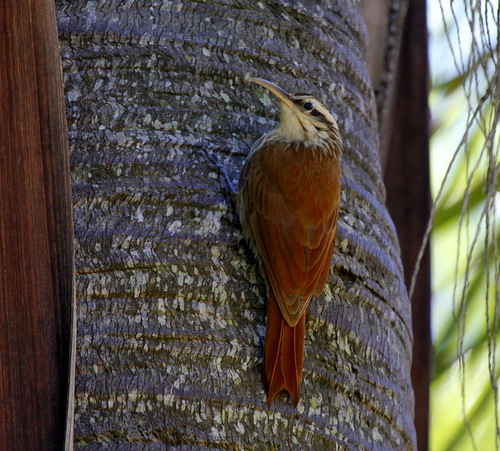
The narrow-billed woodcreeper (Lepidocolaptes angustirostris) measures 18 to 22 cm (7.1 to 8.7 in) in length. Males weigh 23 to 37.5 g (0.81 to 1.3 oz), while females weigh 21.5 to 33.5 g (0.76 to 1.2 oz). It is a slim, medium-sized woodcreeper with a long, slim, moderately decurved bill. The sexes share identical plumage. For adults of the nominate subspecies L. a. angustirostris, lores are pale, a buffy white supercilium widens toward the rear and becomes a line of broken spots, and a black stripe runs behind the eye. Crown and nape are blackish brown with whitish buff streaks. Back and wing coverts are rufous brown with a faint olive tinge; some coverts have dusky outer webs, and others are olive. Wings, rump, and tail are rufous-chestnut, with browner outer webs and blackish tips on the primaries. Throat and cheeks are plain whitish. Breast and belly are buffy-white with dusky spots or streaks; these markings disappear on the lower belly and reappear on the undertail coverts. Underwing coverts are rosy-cinnamon. The iris is brown to chestnut, the bill is pale gray to pinkish horn with dusky sides on the base of the mandible, and legs and feet are greenish gray to dark gray. Juveniles have darker upperparts than adults, a more blackish head, a more ochraceous supercilium and underparts, and more distinct streaks on the underparts. Subspecies of the narrow-billed woodcreeper differ mainly in the color tone of their upper- and underparts, and in the amount of streaking they have. Their differences from the nominate subspecies and each other are as follows: L. a. praedatus is larger and longer-billed than the nominate, has more olive-brown and less rufous upperparts, and heavier darker underparts streaking. L. a. certhiolus has lighter, more cinnamon-rufous to ferruginous upperparts than the nominate. L. a. bivittatus has more rufescent upperparts than the nominate, and creamy to dirty grayish white underparts with indistinct streaks. L. a. hellmayri has deeper rufous upperparts and more conspicuous streaks than L. a. bivittatus. L. a. coronatus has more rufescent upperparts than the nominate, deeper buff underparts than L. a. bivittatus, and minimally streaked undertail coverts. L. a. bahiae has more rufescent upperparts than the nominate, and deep cinnamon to ochraceous underparts. L. a. griseiceps is the palest subspecies, but still has more rufescent upperparts than the nominate, and unstreaked creamy white underparts. The subspecies of the narrow-billed woodcreeper have the following distributions. The boundaries between some subspecies are poorly defined, especially that between L. a. angustirostris and L. a. praedatus. L. a. griseiceps occurs in the Sipaliwini Savanna in southern Suriname, and possibly in Amapá, Pará, and northern Brazil. L. a. coronatus is found in northeastern Brazil, from Maranhão and Piauí south to Tocantins and Bahia. L. a. bahiae occurs in Brazil in Bahia east of the Rio São Francisco; populations north of the river from Ceará to Alagoas are thought to belong to this subspecies. L. a. bivittatus is found in central and southeastern Brazil from Mato Grosso to São Paulo, in Pará south of the Amazon River, and in northern and eastern Bolivia. L. a. hellmayri occurs in the Cochabamba, Santa Cruz, and Tarija departments in central Bolivia. L. a. certhiolus is found in Bolivia from southwestern Santa Cruz to Tarija, Alto Paraguay Department in western Paraguay, and the Jujuy and Salta provinces in northwestern Argentina. L. a. angustirostris occurs in Mato Grosso do Sul in southern Brazil and eastern Paraguay. L. a. praedatus is found in north and central Argentina south to Mendoza, La Pampa, and Buenos Aires provinces; western and central Uruguay; and Rio Grande do Sul in Brazil. The narrow-billed woodcreeper inhabits a range of semi-open and open landscapes, mostly within the tropical zone, but reaches the subtropics in the eastern Andean foothills. Habitats it uses include deciduous forest, Gran Chaco woodlands and scrublands, gallery forest, secondary forest, caatinga, cerrado, plantations, and open areas of populated regions. It occurs less often in palm swamps. Across most of its range it is found from lowlands up to 1,200 m (3,900 ft); it reaches as high as 3,000 m (9,800 ft) in Bolivia.