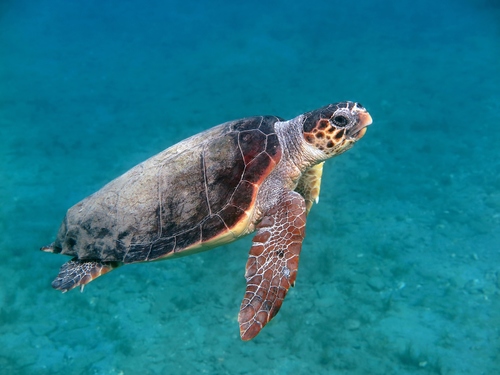
About Lepidochelys olivacea (Eschscholtz, 1829)
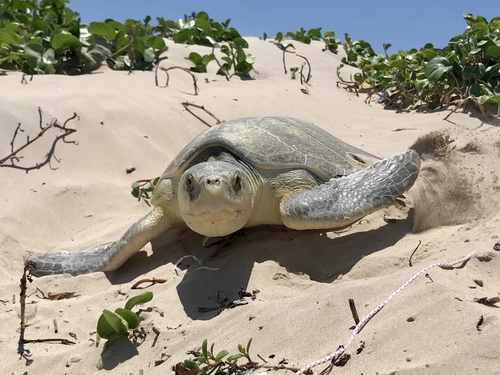
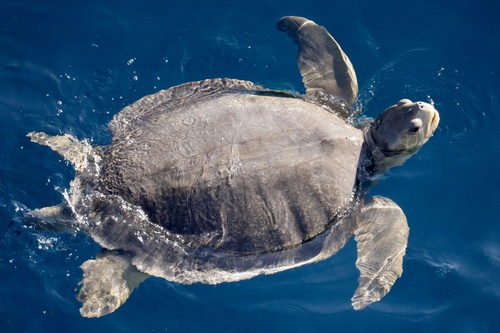
Description: The olive ridley sea turtle, Lepidochelys olivacea, reaches approximately 61 cm (2 ft) in curved carapace length. It gets its common name from its olive-colored, heart-shaped, rounded carapace. Males and females grow to the same overall size, though females have a slightly more rounded carapace than males. The heart-shaped carapace has four pairs of pore-bearing inframarginal scutes on the bridge, two pairs of prefrontals, and up to nine lateral scutes per side. L. olivacea is unique because it can have variable and asymmetrical lateral scute counts, ranging from five to nine plates on each side, with six to eight being the most common. Each side of the carapace has 12–14 marginal scutes. The carapace is flattened on the dorsal side and is highest anterior to the bridge. This turtle has a medium-sized, broad head that appears triangular when viewed from above. The concave sides of the head are most visible on the upper part of the short snout. It has paddle-like fore limbs, each with two anterior claws. The turtle's upper parts range from grayish-green to olive in color, but sometimes appear reddish when algae grow on the carapace. The bridge and hingeless plastron of an adult changes color from greenish white in younger individuals to creamy yellow in older specimens. The maximum recorded age for this species is up to 50 years. Hatchlings are dark gray with a pale yolk scar, but appear entirely black when wet. Hatchling carapace length ranges from 37 to 50 mm (1.5 to 2.0 in). A thin white line borders the carapace, as well as the trailing edge of both the fore and hind flippers. Both hatchlings and juveniles have serrated posterior marginal scutes, which become smooth as the turtle ages. Juveniles also have three dorsal keels; the central longitudinal keel gives younger turtles a serrated profile that remains until they reach sexual maturity. The olive ridley sea turtle rarely weighs over 50 kg (110 lb). For adults studied in Oaxaca, Mexico, weights ranged from 25 to 46 kg (55 to 101 lb); adult females had an average weight of 35.45 kg (78.2 lb) from a sample of 58 individuals, while adult males weighed significantly less, averaging 33.00 kg (72.75 lb) from a sample of 17 individuals. Hatchlings usually weigh between 12.0 and 23.3 g (0.42 and 0.82 oz). Adults are sexually dimorphic. Mature males have a longer and thicker tail, which is used for copulation. Males also have enlarged and hooked claws on their front flippers that allow them to grasp the female's carapace during copulation. Males also have a longer, more tapered carapace, while females have a rounded, dome-like carapace. Males also have a more concave plastron, which is thought to be another adaptation for mating. The male's plastron may also be softer than the female's plastron. Distribution: The olive ridley turtle has a circumtropical distribution, living in tropical and warm waters of the Pacific and Indian Oceans from India, Arabia, Japan, and Micronesia south to southern Africa, Australia, and New Zealand. In the Atlantic Ocean, it has been observed off the western coast of Africa and the coasts of northern Brazil, Suriname, Guyana, French Guiana, and Venezuela. Additionally, the olive ridley has been recorded in the Caribbean Sea as far north as Puerto Rico. A female was found alive on an Irish Sea beach on the Isle of Anglesey, Wales, in November 2016, marking the northernmost recorded appearance of this species. It was taken to the nearby Anglesey Sea Zoo for health assessment. A juvenile female was found off the coast of Sussex in 2020. The olive ridley is also found in the eastern Pacific Ocean from the Galápagos Islands and Chile north to the Gulf of California, and along the Pacific coast to at least Oregon. Migratory movements have been studied less intensely in olive ridleys than other marine turtle species, but they are believed to use the coastal waters of over 80 countries. Historically, this species has been widely regarded as the most abundant sea turtle in the world. More than one million olive ridleys were commercially harvested off the coasts of Mexico in 1968 alone. The population of Pacific Mexico was estimated to be at least 10 million prior to the era of mass exploitation. More recently, the global population of annual nesting females had been reduced to about two million by 2004, and was further reduced to 852,550 by 2008. This indicates a dramatic decrease of 28–32% in the global population within only one generation, equal to approximately 20 years. Olive ridley sea turtles remain the most abundant sea turtle, but globally they have declined by more than 30% from historic levels. These turtles are considered endangered because they have very few remaining nesting sites around the world. Eastern Pacific turtles have been found to range from Baja California, Mexico, to Chile. Pacific olive ridleys nest around Costa Rica, Mexico, Nicaragua, and the northern Indian Ocean; the breeding colony in Mexico was listed as endangered in the United States on July 28, 1978. Habitat: Most observations of this species are typically within 15 km (9.3 mi) of mainland shores in protected, relatively shallow marine waters 22–55 m deep. Olive ridleys are occasionally found in open waters. The multiple habitats and geographical locations used by this species vary throughout its lifecycle. Reproduction: Mating is often assumed to occur in the vicinity of nesting beaches, but copulating pairs have been reported over 1,000 km from the nearest beach. Research from Costa Rica found that the number of copulating pairs observed near the beach could not fertilize the tens of thousands of gravid females in the area, so a significant amount of mating is believed to occur elsewhere at other times of the year. Gahirmatha Beach in Kendrapara district of Odisha, India, which is now part of Bhitarkanika Wildlife Sanctuary, is the largest breeding ground for these turtles. Gahirmatha Marine Wildlife Sanctuary, which borders Bhitarkanika Wildlife Sanctuary to the east, was created in September 1997, and includes Gahirmatha Beach and an adjacent portion of the Bay of Bengal. Bhitarkanika mangroves were designated a Ramsar Wetland of International Importance in 2002. It is the world's largest known rookery of olive ridley sea turtles. Apart from the Gahirmatha rookery, two other mass nesting beaches have been located at the mouths of the Rushikulya and Devi rivers. The spectacular mass congregation of olive ridley sea turtles for mating and nesting attracts both scientists and nature lovers from around the world. Olive ridley sea turtles migrate in huge numbers starting in November every year to mate and nest along the coast of Odisha. Gahirmatha coast sees between 100,000 and 500,000 nesting individuals each year. A population decline has occurred in recent decades due to mass mortality. The olive ridley sea turtle has been listed on Schedule – I of the Indian Wildlife (Protection) Act, 1972 (amended 1991). The species is listed as vulnerable under the IUCN Red List. These sea turtles are protected under the Convention on Migratory Species and the Convention on International Trade in Endangered Species of Wild Fauna and Flora (CITES). India is a signatory to all of these conventions. The homing characteristics of ridley sea turtles make them more prone to mass casualty. The voyage to their natal nesting beaches is the primary threatening factor for this species. Since Gahirmatha coast serves as the natal nesting beach for millions of turtles, it has immense importance for olive ridley conservation. Olive ridleys generally begin to aggregate near nesting beaches about two months before nesting season, although this timing can vary across their range. In the eastern Pacific, nesting occurs throughout the year, with peak mass nesting events called arribadas occurring between September and December. Nesting beaches are typically relatively flat, located in the midbeach zone, and free of debris. Beach fidelity is common but not absolute. Nesting events are usually nocturnal, but diurnal nesting has been reported, especially during large arribadas. The exact age of sexual maturity is unknown, but it can be partially inferred from data on minimum breeding size. For example, the average carapace length of nesting females from a sample of 251 individuals at Playa Nancite, Costa Rica, was determined to be 63.3 cm (24.9 in), with the smallest recorded individual at 54.0 cm (21.3 in). Females can lay up to three clutches per season, but most only lay one or two clutches. The female remains near shore during the internesting period, which lasts about one month. Mean clutch size varies across the species' range and decreases with each successive nesting attempt. A mean clutch size of 116 eggs with a range of 30–168 eggs was observed in Suriname, while nesting females from the eastern Pacific had an average clutch size of 105 eggs with a range of 74–126 eggs. The incubation period is usually between 45 and 51 days under natural conditions, but may extend to 70 days in poor weather. Eggs incubated at temperatures of 31 to 32 °C (88 to 90 °F) produce only females; eggs incubated at 28 °C (82 °F) or lower produce only males; and incubation temperatures of 29 to 30 °C (84 to 86 °F) produce clutches with both sexes. Hatching success can vary by beach and year, due to changing environmental conditions and varying rates of nest predation.