About Lepidoblennius marmoratus (Macleay, 1878)
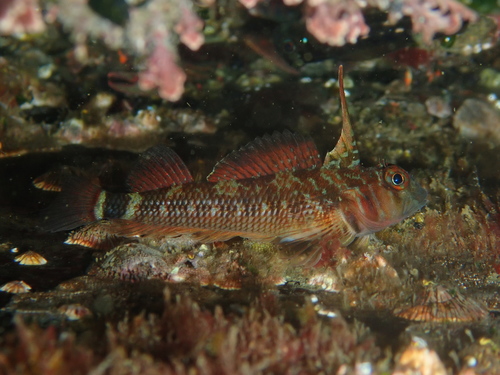
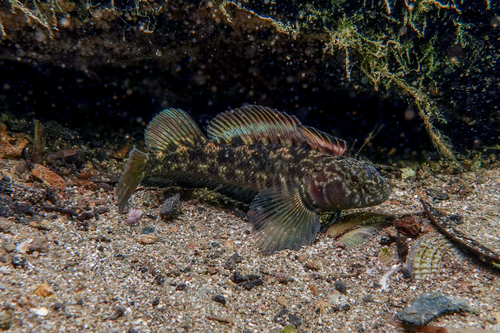
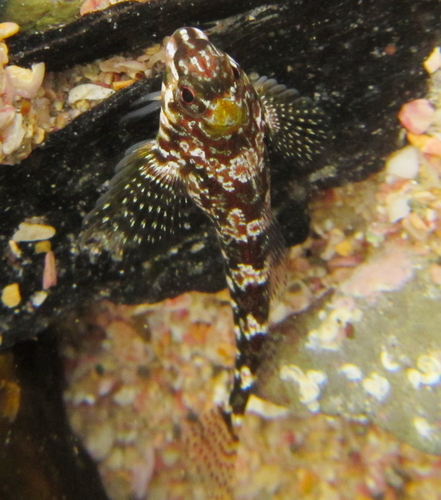
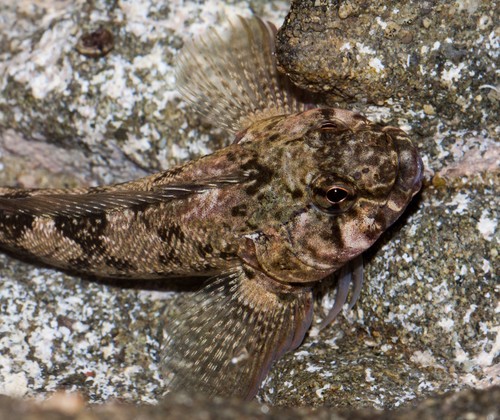
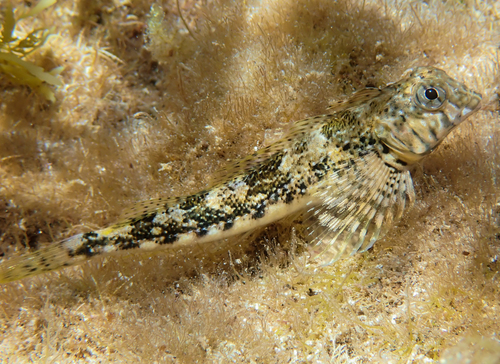
The western jumping blenny, scientific name Lepidoblennius marmoratus (Macleay, 1878), has a slightly compressed body, a steep snout, and a naked, scaleless head. Its body ranges in color from greyish to greenish-grey, and is paler on the underside. It has dark vertical lines on its head, lines of small dark spots on the dorsal, caudal, and pectoral fins, and irregular blotches along its flanks. This species reaches a maximum standard length of 11.4 centimetres, or 4.5 inches. It can be distinguished from the allopatric, congeneric eastern jumping blenny by two key features: a deep incision between the last spine of the first dorsal fin and the first spine of the second dorsal fin, and two spines in the anal fin, while the eastern jumping blenny has no anal fin spines. The western jumping blenny is endemic to Australia. It inhabits the west and south coasts, ranging from 32° south in Western Australia to Kangaroo Island off South Australia, with its northernmost recorded locality at the Swan River. This species lives in tidal pools, as well as rocky subtidal and intertidal areas, found specifically where rocks are covered in algae. It occurs at depths between 0 and 3 metres, or 0.0 and 9.8 feet. It is frequently found out of water, and can easily return to the water by flicking its tail.