About Lepidium heterophyllum Benth.
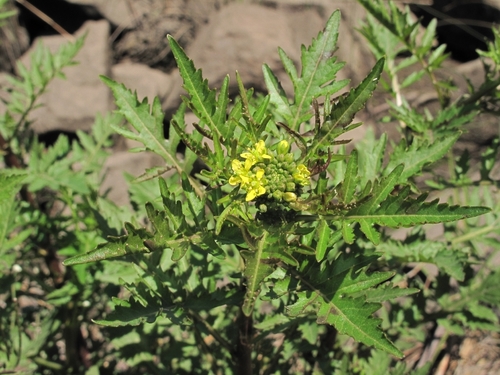
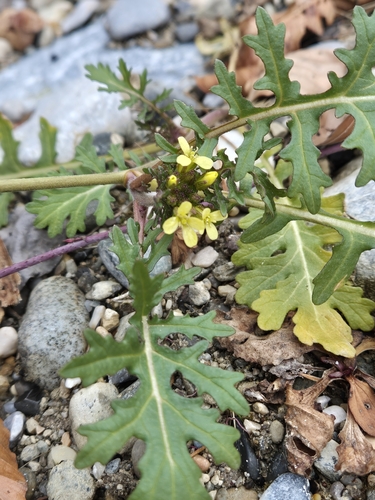
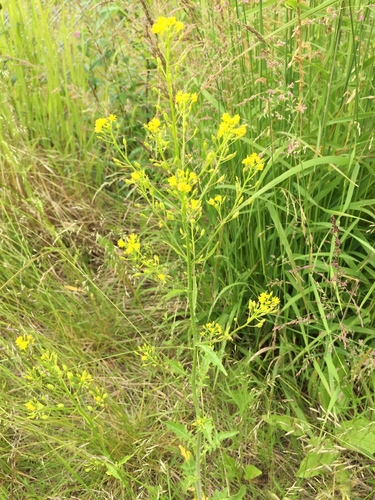
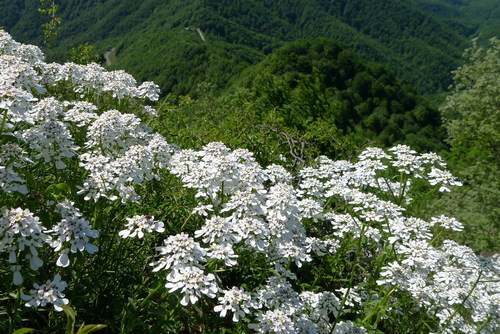
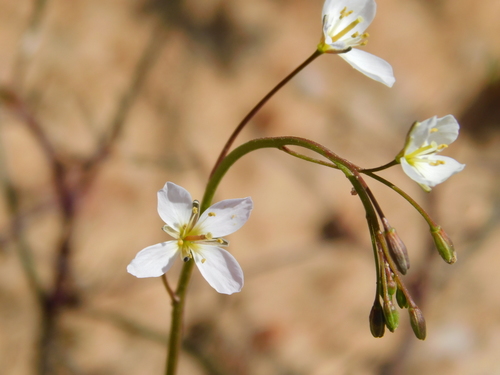
Lepidium heterophyllum Benth. is similar in form to the native species Lepidium campestre, and the two are often misidentified with each other in Belgium, especially at the early seedling stage. This is a perennial plant that grows between 10–90 cm (3.9–35.4 in) tall. Its hirsute (hairy) stems are often branched from the base. It has grey-green foliage, with narrowly triangular, variably toothed stem leaves that cling to the stem via long pointed auricles. Stem leaves can grow up to 50 mm long. The basal leaves differ: they have long stalks and are either strap-shaped or oblong-elliptic. They often have 1–3 pairs of small, broad-sided lobes, and fade quickly when the plant blooms, but can regrow as the plant sets seed. It blooms between May and August or May and September in the UK, and between May and July in the US. The very small flowers, measuring 2–3.6 mm (0.079–0.142 in) long, grow on short stalks held at right angles to the stem. The plant can produce several crowded, parallel-sided flower spikes. Its white, spatulate (spoon-shaped) petals are the same length as the oblong sepals, and it has 6 styles that have a notch. The flowers also have stamens with violet anthers. After flowering, the plant produces an oval, smooth fruit capsule with a distinctive beak at the top. Capsules measure 4.5–8.6 mm (0.18–0.34 in) long, and hold ovoid dark brown seeds inside. Lepidium heterophyllum is native to temperate areas of western Europe. It is found in Denmark, France, Germany, Ireland, the Netherlands, Portugal, Spain, and the United Kingdom within Europe. It is also widely naturalised in other parts of Europe including Belgium, the Czech Republic, Finland, Norway, and Sweden, as well as in Canada, Chile, and the United States. In North America, it has been recorded in British Columbia, Newfoundland and Labrador, California, Colorado, Maine, Massachusetts, New York, Oregon, Pennsylvania, and Washington. Records from Maine and Massachusetts come from old plant collections, and it is not confirmed whether the species has become established as part of the weedy flora in these states. In Belgium, it was first recorded in fallow fields between 1881 and 1884 in Egenhoven, then in 1886 near Bouillon. It was later observed in Stokt, in the Dutch province of Limburg, in the 19th century. More recently, in 2004 and 2005, it was recorded on gravelly riverbanks of the River Maas, which rises in France and flows through Belgium and the Netherlands to the North Sea. It grows in acidic soils, on hillsides, in shingle, on railway ballast and embankments, and occasionally in arable fields. It is normally found at altitudes of 0–425 m (0–1,394 ft) above sea level.