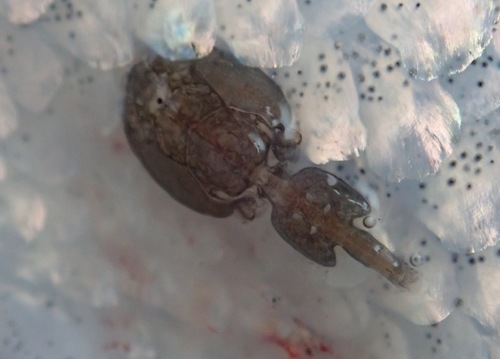
About Lepeophtheirus salmonis (Krøyer, 1837)
Description: The thorax of Lepeophtheirus salmonis is broad and shield-shaped. Its abdomen is narrower; in females, the abdomen holds eggs, and two long egg strings are attached to it. The salmon louse uses its feet to move across its host or swim between different hosts.
Life cycle: While most research on this species has focused on the problems it causes in aquaculture, little is known about its life history in natural environments. Salmon louse infections on fish farms can lead to epizootics in wild salmonid populations. When aquaculture producers place post-smolts into seawater, these post-smolts are typically free of ectoparasites, and can remain free of parasites for many months.
L. salmonis has a direct single-host life cycle that consists of eight distinct life stages separated by molts. The first two stages are planktonic nauplii, which cannot swim directionally against water currents, instead drifting passively, though they can adjust their depth within the water column. Nauplii are almost translucent and measure around 0.5–0.6 mm (0.020–0.024 in) long. At 5 °C (41 °F), the first nauplius stage lasts around 52 hours, and it lasts around 9 hours at 15 °C (59 °F). The second nauplius stage lasts 170 hours at 5 °C and 36 hours at 15 °F, respectively. Nauplii respond to changes in light and salinity. Low salinities impact the planktonic life stages more strongly than they impact the parasitic stages. Newly hatched larvae do not survive at salinities below 15‰, and development to the infective copepodid stage is poor between 20 and 25‰. Both nauplii and copepodids are positively phototactic, and perform daily vertical migration, moving higher in the water column during the day and sinking at night. Their ability to locate hosts does not depend on light. They respond to low-frequency water accelerations, like those created by a swimming fish. How the species successfully locates migratory hosts across the open ocean remains unsolved by scientists, though the species has done this effectively for thousands of years.
The third life stage is the copepodid stage, where individuals measure about 0.7 mm (0.028 in) long. This stage lasts 2 to 14 days depending on water temperature, and during this stage the salmon louse attaches itself to a host fish. The fourth and fifth stages are the chalimus stages. After these stages, the salmon louse becomes mobile, able to move across the surface of its host fish and swim in the water column. Stage four individuals grow to 1.1 mm (0.043 in) long, and stage five individuals grow to 2.3 mm (0.091 in) long. The first chalimus stage can last up to 10 days, and the second chalimus stage can last up to 15 days. The sixth and seventh stages make up the pre-adult phase. At 10 °C (50 °F), pre-adult stage I typically lasts 10 days for females and 8 days for males; pre-adult stage II typically lasts 12 days for females and 9 days for males. Pre-adult individuals range from 3.4 to 5.2 mm (0.13 to 0.20 in) in length, with a mean length of around 3.6 mm (0.14 in), and their genital complex is underdeveloped. After the two pre-adult stages comes the fully mature adult phase, following final molts into adult males and females. Adult females are larger than adult males: males measure 5–6 mm (0.20–0.24 in) long, while females measure 8–18 mm (0.31–0.71 in) long. Over their lifespan, adult females can produce 10 to 11 pairs of egg strings. At 7.2 °C (45.0 °F), the recorded mean number of eggs per egg string is 152 (±16), with a range of 123 to 183. The development to sexual maturity after attaching to a host fish depends on water temperature. Generation time, from egg to mature adult, ranges from 32 days at 15 °C (59 °F) to 106 days at 7.5 °C (45.5 °F). At lower temperatures, egg strings tend to be longer and have higher fecundity, but the full set of factors affecting egg production remains poorly understood. Overall, generation time is around 8–9 weeks at 6 °C (43 °F), 6 weeks at 9 °C (48 °F), and 4 weeks at 18 °C (64 °F). The lifespan of adult L. salmonis under natural conditions has not been confirmed, but in laboratory conditions, females have survived for up to 210 days.

