About Lepas testudinata Aurivillius, 1892
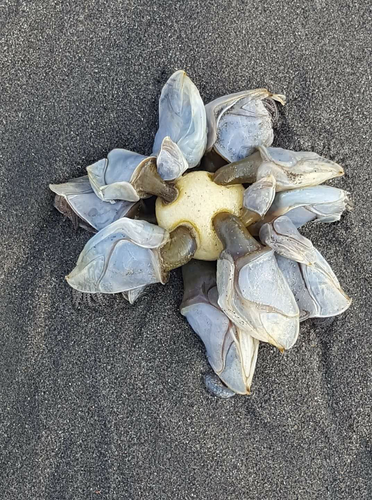
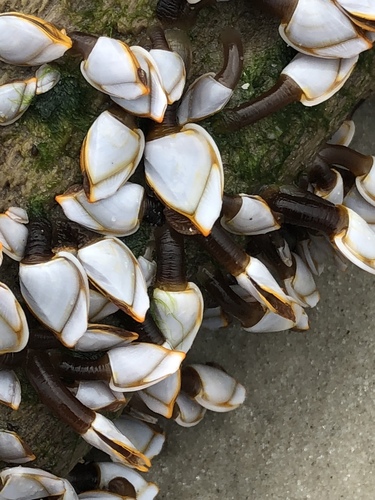
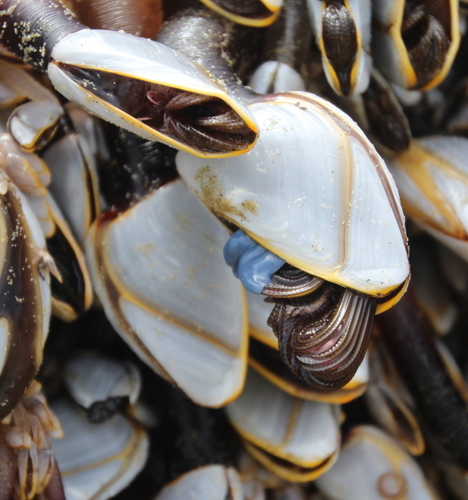
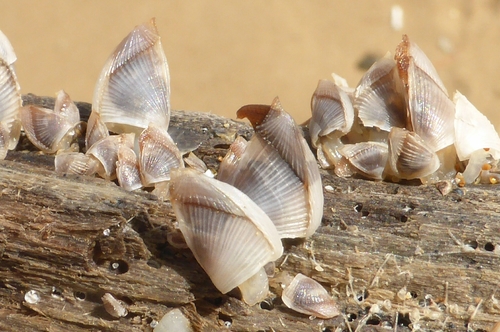
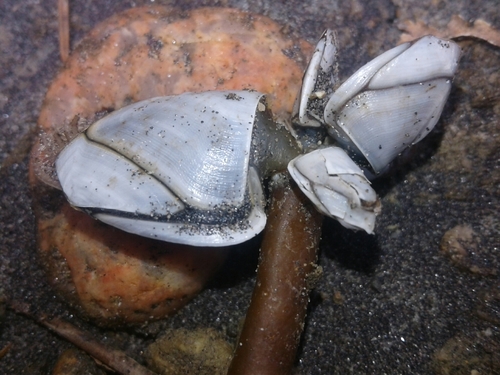
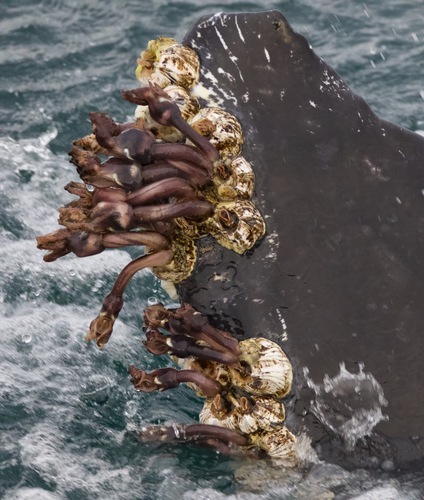
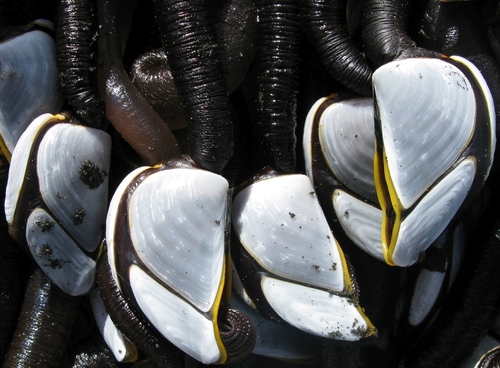
Lepas testudinata Aurivillius, 1892 is a planktonic filter-feeding barnacle. Its shell is made of two bivalved sections, each composed of five symmetrical calcite plates stacked on top of one another. This five-plate structure is characteristic of all species in the genus Lepas. L. testudinata has a distinct abdominal segment, and its adductor muscles are positioned in front of the head shield. Adult individuals can grow up to 5 centimetres (2.0 in) in body size. A sensory organ called the frontal horn, made of glandular tissue, is located antero-laterally to the head shield. The species also has a photoreceptive naupliar eye inside the mantle cavity. It has a single, muscular peduncle (also called a stem or stalk) that extends from the shell to attach the barnacle to an object. The form of this stalk is largely dependent on the object the barnacle attaches to. When attached to kelp, the peduncle is smooth and can reach up to 25 centimetres (9.8 in) in length. Non-kelp attached forms, by contrast, have a short and spiny peduncle. It remains unclear whether these two phenotypes represent two separate lineages within the species, or a morphological adaptation that is not yet fully understood. In 2015, Philipp H. Schiffer and Hans-Georg Herbig hypothesized that the number of shell plates increased over the course of the species’ evolution. A 2012 study by Marcos Pérez-Losada and colleagues argued instead that the modern five-plate structure is the result of secondary loss, which is the evolutionary reversion to an ancestral physiology. The authors concluded that evolutionary pressures do not drive this species to develop thicker shells. Lepas testudinata is broadly distributed across the Southern hemisphere, with its range extending into parts of the Northern hemisphere, but it is restricted exclusively to pelagic, temperate waters. Specifically, it can be found throughout the China Seas, Australian Sea, and the Indo-West Pacific. The species was not recorded in China’s seas until the 1990s, and ongoing research aims to determine whether it was accidentally introduced to this region. Despite its wide range, L. testudinata is generally considered a rarely observed species, and it has not been evaluated by the IUCN. Mitochondrial data for L. testudinata shows there are two genetic subgroups within the species: one found in South African waters, and one found in Australian waters. While the exact relationship between these subgroups is not confirmed, Schiffer and Herbig proposed that the genetic divergence between these two groups arose because the species’ native range is discontinuous. The species cannot survive in Antarctic waters, so the Antarctic current system acts as a barrier that separates the South African and Australian subgroups. Analysis of the 18S gene places L. testudinata in an ingroup with L. anatifera, while analysis of the 28S sequence places it in an ingroup with L. australis. Due to extensive morphological similarities between these three species, they are considered very closely related, and their phylogenetic relationships remain the subject of ongoing study. Lepas testudinata is hermaphroditic, and the species shows no sexual dimorphism. It reproduces via broadcast spawning, where eggs are fertilized inside the barnacle’s mantle cavity. Eggs hatch into nauplii larvae, which go through six naupliar developmental stages. After these stages, larvae enter a non-feeding cyprid larval stage, also known as the settling stage. From here, they metamorphose into their final adult form. Like other cirripedia species, L. testudinata has a set of compound eyes before metamorphosis; these eyes are partially lost during metamorphosis, and continue to function in a reduced state through adulthood. Like other barnacle species, Lepas testudinata forms colonies on tidewrack, driftwood, and man-made objects. It does not attach to stationary objects, and exclusively prefers mobile, floating objects. This preference has allowed the species to become widespread across temperate oceans of the Southern Hemisphere. L. testudinata specifically prefers to colonize the kelp species Ecklonia maxima. The species regularly forms colonies of more than 1000 individuals, and tends to colonize plastic pollution when it is available. Its colonization of man-made objects is the main factor that has allowed the species to spread throughout the South African region. Off the coast of New Zealand, the sea slug Fiona pinnata preys on Lepas species barnacles, and L. testudinata is often found colonizing the kelp species Durvillaea antarctica. Alongside other Lepas barnacle species, Lepas testudinata presents a major risk of biofouling damage, because colonies can grow on man-made structures and cause damage. When L. testudinata colonies wash ashore, the species acts as a foundation species, and the colonies are consumed by scavengers. A 2021 study by Thomas Mesaglio and colleagues found that the presence of washed-up L. testudinata colonies on beaches triggers ecological succession that significantly increases species diversity in the local environment.