About Lepadogaster purpurea (Bonnaterre, 1788)
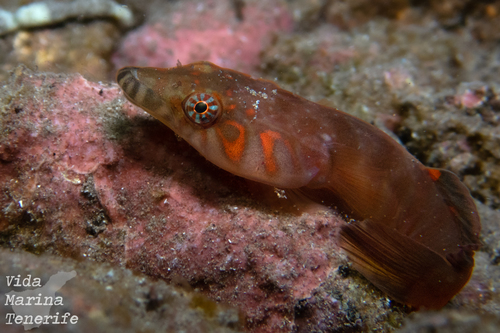
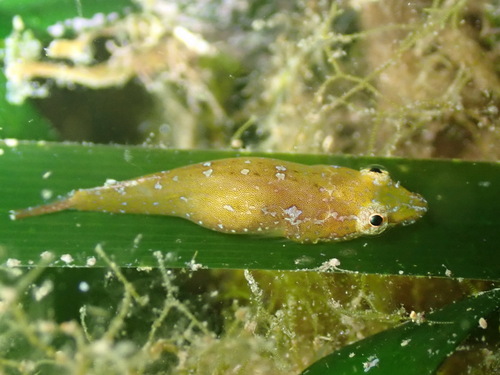
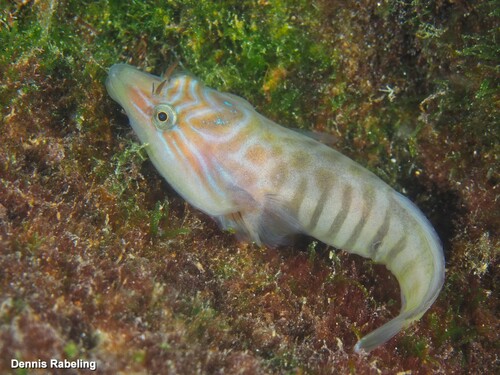
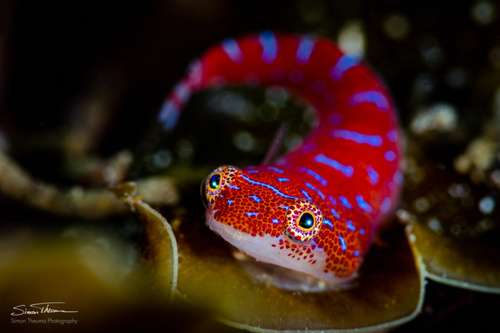
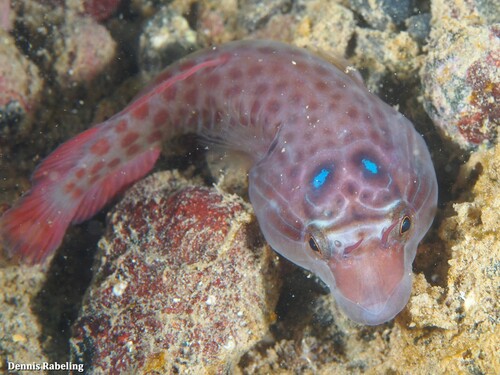
Lepadogaster purpurea has a distinct tadpole-like body shape: its body is small, while its head is large and flattened, with a large mouth shaped like a duck's bill. A single tentacle sits behind each of its nostrils. Its pelvic fins are fused, and together with surrounding tissue, these fins form a suction disc, or sucker. This species is variable in colour, and can alter its colouration to blend in with the substrate it clings to. Normally, it has a pale background body colour patterned with bars and spots, which range in shade from dark purple and reddish brown to green. There are two bright blue ocelli, or eyespots, on its nape; these are thought to be defensive, serving to confuse predators. Lepadogaster purpurea reaches a maximum standard length of 7.5 centimetres, or 3.0 inches. Lepadogaster purpurea is distributed in the eastern North Atlantic Ocean, ranging from the Shetland Islands southward to the Canary Islands and Dakar, Senegal. It also occurs in the western Mediterranean Sea, reaching as far east as Cap Roux, located near Cannes, France. This species inhabits rocky shorelines, from just above to just below the low water mark, down to a maximum depth of 9 metres, or 30 feet, where it hides underneath boulders. It spends long periods of time in shelters, and typically maintains one preferred shelter within its habitat. When Lepadogaster purpurea detects potential prey near its shelter, it waits until the prey moves closer, then swims out to capture the prey, and returns immediately to its shelter to eat it.