About Leotia lubrica (Scop.) Pers.
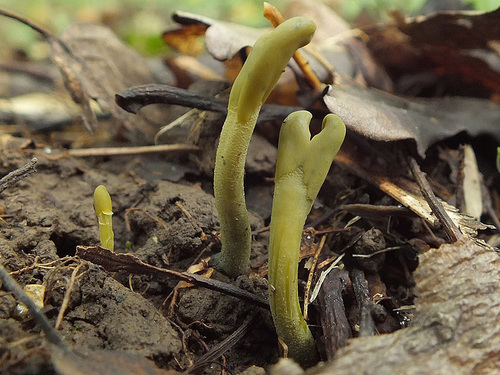
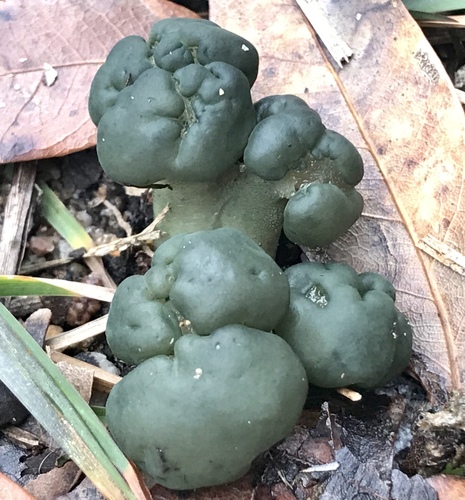
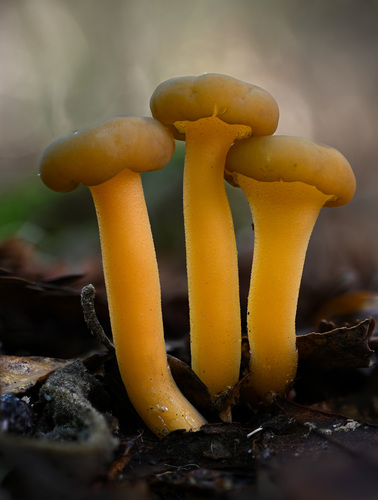
The fungus Leotia lubrica produces fruit bodies that grow between 1 and 6 centimetres (1⁄2 to 2+1⁄4 inches) in height. Youngest fruit bodies are conical in shape. Once the body reaches approximately 2 millimetres (1⁄16 in) in length, the tip of the cone begins expanding to form the head. At this stage, the hymenium becomes differentiated from the rest of the body, and the fruit bodies quickly reach their mature shape, only increasing in size after this point. Each fruit body has one fertile "head" 1–3 cm (1⁄2–1+1⁄4 in) across, coloured olive-greenish ochre and gelatinous. The surface of the head can feel smooth, clammy, or slimy. While the head is convex in overall shape, it is formed of irregular lobes and undulations, and its edge is rolled inward. The underside of the head is paler than the upper surface and smooth. The head attaches to a central stalk, which measures 2–8 cm (3⁄4–3+1⁄8 in) long and 3–10 mm (1⁄8–3⁄8 in) wide, and tapers to be thinner toward the growing substrate. The stalk is typically cylindrical, but may be flattened, and occasionally has furrows. Its colour is similar to that of the head, though more yellow, and its surface is covered in very small greenish granules. The flesh of the head is gelatinous, while the stalk is mostly hollow, but may be filled with gel. The fungus has no discernible smell or taste.
Fruit bodies are most commonly found from late summer to late autumn in Europe, and from late spring to autumn in North America, where it is the most common species in the genus Leotia. It has also been recorded in eastern Asia, specifically in China and Tibet, as well as in New Zealand and Australia. L. lubrica prefers damp deciduous woodland, but can also grow under conifers. Particularly favoured habitats include path sides and areas underneath bracken, and it grows on substrates including soil, moss, and plant waste. Fruit bodies typically grow in large groups, sometimes forming clumps, though solitary specimens are occasionally found. Multiple fruit bodies may be connected at their bases, or younger fruit bodies can grow out of the bases of older ones.
While L. lubrica has traditionally been classified as a saprotroph, molecular, isotopic, and other evidence suggests that it actually forms ectomycorrhizae. Its fruit bodies can be infected by the mould Hypomyces leotiarum, the asexual reproductive form of Hypomyces leotiicola.
Leotia lubrica fruit bodies have little culinary interest. Contrary to what its common name suggests, most field guides describe the species as inedible. Some reports note it is technically edible but tasteless. Mycologist Charles McIlvaine even considered it good to eat, while other writers describe it as bland. Fruit bodies of L. lubrica have been found to contain low levels of monomethylhydrazine, a toxic compound also linked to the poisonous false morel Gyromitra esculenta.