About Leontopodium nivale (Ten.) A.Huet ex Hand.-Mazz.
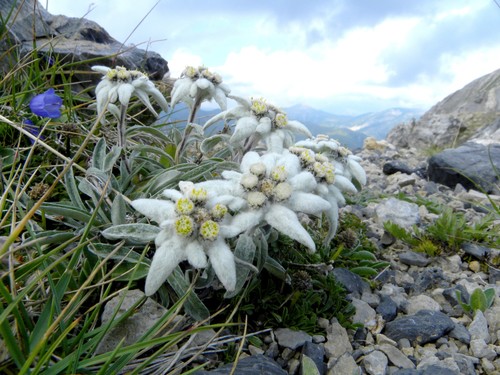
Leontopodium nivale, commonly known as edelweiss, has leaves and flowers covered in white hairs that give it a woolly, tomentose appearance. In the wild, its flowering stalks reach 3 to 20 centimetres (1 to 8 inches) tall, while cultivated plants can grow up to 40 cm (16 in) tall. Each bloom is made of 5 to 6 small yellow clustered spikelet-florets around 5 mm (3⁄16 in) wide, surrounded by fuzzy white bracts often mistaken for petals arranged in a double-star formation. Flowering occurs between July and September. This species prefers rocky limestone habitats in the Alps, Pyrenees Mountains, and Italian Apennines, at altitudes between roughly 1,800 and 3,400 metres (5,900 to 11,200 ft). Leontopodium nivale is native to European mountains, with a distribution centered on the Alps that extends west to the Pyrenees and east into parts of the Balkans and the Apennines. Its populations are usually restricted to exposed, calcareous (limestone and dolomite) scree and rocky cliffs, often on north-facing slopes where microclimate and soil conditions limit competition from taller vegetation. Modern taxonomic resources from World Flora Online and Kew map this species and its subspecies across central and southern European mountain ranges. While its typical elevation range is 1,800–3,400 m (roughly 6,000–11,000 ft), local populations may grow slightly outside this range depending on site exposure and substrate. The species is adapted to high UV radiation, strong winds, wide temperature fluctuations, and thin soils. The woolly hairs on its leaves and bracts reduce water loss and block or scatter harmful ultraviolet wavelengths. Leontopodium nivale is cultivated in gardens for its distinctive inflorescence and silver foliage, and growth begins at the end of May. It is a short-lived plant that can be grown from seed. In the 19th century, edelweiss became a symbol of the rugged purity of the Alpine region and its native inhabitants. Interest in the previously overlooked plant began in the mid-19th century, sparked by a well-documented 1856 incident: Austrian Emperor Franz Joseph I hiked to Pasterzen Glacier on Großglockner with his wife Empress Elisabeth (Sisi), where he picked an edelweiss for her from steep rock, saying "The first in my life that I picked myself". This public story drew widespread attention to the alpine plant, and it became known as a symbol of Empress Elisabeth. A 1865 portrait by painter Franz Xaver Winterhalter depicts Elisabeth with nine artificial edelweiss-shaped stars braided into her hair; these diamond-and-precious-metal hair ornaments were designed after 1850 by court and chamber jeweler Alexander Emanuel Köchert. As mountain tourism grew at the end of the 19th century, edelweiss became a badge and symbol for alpinists and mountaineers. To prevent extinction of the frequently picked symbolic species, it was granted legal nature protection early on. It was soon adopted as a symbol in the logos of many alpine clubs and associations. Especially in the Austro-Hungarian Army, the plant’s characteristics as a defiant, frugal, resilient alpine species were linked to the perseverance, agility, and cutting edge required of alpine troops; this connection was recognized, emphasized, and promoted through badges and unit designations. Emperor Franz Joseph designated Alpen-Edelweiss as an official badge for three mountain-focused Kaiserschützen regiments of the Austro-Hungarian Army, worn on the collar of the uniform. In Berthold Auerbach's 1861 novel *Edelweiss*, the difficulty of obtaining a wild edelweiss was exaggerated to the point that "the possession of one is a proof of unusual daring." This idea became part of the popular mythology of early alpinism. An 1869 English translation of Auerbach's novel included a preface quote attributed to Ralph Waldo Emerson, which describes an alpine edelweiss growing on the most inaccessible Tyrolese cliffs, where hunters climb to gather it—sometimes dying in the attempt—for its high value to Swiss maidens, noting the plant signifies "Noble Purity". Today, edelweiss is paired with alpine gentian as a symbol of lonely Alpine peaks and clean Alpine air. The plant is celebrated in songs, and many edelweiss-themed souvenirs are sold.