About Leontopithecus rosalia (Linnaeus, 1766)
Scientific name: Leontopithecus rosalia (Linnaeus, 1766)
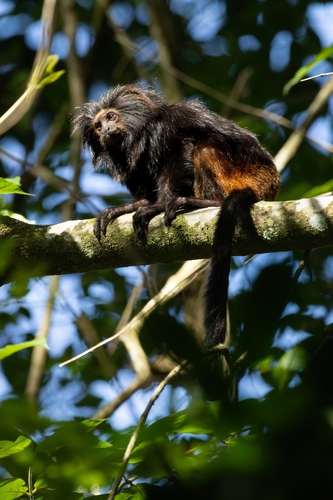
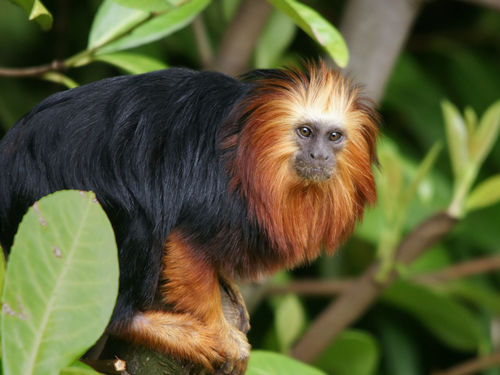
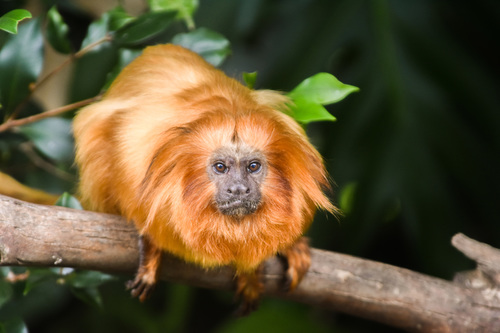
Physical characteristics The golden lion tamarin gets its name from its bright reddish-orange fur coat and the extra-long hairs around its face and ears that form a distinctive mane. Its face is dark and hairless. Unlike many naturally occurring bright orange animal colors, the bright orange fur of this species does not contain carotenoids. It is the largest species of callitrichid monkey. Adults are typically around 261 mm (10.3 in) long and weigh around 620 g (1.37 lb), with almost no size difference between males and females. Like all callitrichids, golden lion tamarins have claw-like nails instead of the flat nails found in other monkeys and apes; the only exception is the big toe, which retains a flat nail. Golden lion tamarins walk, run, and bound on four limbs along the tops of branches, and less frequently run and walk on the ground. When running or bounding, their hindlimbs alternately overstride their forelimbs, and their feet rest atop the support surface and grasp it almost perpendicular to the direction of travel. This makes the body's direction of travel oblique rather than precisely parallel to the substrate, a movement pattern called “transaxial bounding”. Their claw-like nails also allow them to cling and climb on vertical tree trunks (see photographs in Serra (2019), pp 108–117, 137, 155).
Habitat and distribution The golden lion tamarin currently occupies a very limited range, because most of its original habitat in the Brazilian state of Rio de Janeiro has been lost to deforestation. Today, the species is restricted to isolated forest fragments within the state, including Poço das Antas Biological Reserve, União Biological Reserve, other protected areas, and privately owned lands. Most of its occupied area is covered by vegetation classified as dense broadleaf evergreen forest, or seasonal deciduous and semideciduous forest. Some tamarins living closest to the coast occupy a sandy soil forest type called "arboreal restinga". Golden lion tamarins are thought to primarily live in low-elevation forests, up to 150 or 300 meters above sea level. However, a 1990–1992 survey identified two groups living above 500 meters, and recent records from the newly identified western part of the species' range include groups above 700 meters. Population estimates for the 1960s and 1970s ranged from only 100 to 600 individuals, though these estimates were not based on range-wide censuses. The first range-wide census, conducted in 1990–1992, counted about 560 wild individuals, with an additional 100 individuals from reintroduction programs also living in the wild. Following sustained conservation efforts that included reintroduction of zoo-born animals, translocation of wild individuals from small, at-risk forest fragments to areas that were previously unoccupied by tamarins, reforestation focused on connecting separated habitat patches, and community-based conservation engagement programs, the population has grown significantly. Most recently, a 2022-23 census estimated about 4,800 golden lion tamarins living in the current primary non-coastal area of occurrence in the São João and Macaé River basins. Smaller additional numbers are present in limited coastal forests and west of the primary area of occurrence, though their total count is unknown.
Home range and use of space Golden lion tamarin groups are highly territorial. They hold areas of exclusive use, and engage in aggressive encounters with neighboring groups at range borders and overlapping areas. These encounters involve chases, characteristic vocalizations, and posturing, and can include brief physical contact and fights. Peres proposed that these encounters reinforce territory boundaries and preserve areas of exclusive use, "preventing neighbors from trespassing farther" (p 232). The term "home range" here refers to the full area that a tamarin group uses, including both areas of exclusive use and areas that overlap with the ranges of neighboring groups. For one study group in Poço das Antas Biological Reserve, around 60% of the group's home range overlapped with the home ranges of neighboring groups. A long-term study in Poço das Antas Biological Reserve calculated a mean annual home range size of 50.5 ha (124.8 acres) for golden lion tamarin groups (pp 66–67), with individual home ranges ranging from 17.4 to 87.7 ha (43.0 to 216.7 acres). Reports from União Biological Reserve recorded larger home range sizes. This difference may be due to the lower population density at União when the studies were conducted, as well as differences in how home range size was calculated. Golden lion tamarin home ranges are not static over time. One study found a mean annual home range overlap of 77% for the same group between consecutive years. Wild golden lion tamarins do not use their home ranges evenly: some areas are used much more heavily than others. In a study in Poço das Antas Biological Reserve, "core areas"—areas where 50% of a group's location records were documented—averaged around 10% of a group's total home range. Reported average daily travel distances for individual groups range from 1,339 to 2,135 m (4,393 to 7,005 ft). Single-day travel distances for groups vary much more widely. For example, a study of two groups in União Biological Reserve recorded single-day travel distances ranging from 401 to 3,916 m (1,316 to 12,848 ft).
Reproduction The mating system of the golden lion tamarin is largely monogamous. When a group contains two adult males, only one mates with the group's female. There are rare cases where a single male mates with two females, most commonly a mother and her daughter. Reproduction is seasonal and tied to rainfall. Mating activity peaks at the end of the rainy season, between late March and mid-June, and births peak during the September–February rainy season. Females reach sexual maturity between 15 and 20 months old, but cannot reproduce until they reach 30 months old. Only dominant females reproduce, and they suppress reproduction in other subordinate females in the group. Males may reach puberty by 28 months old. The gestation period for golden lion tamarins is four months. Golden lion tamarin groups practice cooperative rearing of infants, because this species most commonly gives birth to twins; triplets and quadruplets occur less frequently. For example, 78% of recorded births in 2001 at Poço das Antas Reserve were twins. A mother cannot provide enough care for her litter on her own, so she needs help from other members of the group. Younger group members may miss out on breeding opportunities by helping rear younger siblings, but they gain valuable parental experience in the process. In their first four weeks of life, infants are completely dependent on their mother for nursing and transport. By week five, infants spend less time on their mother's back and begin to explore their surroundings. Young golden lion tamarins reach the juvenile stage at 17 weeks old and start socializing with other group members. They reach the subadult phase at 14 months old, when they first begin to display adult behaviors.
Tool use Stoinski and Beck reported observations of golden lion tamarins using and modifying tools while living in free-ranging zoo exhibits. Eight different individual golden lion tamarins were observed spontaneously using tools, and three individuals were observed modifying tools. The tamarins used twigs (which they sometimes broke off before use) and the wire antennas from their radiocollars as tools. The most common uses of these tools were prying under tree bark and probing into tree crevices while foraging for animal prey, and probing on skin and through fur during allogrooming and autogrooming. The total number of observed tool use bouts was not reported, but Stoinski and Beck stated that “the behavior was frequent, occurring at least weekly” (p 321). Tool use developed independently in several different groups of free-ranging golden lion tamarins in this setting. Following Shumaker et al.’s definitions of tool use and tool manufacture, golden lion tamarins are one of only two callitrichid species documented to use tools. The other documented case of callitrichid tool use is also from a lion tamarin: one wild black lion tamarin (Leontopithecus chrysopygus) that inserted and probed with a stick between bromeliad leaves to flush out insects. This was the only case of tool use documented in the Kaisin et al. study, which involved observing four groups for a total of more than 2,500 hours. For golden lion tamarins, despite thousands of hours of monitoring by skilled observers, there are no documented reports of tool use by wild individuals, or by reintroduced individuals and their descendants. Shumaker et al. emphasized that tool use is not unequivocally an indicator of intelligence; much animal tool use is based on simple associative learning processes or genetically programmed behaviors. Even so, the golden lion tamarins observed by Stoinski and Beck showed flexibility when modifying and using different types of tools (twigs and wire), in several different ways (inserting, probing, prying, reaching), on different substrates (bark, tree holes, skin), and in different contexts (foraging, grooming).