About Leontocebus tripartitus (A.Milne-Edwards, 1878)
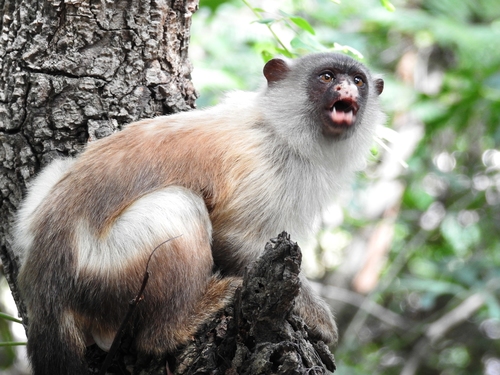
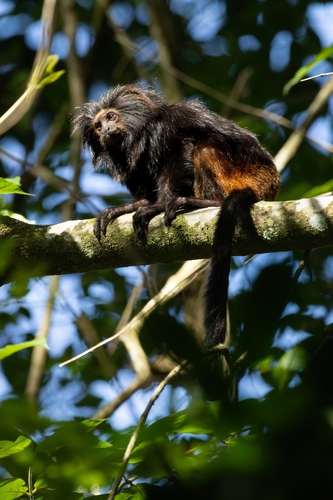
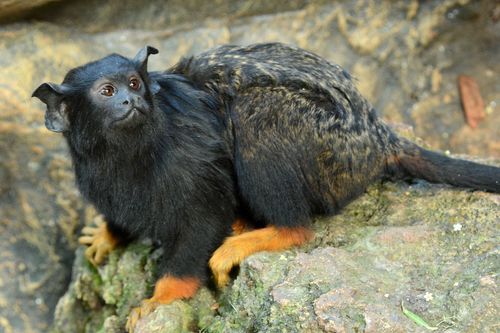
This species of tamarin, Leontocebus tripartitus, measures 218–240 mm from the tip of the nose to the base of the tail, with a tail length of 316–341 mm and an ear length of 31–32 mm. Its head is black, with a continuous black hair collar under the throat. The muzzle, and sometimes the entire face, is pure white, and the back of the neck has a ruff of bright golden to creamy fur that contrasts sharply with the black crown. The underparts of the body are orange. Like all tamarins, its long tail is not prehensile, and it has large forward-facing eyes. The species is monomorphic. It has large canines, and claw-like nails on all digits except the opposable one. Leontocebus tripartitus lives in small social groups that usually contain 4 to 9 individuals, with distinct reproductive traits. They give birth to twins, and only one dominant female breeds within each social group. Hormones in the dominant female's urine suppress the reproductive cycles of subordinate females in the group. Groups have a polygynandrous mating system, and average gestation length is 140 days. As with other callitrichids, this species has unusually intensive group involvement with infants. Newborns may be carried from their first day of life by group members other than the mother, including group males. Weaning takes place between 9 and 13 weeks of age, by which point most of the food the young consume is obtained through food sharing or stealing. The juvenile stage begins at 4 to 7 months of age, when 'twin fights' may occur, especially between same-sexed twins, to establish status differences. The sub-adult stage begins at 9 to 14 months of age; at this point, young individuals already have the size and appearance of adults, puberty occurs, but they do not yet reproduce. The adult stage begins at 12 to 21 months of age, when sexual maturity is reached.