About Leodia sexiesperforata (Leske, 1778)
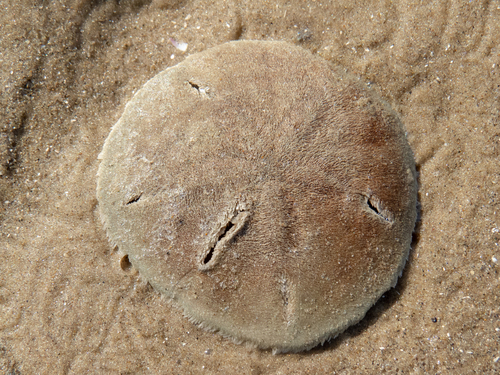
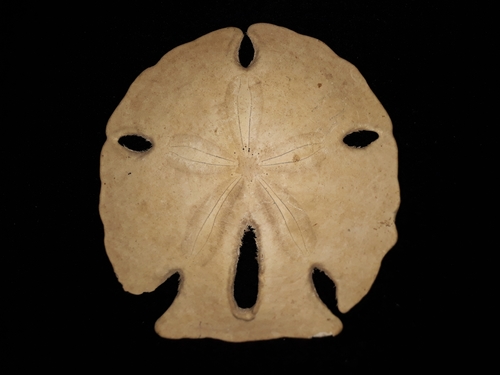
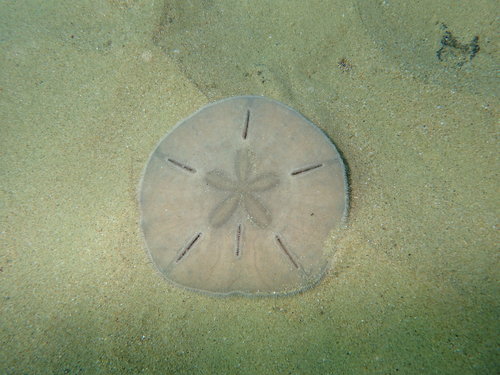
Like other sand dollars, Leodia sexiesperforata is radially symmetrical and flattened from the upper (dorsal) to lower (ventral) surface, with a circular or semi-pentagonal shape. It also has secondary front-to-back bilateral symmetry. Its diameter typically ranges from 4.8 to 14.5 cm (1.9 to 5.7 inches). The mouth sits on the oral (under) surface, surrounded by the peristome and five deep, narrow food grooves that branch out as they approach the edge of the body. On the aboral (upper) surface of its hard outer test are five short, petal-like areas that function as gills, plus six oval lunules (slots). These six slots give the species its specific epithet sexiesperforata. Five of the slots are located in the ambulacral areas, and the sixth lies on the posterior interambulacral area; the anus is positioned within this sixth lunule. The aboral surface is shallowly domed, with its highest point at the anterior petal, while the oral surface is flat. The body surface is covered in small spines that give it a velvety texture. The color of this sand dollar varies, but it is usually some shade of yellowish-brown or pale brown. Leodia sexiesperforata is native to the tropical and subtropical western Atlantic Ocean. Its range extends from North Carolina southward to Uruguay. It can be found at depths down to approximately 60 m (200 ft), but it is most common at depths less than 30 m (half of 60 m). It lives in sandy areas with little seagrass or algal growth. Leodia sexiesperforata lives on the seabed and buries itself in soft sediment to a depth of about 2.5 cm (1 inch). It can complete burying itself in five to seven minutes. The lunules may function to equalize pressure above and below the sand dollar, reducing lift and helping prevent the organism from being washed away by strong currents. It feeds on detritus and small organic particles. It picks up these particles with tube feet on its oral surface, moves them to the food grooves, and then transfers them to the mouth, where the particles are ground up by its teeth.