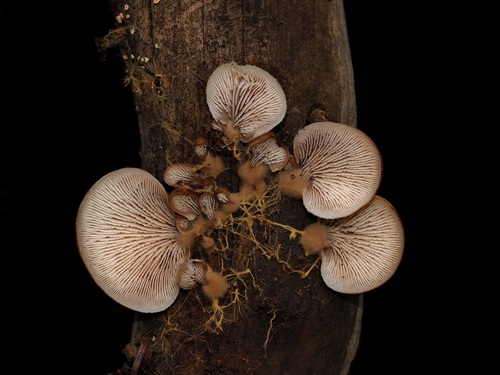
About Lentinellus montanus O.K.Mill.
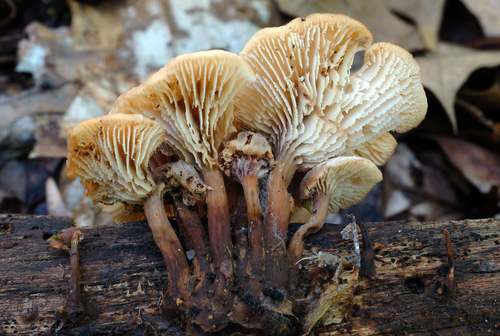
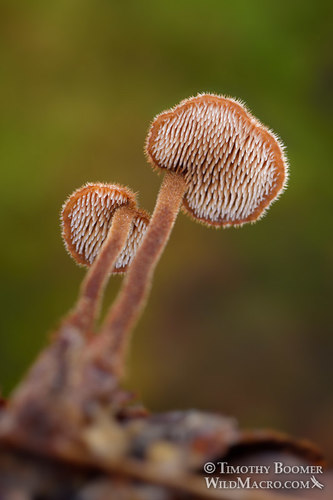
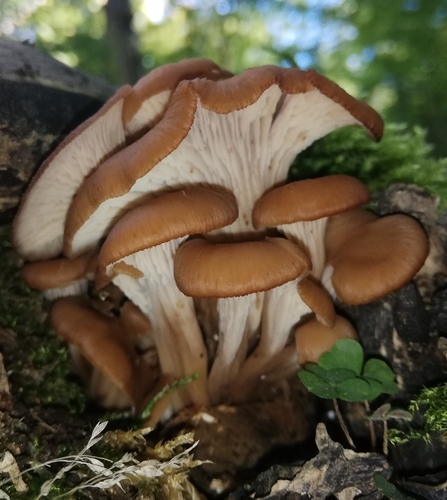
The fruit bodies of Lentinellus montanus are sessile, which means they lack a stipe and grow directly attached to their growing substrate. The cap is shell-shaped to fan-shaped, and measures 4–11 cm (1+5⁄8–4+3⁄8 inches) in diameter. The cap is dark brown to red brown, except for its margins, which are light cinnamon to pale pinkish-buff. The cap surface is moist but not sticky; it is somewhat hairy to shaggy at the center, and smooth in all other areas. The gills are broad, somewhat distantly spaced, and interspersed with long lamellulae—gills that do not reach all the way from the stipe attachment point to the cap margin. The gill edges are coarsely serrated. When young, gills are white with purplish tints, and they fade to buff as they mature. The flesh is tough, light brown, 1–4 mm thick, with a mild to slightly aromatic odor, and a mild to somewhat acrid taste. Fruit bodies produce a spore print that ranges in color from cream to buff. The spores are egg-shaped to roughly spherical, with thick walls, and measure 4.5–6.5 by 4–5 μm. Blunt spikes cover the entire spore surface. The basidia, which are the spore-bearing cells of the fungus, are club-shaped, four-spored, and measure 20–47 by 5.2–8 μm. Like all species in the genus Lentinellus, Lentinellus montanus is inedible due to its bitterness. Lentinellus montanus is a white rot fungus. Its fruit bodies grow singly, or more commonly in clusters, on decaying conifer wood, at elevations between 5,000 and 10,000 feet (1,500 to 3,000 m). Recorded tree substrates include Engelmann spruce (Picea engelmannii), Shasta red fir (Abies magnifica var. shastensis), subalpine fir (Abies lasiocarpa), and Pinus contorta. The fungus' mycelium has also been found growing on fire wounds on living trees of Engelmann spruce and Lodgepole pine (Pinus contorta). In this location, the fungus attacks the springwood and causes small pockets of rot. As a snowbank mushroom, L. montanus produces fruit bodies near melting snow banks, typically in spring and early summer, from May to July. The species occurs across the northern and central Rocky Mountains, extending east to the Cascade Range and south to Utah. It has also been recorded in the US states of Washington, Idaho, Montana, Colorado, Wyoming, and California.