About Lemur catta Linnaeus, 1758
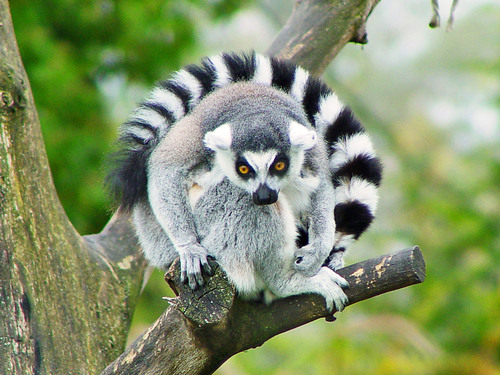
The ring-tailed lemur (Lemur catta) is a medium to larger-sized strepsirrhine, or wet-nosed, primate, and is the most internationally recognized lemur species due to its long, black-and-white ringed tail. It is a member of the lemur family Lemuridae, one of five living lemur families, and is the only species in the genus Lemur. Like all lemurs, it is endemic to the island of Madagascar, where it is classified as endangered. Locally in Malagasy it is called maky (pronounced [makʲ], spelled maki in French) or hira, and it inhabits areas from gallery forests to spiny scrub in the southern regions of the island. It is omnivorous, and is the most terrestrially adapted of all living lemurs. Ring-tailed lemurs are highly social, living in groups called troops that can reach up to 30 individuals. The species is female-dominant, a trait common among lemurs. Groups huddle together to stay warm and reinforce social bonds. Mutual grooming is another key part of lemur social behavior, as it is for all primates; it reinforces social and family connections, while also removing potential parasitic insects from each individual. Ring-tailed lemurs are strictly diurnal, meaning they are active only during daylight hours. As part of this daily lifestyle, they sunbathe, and can be observed sitting upright on their tails, holding their soft white belly fur toward the sun. They often keep their palms open and their eyes gently closed while sunbathing. Like other lemurs, this species relies heavily on its sense of smell, and uses scent glands for territorial marking to send communication signals across a group's home range. Its scent glands are located near the eyes and near the anus. Males perform a unique scent-marking behavior called spur-marking, and take part in 'stink fights' by covering their tails with their pheromones and wafting the scent toward opponents. Both males and females will also scent-mark trees, logs, rocks and other objects by rubbing their faces and bodies on them, similar to the behavior of a domestic cat. As one of the most vocal primate species, the ring-tailed lemur uses a wide range of vocalizations, including calls to maintain group cohesion and alarm calls to warn of predators. Experiments have shown that despite having a smaller brain than simiiform primates (monkeys and apes), ring-tailed lemurs can organize sequences, understand basic arithmetic, and preferentially select tools based on their functional qualities. Although the species adapts well to captivity and breeds easily in human care, and is the most common lemur species in zoos worldwide with over 2,000 captive-raised individuals, the wild population is listed as Endangered on the IUCN Red List due to habitat destruction, local hunting for bushmeat, and capture for the exotic pet trade. As of early 2017, the wild population is believed to have dropped to as few as 2,000 individuals, putting the species at far higher risk of extinction. Local Malagasy farmers and logging industries frequently use slash-and-burn deforestation to make space for livestock and larger crop fields, with smoke regularly visible on the horizon across Madagascar. Endemic to southern and southwestern Madagascar, the ring-tailed lemur ranges further into highland areas than any other lemur species. It inhabits deciduous forests, dry scrub, montane humid forests, and gallery forests (forests growing along riverbanks). It strongly prefers gallery forests, but most of these forests have already been cleared across Madagascar to create pasture for livestock. Across its geographic range, temperatures can vary from −12 °C (10 °F) at the Andringitra Massif to 48 °C (118 °F) in the spiny forests of Beza Mahafaly Special Reserve. The species occurs as far east as Tôlanaro, inland to the Andringitra mountains on the southeastern plateau, throughout the southern island's spiny forests, and north along the west coast to the town of Belo sur Mer. Historically, the northern limit of its western range extended to the Morondava River near Morondava. It can still be found in Kirindy Mitea National Park, just south of Morondava, though at very low population densities. It does not occur in Kirindy Forest Reserve, north of Morondava. Across the rest of its range, its distribution is very fragmented, with widely varying population densities. Ring-tailed lemurs are easily observed in five national parks across Madagascar: Andohahela National Park, Andringitra National Park, Isalo National Park, Tsimanampetsotse National Park, and Zombitse-Vohibasia National Park. It also occurs in Beza-Mahafaly Special Reserve, Kalambatritra Special Reserve, Pic d'Ivohibe Special Reserve, Amboasary Sud, Berenty Private Reserve, Anja Community Reserve, and marginally in Kirindy Mitea National Park. It has been reported in unprotected forests including Ankoba, Ankodida, Anjatsikolo, Anbatotsilongolongo, Mahazoarivo, Masiabiby, and Mikea. Within the protected regions it inhabits, the ring-tailed lemur is sympatric (shares its range) with up to 24 other lemur species, covering every living lemur genus except Allocebus, Indri, and Varecia. Historically, the species was sympatric with the critically endangered southern black-and-white ruffed lemur (Varecia variegata editorum), which once occurred at Andringitra National Park, but no sightings of this ruffed lemur subspecies have been recorded in recent years. In western Madagascar, sympatric populations of ring-tailed lemurs and red-fronted lemurs (Eulemur rufifrons) have been studied together. The two species interact very little. While their diets overlap, they consume different proportions of shared foods, because the ring-tailed lemur has a more varied diet and spends more time on the ground. The ring-tailed lemur is diurnal and semi-terrestrial. It is the most terrestrial of all lemur species, spending up to 33% of its time on the ground. Even so, it still spends a considerable portion of its time in trees: 23% in the mid-level canopy, 25% in the upper-level canopy, 6% in the emergent layer, and 13% in small bushes. Seventy percent of troop travel happens on the ground. Troop size, home range size, and population density vary based on region and food availability. Troops typically range from 6 to 25 individuals, though troops with more than 30 members have been recorded. The average troop has 13 to 15 individuals. Home range size ranges between 6 and 35 hectares (15 and 86 acres). Ring-tailed lemur troops maintain territories, but territory overlap is often high. Encounters between troops are agonistic, or hostile. A troop will usually occupy the same part of its range for three or four days before moving. When it moves, the average travel distance is 1 km (0.62 mi). Population density ranges from 100 individuals per 1 km² (0.39 sq mi) in dry forests to 250–600 individuals per km² in gallery and secondary forests. The ring-tailed lemur has both native and introduced predators. Native predators include the fossa (Cryptoprocta ferox), the Madagascar harrier-hawk (Polyboroides radiatus), the Madagascar buzzard (Buteo brachypterus), the Madagascar ground boa (Acrantophis madagascariensis), the black kite, and the Malagasy giant hognose snake. Introduced predators include the small Indian civet (Viverricula indica), the domestic cat, and the domestic dog. The ring-tailed lemur is polygynandrous, though the dominant male in a troop typically mates with more females than other males. Fighting is most common during the breeding season. A receptive female may initiate mating by turning her backside toward a desired male, lifting her tail, and looking at him over her shoulder. Males may inspect a female's genitals to confirm she is receptive. Females usually mate within their own troop, but may seek out outside males. The breeding season runs from mid-April to mid-May. Estrus lasts 4 to 6 hours, and females mate with multiple males during this period. Within a troop, females stagger their receptivity so each female enters breeding season on a different day, reducing competition for male attention. Females lactate during the wet season, from December through April, when food resources are abundant. They gestate during the dry season, from May through September, when resources are scarce. They give birth when resources such as flowers are at peak availability. Gestation lasts approximately 135 days, and birth occurs in September, or occasionally in October. In the wild, a single offspring is standard, though twins sometimes occur. Ring-tailed lemur infants weigh 70 g (2.5 oz) at birth, and are carried ventrally (on the mother's chest) for the first 1 to 2 weeks, then are carried dorsally (on the mother's back). Young lemurs begin eating solid food after two months and are fully weaned after five months. Sexual maturity is reached between 2.5 and 3 years of age. Males contribute very little to infant rearing, though the entire troop, regardless of age or sex, will care for the young. Alloparenting (care by females other than the mother) between troop females has been reported. Female kidnapping of infants and male infanticide both occur occasionally. Due to harsh environmental conditions, predation, and accidents such as falls, infant mortality can reach as high as 50% within the first year of life, and as few as 30% of infants reach adulthood. The longest-lived wild ring-tailed lemur was a female at the Berenty Reserve who lived to 20 years old. In the wild, females rarely live past 16 years, while male life expectancy is not well understood due to the species' social structure. The longest recorded lifespan for a wild male is 15 years. The maximum recorded lifespan in captivity is 27 years. Historically, studies of learning and cognition in non-human primates have focused on simians (monkeys and apes), while strepsirrhine primates such as the ring-tailed lemur and its relatives have been overlooked, and are popularly assumed to be unintelligent. Two factors from early experiments contributed to this assumption. First, the experimental design of older tests favored the natural behavior and ecology of simians over that of strepsirrhines, making the experimental tasks unsuitable for lemurs. For example, simians are known for manipulative play with non-food objects, while lemurs are only known to manipulate non-food objects in captivity, and this behavior is usually connected to food. Lemurs also more often displace objects with their nose or mouth than with their hands, so an experiment that requires a lemur to manipulate an object without prior training will naturally favor simians over strepsirrhines. Second, individual ring-tailed lemurs that are used to living in troops may not respond well to isolation for laboratory testing, and past studies have recorded hysterical behavior in these scenarios. The idea that lemurs are unintelligent has also been reinforced by the view that neocortex ratio, a measure of brain size, indicates intelligence. Early in her career, primatologist Alison Jolly noted that some lemur species including the ring-tailed lemur had evolved social complexity similar to that of cercopithecine monkeys, but without matching intelligence. After years of observing wild ring-tailed lemur populations at the Berenty Reserve in Madagascar and baboon populations in Africa, Jolly concluded that despite outward appearances, this highly social lemur species does not actually have the same level of social complexity as cercopithecine monkeys. Regardless, continued research has revealed the complexity of lemur cognition, with a focus on the cognitive abilities of the ring-tailed lemur. As early as the mid-1970s, studies showed that ring-tailed lemurs can be trained through operant conditioning using standard reinforcement schedules. The species is capable of learning to distinguish between patterns, brightness levels, and objects, a skill common to many vertebrates. It has also been shown to learn a variety of complex tasks, often performing equally well or even better than simians. More recently, research at the Duke Lemur Center has shown that the ring-tailed lemur can organize sequences in memory and retrieve ordered sequences without language. The experimental design confirmed that the lemurs used internal representations of the sequences to guide their responses, rather than simply following a trained sequence where one item cues the selection of the next. This is not the limit of the ring-tailed lemur's reasoning ability. Another study conducted at the Myakka City Lemur Reserve suggests that this species, along with several other closely related lemur species, can understand simple arithmetic operations. Since tool use is considered a key marker of primate intelligence, the apparent lack of this behavior in wild lemurs, combined with the lack of non-food object play, has helped reinforce the perception that lemurs are less intelligent than simian primates. However, another study at the Myakka City Lemur Reserve examined how ring-tailed lemurs and common brown lemurs represent tool functionality, and found that, like monkeys, they prefer tools based on functional properties such as tool orientation or ease of use, rather than nonfunctional features such as color or texture. Though ring-tailed lemurs do not use tools in the wild, they can not only be trained to use tools, but will actively choose tools based on their functional qualities. This suggests that the conceptual ability to use tools may have existed in the common primate ancestor, even though widespread tool use did not evolve until much later.