About Leiostomus xanthurus Lacepède, 1802
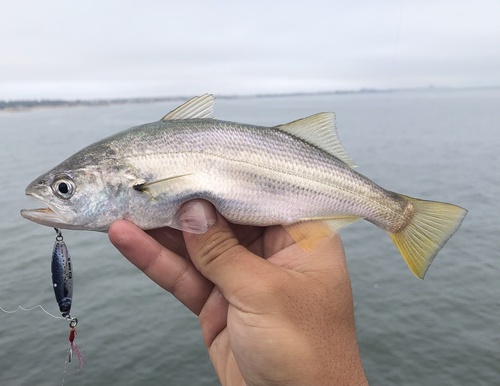
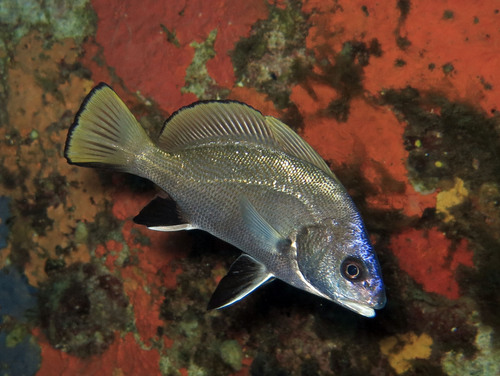
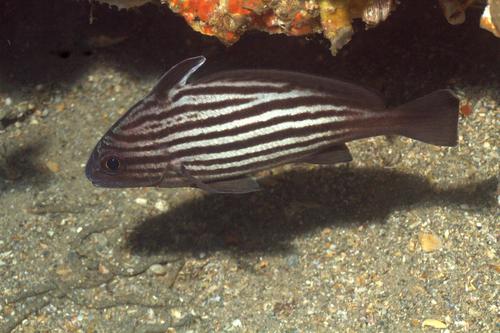
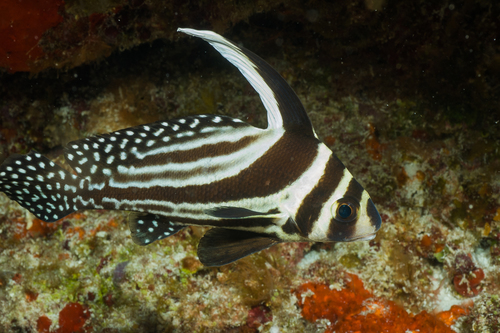
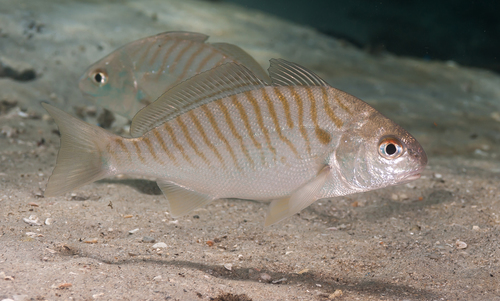
Leiostomus xanthurus Lacepède, 1802, commonly called the spot, is a relatively deep-bodied, compressed fish with a humped back. Its mouth is nearly horizontal and lined with bands of small teeth. There is no barbel on the chin, but five pores are present there; additional pores are found on the snout, with five on the sides of the snout and five at its front. The upper angle of the operculum is incised, and the edge of the preoperculum is smooth rather than serrated. The dorsal fin is deeply incised, which separates the front spiny section (holding 11 spines) from the rear soft-rayed section, which is supported by 29 to 35 soft rays. The anal fin has two spines and 12 or 13 soft rays, with the second spine measuring half the length of the first soft ray. The caudal fin is truncate, and sometimes slightly notched. The spot has large ctenoid scales across most of its body, with the exception of scales beneath the eye and on the lower head, which are cycloid. One or two scale rows run along the base of the soft-rayed section of the dorsal fin. This species reaches a maximum total length of 36 cm (14 in), with 25 cm (9.8 in) being a more typical size. The upper body is bluish-gray, fading to yellow or golden on the lower body. Young fish have a series of dark bars that run diagonally from the back to the middle of the flanks; these bars fade as the fish ages. A large black spot is present on the body above the upper margin of the operculum.
The spot is native to the west central and northwestern Atlantic Ocean. It occurs along the Gulf of Mexico, and ranges along the southern U.S. Atlantic coast from Massachusetts south to Campeche, Mexico. It is most commonly found at depths of no more than 6 meters, but may occur as deep as 50 meters. It inhabits saltwater, especially brackish water, and is mostly found over sandy and muddy seabeds. It stays in estuaries and bays until spring, when it migrates to deeper waters to spawn. In summer, it moves to water with higher salinity, and moves offshore once autumn begins and water cools.
Spawning occurs from fall to early winter. The spot migrates from its usual bay and estuary habitats to deeper offshore areas, where females may lay up to 1.7 million eggs. The eggs are fertilized externally and drift back toward shore. Larvae grow quickly in the warmer offshore water, then move into coastal shallows and bays for the winter.