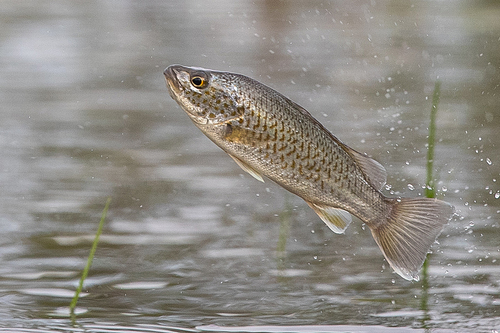
About Leiopotherapon unicolor (Günther, 1859)
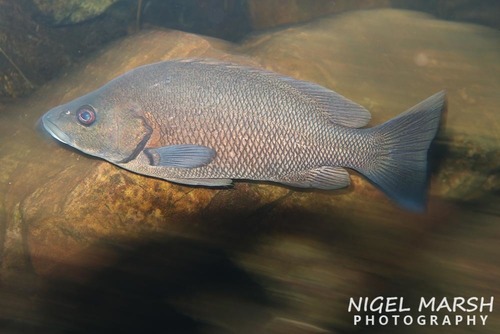
Leiopotherapon unicolor has a slender, oval-shaped, somewhat compressed body; juveniles of this species are more rotund. Its dorsal profile is mostly convex, the ventral profile is evenly convex, and it has a long snout. The mouth is oblique, with the maxilla extending past the level of the front of the eye. The mouth bears strong conical teeth, with an enlarged outer row and a villiform inner band, and no teeth grow on the roof of the mouth. This species has a continuous dorsal fin, with a rounded spiny anterior portion holding 11 to 13 spines; the third or fourth spine is the longest. The posterior portion of the dorsal fin has 9 to 12 soft rays, and the longest soft ray is longer than the longest dorsal spine. The anal fin has 3 short spines and 7 to 10 soft rays, and has a soft, rounded shape. The caudal fin is slightly emarginate. This is an attractive species, with a body color ranging from silvery grey to silvery blue, marked with numerous reddish-brown spots that do not appear on the abdomen. Juveniles have a distinct dark bar on the lower lobe of the caudal fin. The maximum recorded standard length of this species is 31 centimetres (12 in).
Leiopotherapon unicolor was first formally described as Therapon unicolor in 1859 by German-born British ichthyologist and herpetologist Albert Günther (1830-1914), with type localities given as Mosquito Creek and Gwydir River in New South Wales.
Leiopotherapon unicolor has the widest distribution of any freshwater grunter in Australia. It occurs across most of the northern two-thirds of the continent, ranging as far south as Newcastle, New South Wales.
Leiopotherapon unicolor inhabits a very broad range of water conditions. It can be found in water from running to still, with turbidity ranging from clear to nearly opaque. It tolerates a wide range of salinities and can survive across a broad range of temperatures. It can be found in many types of waterbodies, and is most numerous in intermittent waters. It also lives in lakes, dams, rivers, billabongs, bore drains, wells and waterholes. In the Australian interior, this species may occur in any temporary waterbody, even flooded wheel ruts formed after rain. This species has been reported to appear in unexpected locations after so-called "rain of fish" events, as it is often seen scattered on the ground after heavy downpours; however, the fish are actually carried to these locations by flooding. This hardy species can survive dry periods by aestivating in very little moisture at the bottom of temporary waterbodies.
It is an omnivorous species. Its diet consists largely of aquatic and terrestrial insects, crustaceans, and some molluscs, but it also preys on small fish and consumes small amounts of algae and aquatic weeds. Spawning occurs from November, when water temperatures reach 20–26 °C (68–79 °F), and takes place at night. Before spawning, the fish move upstream in rivers, or towards shallows in lakes and ponds, to spawn on soft beds. After being laid, the eggs hatch in two days, and larvae take approximately 24 days to develop into juveniles. Males guard and fan the eggs. Females reach sexual maturity at a standard length of 78 millimetres (3.1 in). A 24 gram (0.85 oz) female can produce 24,000 eggs, while a 65 gram (2.3 oz) female can produce 113,200 eggs.